
First month for free!
Get started
Published 10/6/2025
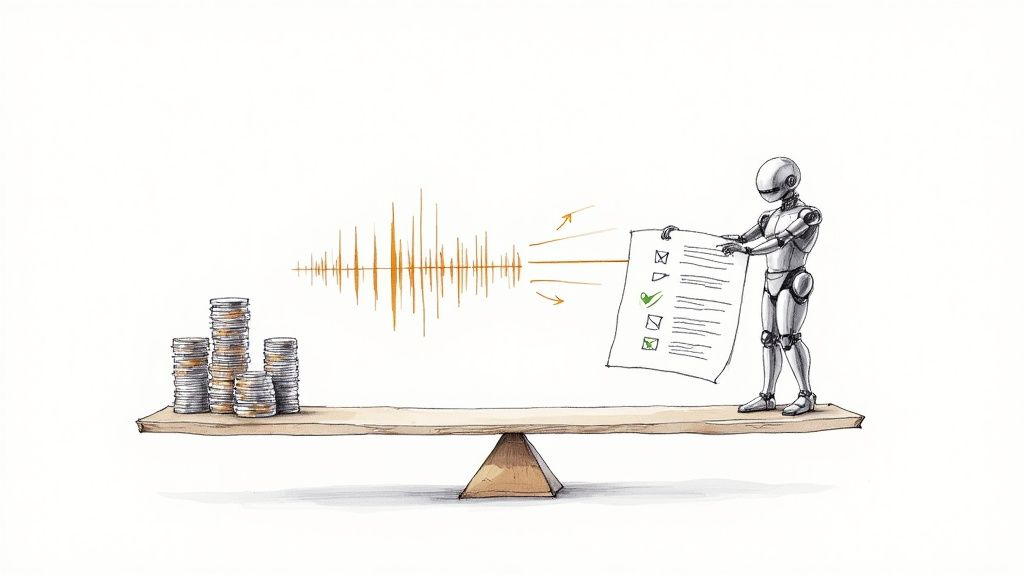
When you're hunting for a transcription service, it’s tempting to just sort by price, lowest to highest. But "affordable" and "cheap" are two very different things. The rock-bottom price might look great on an invoice, but it doesn't account for the hours you might spend fixing a transcript riddled with errors.
True affordability is about getting the best possible value. It's that sweet spot where the cost, accuracy, and turnaround time all line up perfectly with what your project actually needs, without any hidden headaches or time drains.

It’s easy to get fixated on the price-per-minute, but that single number almost never gives you the full picture. A genuinely affordable service is one that delivers a solid return on your investment—a blend of reasonable cost, reliable accuracy, and a speedy delivery.
Think of it this way: you wouldn't buy the cheapest, flimsiest wrench to fix a critical piece of machinery. You know it’ll probably break, costing you more in delays and frustration than if you’d just bought the sturdy one from the start. It’s the same with transcription. A bargain-bin service that hands you a jumbled, inaccurate transcript isn't a bargain at all. It’s a time sink. Every minute you spend correcting mistakes is a hidden cost that wipes out those initial savings.
At the heart of the cost conversation is one big choice: are you going with an automated AI service or a human-powered one? Each has its place, and understanding the difference is key to finding real value.
This isn't a niche market, either. The global transcription industry was valued at around USD 20 billion and is expected to climb to USD 35 billion by 2033. That growth is being powered by major leaps in both AI and human-led services.
The smartest way to find an affordable solution is to match the tool to the task. True affordability isn’t about defaulting to the cheapest option; it’s about picking the right option for the job at hand.
In the end, finding a service that fits your budget means looking past the sticker price. This focus on total value is a core principle in many effective cost reduction strategies and ensures your money is well spent, saving you time and delivering the quality you need.
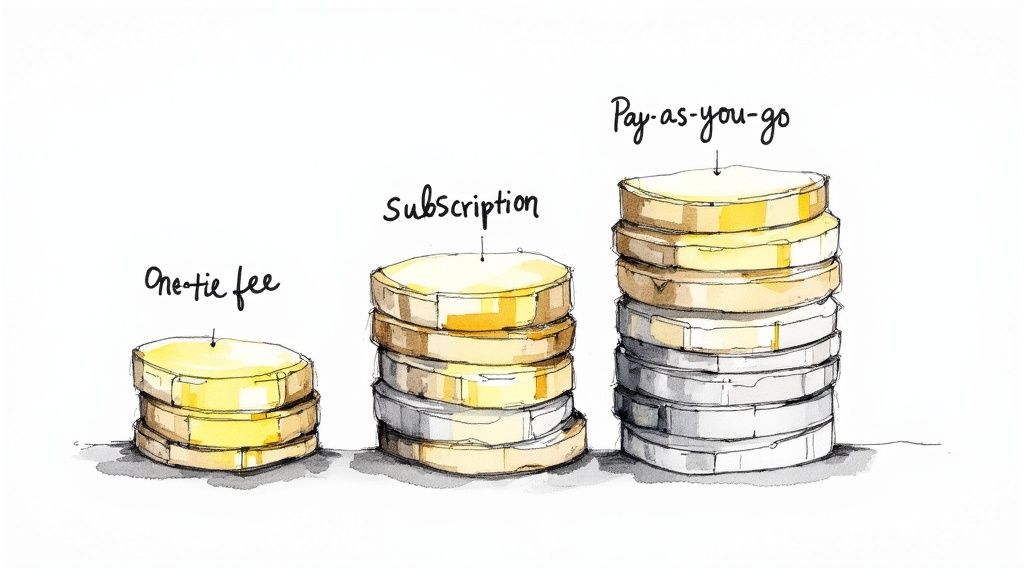
Finding a transcription service that fits your budget starts with understanding how they actually charge you. It's not always a simple sticker price, and the model a service uses can dramatically change what you end up paying. Getting a handle on these pricing structures is the single best way to avoid a surprise bill.
The most traditional model, especially for services that rely on human transcribers, is charging per-audio-minute. On the surface, it’s straightforward: you pay a set rate for every minute of audio you upload.
But there’s a catch. That attractive base rate is usually for a best-case-scenario recording. A whole host of factors can drive that per-minute cost up.
All these things mean more work for the transcriber, and that extra effort gets passed on to you.
Walk into the world of AI transcription, and you'll find that things look a bit different. Most of these services run on a subscription model. You pay a flat monthly or yearly fee for a set number of transcription minutes. This is a game-changer for anyone who needs to transcribe audio regularly, because it makes costs totally predictable.
These plans usually come in tiers—a basic plan might give you a few hours of transcription a month, while a pro plan could offer hundreds. The most important thing to check is what happens if you go over your limit. Some services will just cut you off until your plan renews, but others will hit you with overage fees for every extra minute, which can sometimes be more expensive than standard pay-as-you-go rates.
Think of it like your cell phone data plan. You pick a plan based on what you think you'll use. Sticking to it saves you money, but going over can lead to some painful extra charges. The trick is to estimate your needs upfront.
Nailing that estimate means you get the best bang for your buck without paying for minutes you don’t need.
The infographic below really captures the sweet spot that top-tier AI services are aiming for—that perfect balance of cost, speed, and accuracy.
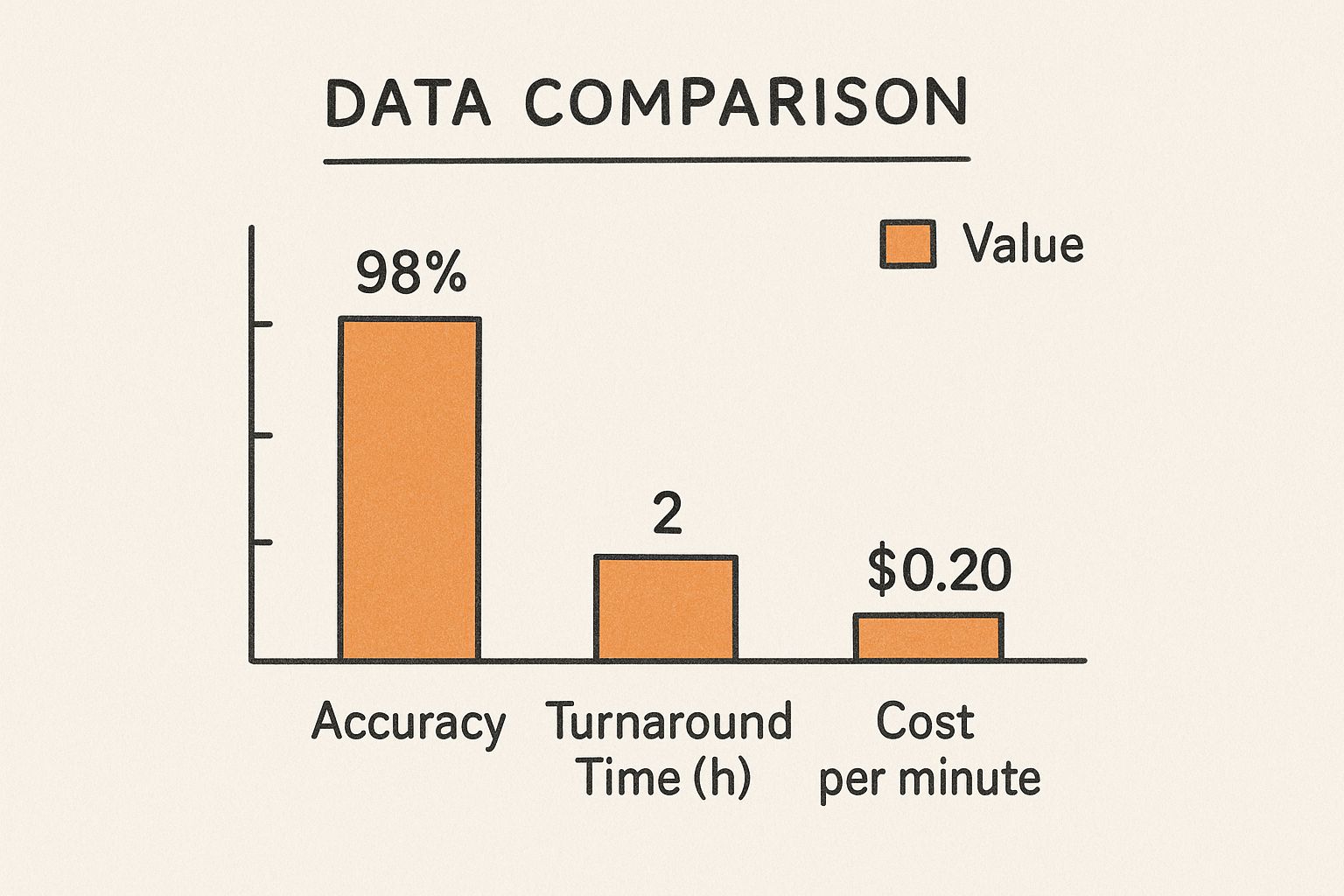
What this shows is that you don't have to choose between cheap, fast, or accurate anymore. The right automated service can deliver all three.
Let's make this tangible. Here’s a look at how these different pricing models stack up when you need to transcribe a single 60-minute audio file. For this example, we’ll assume it’s a pretty clean recording with two speakers.
This table illustrates how different pricing models and service levels impact the total cost for transcribing a one-hour audio file with two speakers and clear quality.
| Service Type | Pricing Model | Estimated Rate | Turnaround Time | Estimated Total Cost |
|---|---|---|---|---|
| Basic AI Service | Subscription | $15/month for 600 mins | ~5 Minutes | Part of monthly fee |
| Premium AI Service | Per-Audio-Minute | $0.25 / minute | ~10 Minutes | $15.00 |
| Standard Human Service | Per-Audio-Minute | $1.50 / minute | 24-48 Hours | $90.00 |
| Rush Human Service | Per-Audio-Minute | $2.50 / minute | < 12 Hours | $150.00 |
The numbers don't lie—the price gap is huge. While a human transcriber is still the gold standard for tricky audio with lots of nuance, the sheer cost-effectiveness of an affordable transcription service powered by AI is undeniable for most everyday needs.
For what you'd pay for one hour of rush human transcription, you could get a premium AI subscription that gives you dozens, if not hundreds, of hours of transcription. For anyone working at scale, that kind of value is impossible to ignore.
When you’re looking for an affordable transcription service, it’s tempting to just sort by price and pick the lowest per-minute rate. It seems like a no-brainer. But focusing only on that initial sticker price can be a classic case of being penny-wise and pound-foolish. A cheap, inaccurate transcript isn't a bargain; it’s a hidden expense that will absolutely come back to bite you.
The real cost of transcription goes way beyond the invoice. It’s the total time, effort, and resources you pour into getting a final document you can actually use. An inaccurate transcript hands the real work back to you, forcing you to spend hours with headphones on, cross-referencing the audio and hunting down mistakes. Suddenly, that "affordable" service has eaten up something far more valuable than money: your time.
At a glance, 95% accuracy sounds pretty impressive. In school, that's a solid A. But in the world of transcription, that remaining 5% error rate can completely derail a project.
Let's break down what that really means. A typical 60-minute interview has about 8,000 to 10,000 words.
This is where the hidden costs reveal themselves. If your time is worth $50 per hour, you’ve just tacked on an extra $100-$150 to the cost of that "cheap" transcript. In the end, the slightly more expensive service with higher accuracy often proves to be the much smarter financial decision.
For any serious work—from legal depositions to content you plan to publish—99% accuracy is the benchmark for a reason. While no automated or human process is 100% flawless, hitting that 99% mark dramatically cuts down on your editing time and, more importantly, minimizes the risk of dangerous misunderstandings.
"A single misinterpreted word in a legal transcript can alter a case's outcome. A misquoted source in market research can lead to flawed business strategy. Accuracy isn't a luxury; it's the foundation of a transcript's value."
This need for precision is what drives the massive U.S. transcription market, valued at around USD 28.19 billion. That growth isn't just about convenience; it’s fueled by strict regulatory requirements in fields like healthcare and law, where a single mistake can have massive consequences. If you want to dig deeper into these industry dynamics, you can read the full report on the U.S. transcription market.
To find a truly affordable transcription service, you need to think in terms of Total Cost of Ownership (TCO), not just the upfront price. This means looking at the entire picture of what a transcript costs you from start to finish.
Your TCO calculation should factor in:
When you start adding up these hidden costs, the math changes completely. A service that delivers a 99% accurate transcript right out of the gate eliminates the most draining and expensive parts of the entire process. You get a document you can trust and use immediately.
Ultimately, paying for accuracy upfront is the best cost-saving strategy you have. It protects your time, preserves the integrity of your work, and gives you a reliable final product. The most affordable transcription service isn't the one with the lowest price—it's the one that gets it right the first time.
https://www.youtube.com/embed/ZPJ3bYzZcWI
For a long time, getting something transcribed was a slow, manual, and often expensive process. But artificial intelligence has completely flipped that script, turning transcription from a niche service into a tool just about anyone can use. AI-powered platforms deliver transcripts at a speed and price point that were once unimaginable, making it a practical option for students, creators, and businesses of all sizes.
Think of an AI transcriber like a super-fast digital stenographer. It chews through hours of audio in minutes, a workload that would take a human team days to get through. This is the core of what makes an affordable transcription service powered by AI even possible—sheer speed and scale.
Let's be clear: the biggest win with AI transcription is its incredible efficiency. When you just need a searchable text version of your audio and you need it fast, automation is your best friend.
It’s perfect for scenarios like these:
As impressive as AI is, it's not foolproof. It’s a machine running on algorithms and patterns, and it can get tripped up by the messy, unpredictable nature of human conversation. Knowing where it stumbles is key to using it wisely.
AI typically has trouble with:
Despite these hurdles, the market is exploding. The AI transcription space was valued at around USD 5.5 billion and is on track to hit USD 25.3 billion by 2033. This boom is fueled by cloud-based tools that keep costs low and make the technology available to everyone.
So, what do you do when you need near-perfect accuracy but don't want to pay top dollar for a fully human service? You go hybrid. It’s a smart, practical approach that blends the best of both worlds: AI's speed and a human's attention to detail.
It works like this: first, you run your audio through an affordable AI service to get a cheap, instant draft. Then, you hand that draft over to a human proofreader who listens to the audio and cleans up the AI’s mistakes.
This two-step process is incredibly cost-effective. The proofreader isn't starting from a blank page; they're just editing. This cuts their time down drastically, which means the final cost to you is much lower. You end up with a polished, 99% accurate transcript for a fraction of what a traditional human-only service would charge. It’s the perfect balance of speed, savings, and quality.

A truly affordable transcription service gives you more than just a wall of text. Sure, the basic job is turning audio into words, but that’s just the starting point. The real value—and the secret to saving yourself hours of grunt work—comes from the features that organize and clarify that text.
Think of it like buying a car. Any base model can get you from A to B. But it's the GPS, cruise control, and heated seats that actually make the drive pleasant and efficient. It's the same with transcription. Those "extra" features are what turn a raw transcript from a simple text file into a genuinely useful tool. They’re what separate a decent service from an indispensable one.
When you're comparing services, don't get fixated on the per-minute rate alone. You need to dig into the feature list, because some tools give you a massive return on your investment by handling the most frustrating parts of the job for you.
Here are the game-changers to look for:
Automatic Speaker Identification: Sometimes called speaker diarization, this feature figures out who is speaking and labels their lines (e.g., "Speaker 1," "Speaker 2"). If you’re transcribing interviews, podcasts, or meetings with more than one person, this is an absolute must-have. Without it, you're stuck with a confusing block of dialogue and have to listen back to the whole thing just to sort out who said what.
Accurate Timestamps: Timestamps connect words in the transcript to the exact moment they were spoken in the audio. This is a lifesaver for video editors syncing captions, researchers trying to find a specific quote, or anyone who needs to quickly jump to a particular part of the recording to double-check something.
Just these two features can easily save you hours of mind-numbing manual work. That's what makes a service truly affordable in the long run.
Beyond the essentials, you’ll find features built for more technical or specific projects. Not everyone will need these, but for the right kind of work, they are incredibly valuable and push the cost-effectiveness even further.
When your work involves specialized language, a generic transcription model is like a translator who only knows conversational phrases. They'll get the gist, but all the critical details will be lost.
Keep an eye out for these powerful additions:
Custom Vocabulary: Does your audio have a lot of industry jargon, unique product names, or acronyms? A standard AI will almost certainly butcher those words. A custom vocabulary feature lets you "teach" the AI your specific terms, which can dramatically improve accuracy for technical content.
Multiple Export Formats: A smart service knows that a transcript is just one step in your workflow. You need to be able to use it elsewhere. Look for a range of export options—like SRT or VTT files for video captions, JSON for developer pipelines, or simple DOCX and TXT files for editing. This kind of built-in flexibility saves you from the headache of converting files yourself.
Ultimately, the key is to match the features to your actual workflow. An affordable transcription service isn’t just the one with the lowest price tag; it’s the one that acts as a force multiplier for your own efficiency. When you prioritize tools like speaker identification, timestamps, and custom vocabularies, you’re not just buying a transcript—you’re buying back your time.
Alright, let's put all the pieces together. Choosing an affordable transcription service isn’t about finding a single "best" option. It’s about finding the right tool for the job you need to do. A podcaster who needs show notes has a completely different set of needs than a lawyer who’s transcribing a deposition.
Figuring out exactly what you need is always the first step. Every project has its own deal-breakers, whether that's near-perfect accuracy, a crazy-fast turnaround time, or rock-solid security. Once you know your priorities, you can avoid paying for features you don't need while making sure you get quality where it counts.
Different jobs have different demands. Someone transcribing a personal voice memo can probably get away with a cheap, quick AI service. A large company, on the other hand, will be far more concerned with security and compliance.
Here’s a look at how needs shift depending on the work:
Before you pull out your credit card, you need to ask a few pointed questions. This checklist will help you see past the marketing fluff and figure out if a service really walks the talk. Think of it as your final gut check to make sure you’re getting what you pay for.
Any provider worth their salt will have straightforward, confident answers to these questions. If you get vague replies about security or their quality process, consider it a major red flag.
Make sure you ask any potential provider these five things:
Going through these steps helps you move beyond a simple price comparison. You’ll be able to confidently pick an affordable transcription service that truly fits your budget, your project, and your standards.
When you're looking for the right transcription service, a few questions always seem to pop up. Let's get you some straight answers to help you sort through the options and find a service that's both affordable and effective.
That's the million-dollar question, isn't it? A "good" price really comes down to what you need. The cost of transcription varies wildly depending on whether you choose an automated service or a human one.
For most everyday needs, a good AI service is going to give you the best bang for your buck, hands down.
Here’s a pro tip: the quality of your original audio file is the single most important factor for getting an accurate transcript. A clean recording makes a world of difference for any service, whether it's AI or human-powered.
A few simple steps can dramatically improve your results:
It all boils down to the classic saying: garbage in, garbage out. The best way to get a great transcript is to start with great audio.
The idea of getting something for free is always appealing, but you have to be careful, especially if your audio isn't just for you. Free tools often come with a hidden price: your privacy.
How do you think they stay in business? Many free services use your data to train their AI models. That means your confidential business meetings or private interviews could end up being reviewed by human contractors or stored on their servers forever. For anything sensitive, that's a risk you just can't take.
Free tools are fine for transcribing personal notes, but for any professional work, investing in a secure and affordable transcription service is the only smart move.
For businesses and developers who need a secure, fast, and seriously affordable option, Lemonfox.ai has a powerful Speech-To-Text API. You can transcribe audio for less than $0.17 per hour with fantastic accuracy, broad language support, and a rock-solid commitment to your privacy. Check out the API and start a free trial to see for yourself.