
First month for free!
Get started
Published 2/10/2026
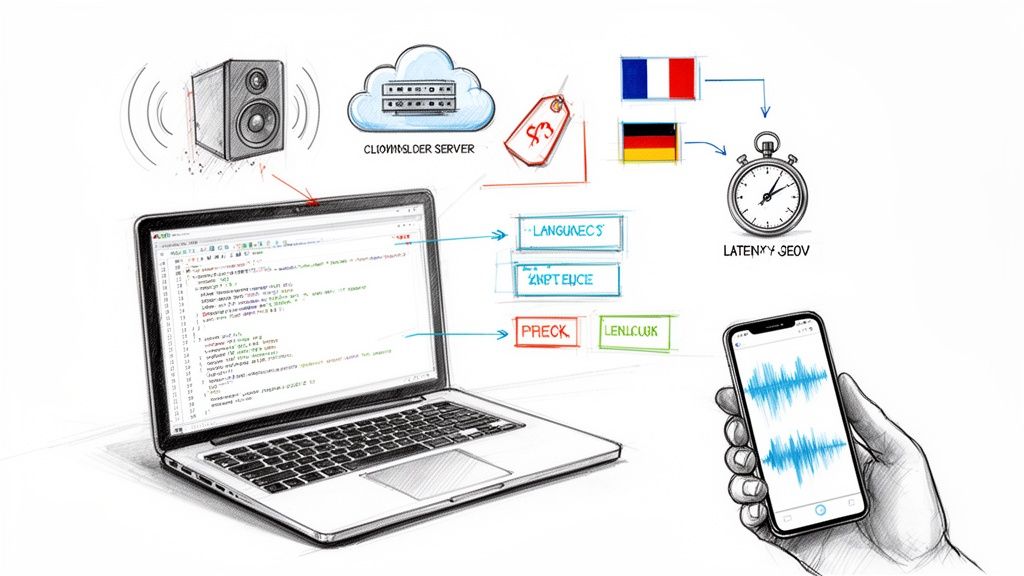
In an era where audio experiences define user engagement, from conversational AI and accessibility tools to dynamic content creation, selecting the right Text-to-Speech (TTS) engine is more critical than ever. The market is crowded with options, each promising the most human-like voice, the lowest latency, or the best price. But the reality is that the best TTS API depends entirely on your specific project requirements and constraints.
Are you building a real-time voice agent where millisecond-level latency is a deal-breaker? Do you need a cost-effective solution for generating high volumes of audio content for an audiobook platform? Or perhaps you require enterprise-grade security and data privacy for a regulated industry like healthcare or finance? Navigating these choices can be overwhelming for developers and product managers alike. Understanding the array of options available, from basic voice synthesis to advanced text-to-speech features, is crucial when selecting the right API.
This guide cuts through the marketing noise to provide a developer-focused, practical comparison of the best TTS APIs available today. We’ll dive deep into each platform, analyzing key differentiators like voice quality, language support, pricing models, and specific use cases. We provide direct links and honest assessments to help you make an informed decision and integrate the perfect voice into your application, whether you're a startup on a tight budget or an enterprise demanding top-tier performance.
Best For: Developers and businesses seeking a high-performance, cost-effective TTS and STT solution.
Lemonfox.ai emerges as a powerful contender in the "best TTS APIs" landscape by delivering an impressive balance of performance, affordability, and developer-centric features. The platform is engineered with a cost-first philosophy, providing access to sophisticated speech synthesis and recognition technology without the steep pricing traditionally associated with top-tier providers. This makes it an exceptional choice for startups, independent developers, and businesses aiming to integrate high-quality voice features while maintaining strict budget controls.
The service is built on a foundation of robust technology, including Whisper large-v3 for its Speech-to-Text service, ensuring high accuracy. For Text-to-Speech, it focuses on real-time performance with minimal latency, a critical factor for interactive applications like voicebots, accessibility tools, and dynamic content narration.
What truly sets Lemonfox.ai apart is its strategic combination of pricing, performance, and privacy. Its pricing model is one of the most competitive on the market, claiming transcription costs under $0.17 per hour and offering substantial value in its subscription tiers. The platform’s commitment to privacy is another significant advantage, with an explicit policy of deleting user data immediately after processing and offering a dedicated EU-hosted API to help businesses meet data residency requirements like GDPR.
While Lemonfox.ai excels in core functionality and value, organizations with stringent enterprise requirements should conduct their own validation. Public information on specific service-level agreements (SLAs), advanced voice customization options, and certifications like SOC 2 is limited. Teams should leverage the free trial to test the API's performance against their specific use cases, especially for noisy audio environments or less common languages.
Website: https://www.lemonfox.ai
As a core part of Amazon Web Services, Amazon Polly is an enterprise-grade service that turns text into lifelike speech, making it one of the best TTS APIs for developers already invested in the AWS ecosystem. It’s designed for reliability and scale, offering a straightforward path to integrate high-quality voice capabilities into applications. Polly supports a wide array of over 40 languages with more than 100 voices available, catering to global audiences with both standard and advanced neural engine options.
The primary advantage of Polly is its seamless integration with other AWS services. You can use AWS Identity and Access Management (IAM) for granular security controls, store audio output directly in S3, and trigger functions with AWS Lambda. This makes it an ideal choice for building robust, secure, and scalable production backends.
The platform provides fine-grained control over speech output using SSML tags, allowing developers to adjust pronunciation, pitch, and speed. While voice cloning is limited compared to specialist providers, its core offering is exceptionally solid for standard use cases like content narration and interactive voice response (IVR) systems.
| Feature | Details |
|---|---|
| Engine Types | Standard (concatenative) & Neural (NTTS) |
| Languages | 40+ languages, 100+ voices |
| SSML Support | Yes, for detailed speech control |
| Output Formats | MP3, OGG, PCM, Speech Marks |
| Free Tier | 5 million characters/month (Standard) for 12 mos. |
| Pricing | From $4.00 per 1 million characters (Standard) |
Pros:
Cons:
Website: https://aws.amazon.com/polly/
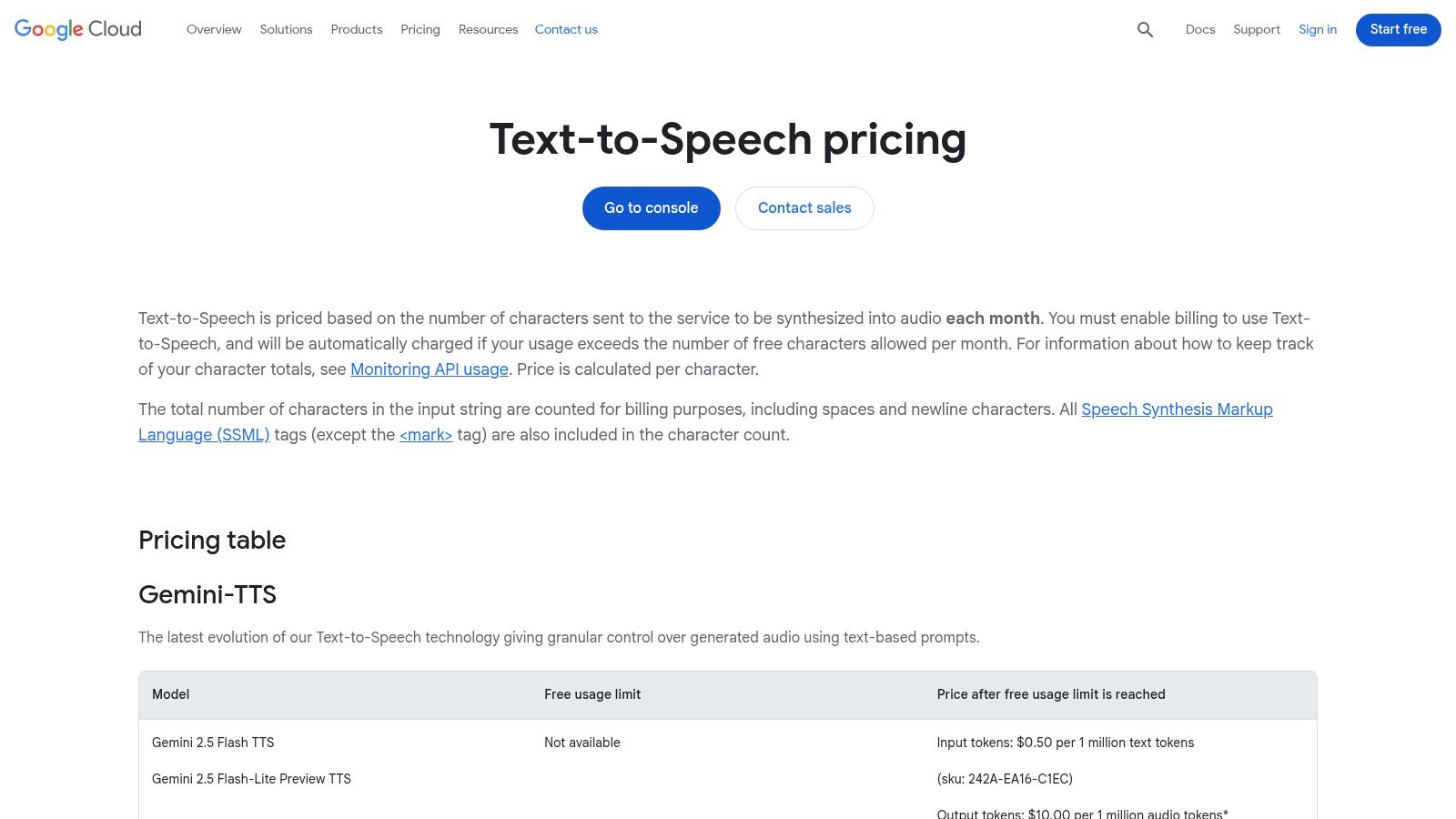
As a key offering within the Google Cloud Platform, Google Cloud Text-to-Speech provides developers with access to a diverse portfolio of sophisticated voice synthesis models. It stands out as one of the best TTS APIs by offering granular model choices, from the renowned WaveNet voices to the newer Neural2 and Gemini-TTS families. This platform is ideal for developers who need transparent, model-level pricing and the reliability of Google's global infrastructure.
The primary advantage of this service is its flexibility. Developers can choose the exact voice model that fits their quality and cost requirements, from standard voices for basic tasks to premium models for rich media. Integration is straightforward with extensive SDKs, clear documentation, and both REST and gRPC endpoints, supporting real-time streaming synthesis and asynchronous jobs for long-form audio.
The platform allows for detailed customization through SSML tags and specific audio profiles to tune output for different devices like headphones or car speakers. While most models follow a per-character billing system, the introduction of token-based pricing for newer models like Gemini-TTS requires careful cost analysis.
| Feature | Details |
|---|---|
| Engine Types | WaveNet, Neural2, Studio, Chirp, Gemini-TTS & Standard voices |
| Languages | 50+ languages, 380+ voices |
| SSML Support | Yes, for extensive speech control |
| Output Formats | MP3, OGG, WAV, LINEAR16 |
| Free Tier | 1 million characters/month (WaveNet); 4 million (Standard) |
| Pricing | From $4.00 per 1 million characters (Standard) |
Pros:
Cons:
Website: https://cloud.google.com/text-to-speech
Part of the expansive Microsoft Azure AI suite, the Text-to-Speech service is an enterprise-focused solution for developers embedded in the Microsoft ecosystem. It excels at delivering natural-sounding neural voices and offers unique deployment flexibility, making it a top contender among the best TTS APIs. Azure AI Speech supports a vast library of over 140 languages and variants, with more than 400 voices, ensuring broad global coverage for diverse applications.
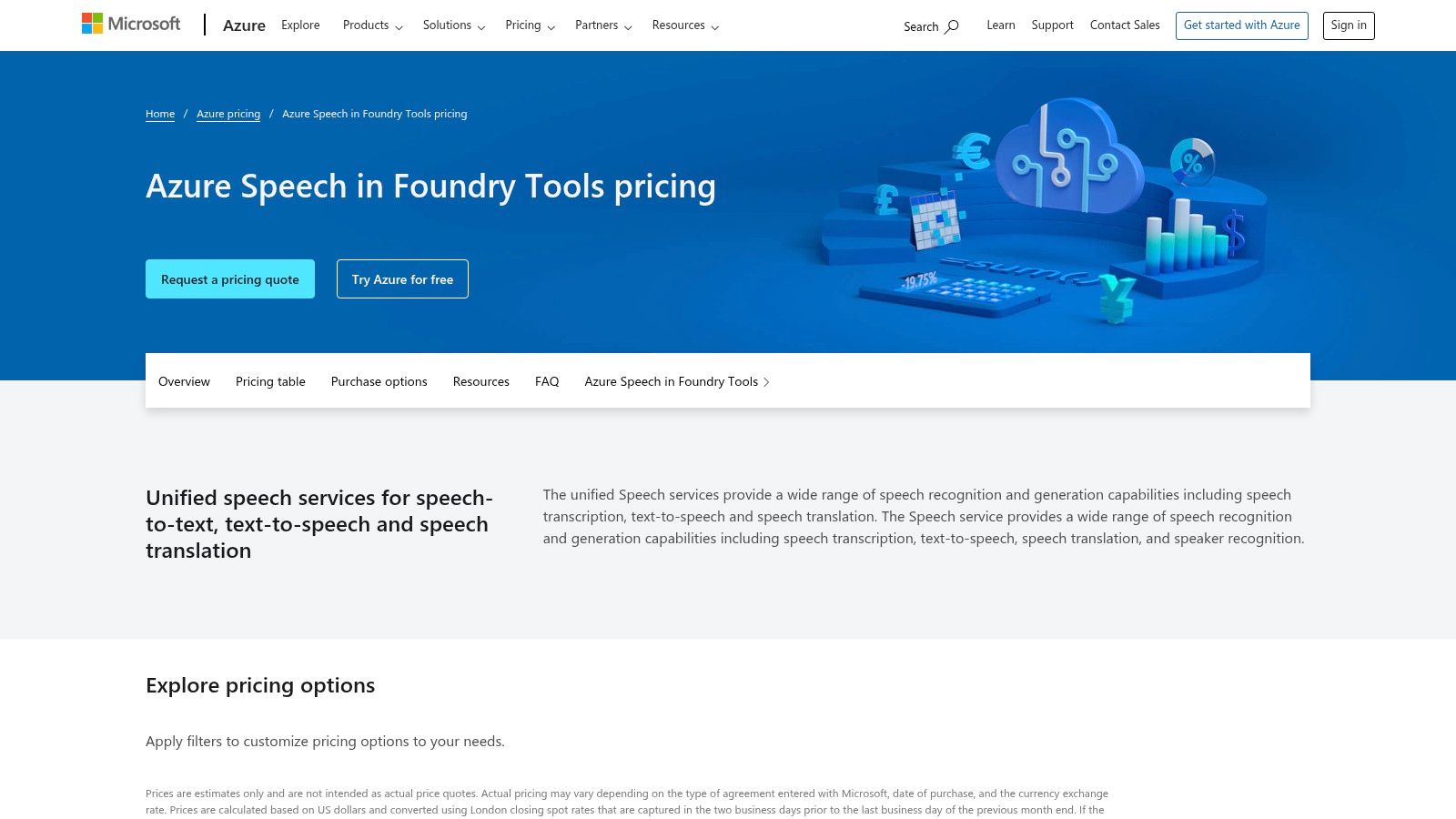
Azure's key differentiator is its support for containerized deployments, allowing businesses to run the TTS engine on-premises or at the edge for low-latency or disconnected scenarios. This capability, combined with deep integration into Azure Active Directory for security and other Azure services for data management, positions it as a powerful choice for large-scale, security-conscious organizations.
The service offers robust SSML support and custom pronunciation lexicons for precise speech control. A standout feature is Custom Neural Voice, which allows organizations to create a unique brand voice with high-quality results. While its pricing can be complex with various tiers, it provides a solid foundation for enterprise needs.
| Feature | Details |
|---|---|
| Engine Types | Neural and Standard voices |
| Languages | 140+ languages and variants, 400+ voices |
| SSML Support | Yes, with custom lexicons |
| Deployment | Cloud-based and On-premise (Containers) |
| Free Tier | 500,000 characters/month (Neural) |
| Pricing | From $16.00 per 1 million characters (Neural) |
Pros:
Cons:
Website: https://azure.microsoft.com/en-us/pricing/details/speech/
For developers already integrated into the OpenAI ecosystem, the Audio/TTS API is a natural and powerful extension. It provides low-latency, real-time text-to-speech models like tts-1, tts-1-hd, and the newer, more cost-effective gpt-4o-mini-tts. This makes it one of the best TTS APIs for applications requiring responsive voice interactions, such as virtual assistants or dynamic content narration, without leaving the familiar OpenAI platform.
The primary advantage of OpenAI's offering is its simplicity and unified billing for those already using its language models. The API is accessed via a straightforward HTTP/JSON request, making integration quick and painless. Its focus on real-time generation ensures minimal delay between text input and audio output, a critical factor for interactive use cases.
The API provides several distinct voices and supports multiple output formats. While it lacks the granular SSML control of more specialized services, its high-quality, natural-sounding output is sufficient for most modern applications. The pricing is token-based, which aligns with other OpenAI services but may require a mental adjustment for those accustomed to per-character billing.
| Feature | Details |
|---|---|
| Engine Types | Real-time optimized models (tts-1, tts-1-hd) |
| Languages | Strong support for major languages |
| SSML Support | No, control is limited to API parameters |
| Output Formats | MP3, Opus, AAC, FLAC |
| Free Tier | No dedicated free tier, usage is pay-as-you-go |
| Pricing | From $7.50 per 1 million characters (gpt-4o-mini-tts) |
Pros:
Cons:
Website: https://platform.openai.com/docs/guides/text-to-speech
ElevenLabs has rapidly become a leader in the text-to-speech space, celebrated for its exceptionally natural and expressive AI voices. Its API is built for developers who prioritize voice quality and realism above all else, making it one of the best TTS APIs for applications like audiobooks, character dialogue, and real-time conversational AI. The platform supports a diverse range of languages and accents, with a strong focus on capturing emotional nuance and intonation.
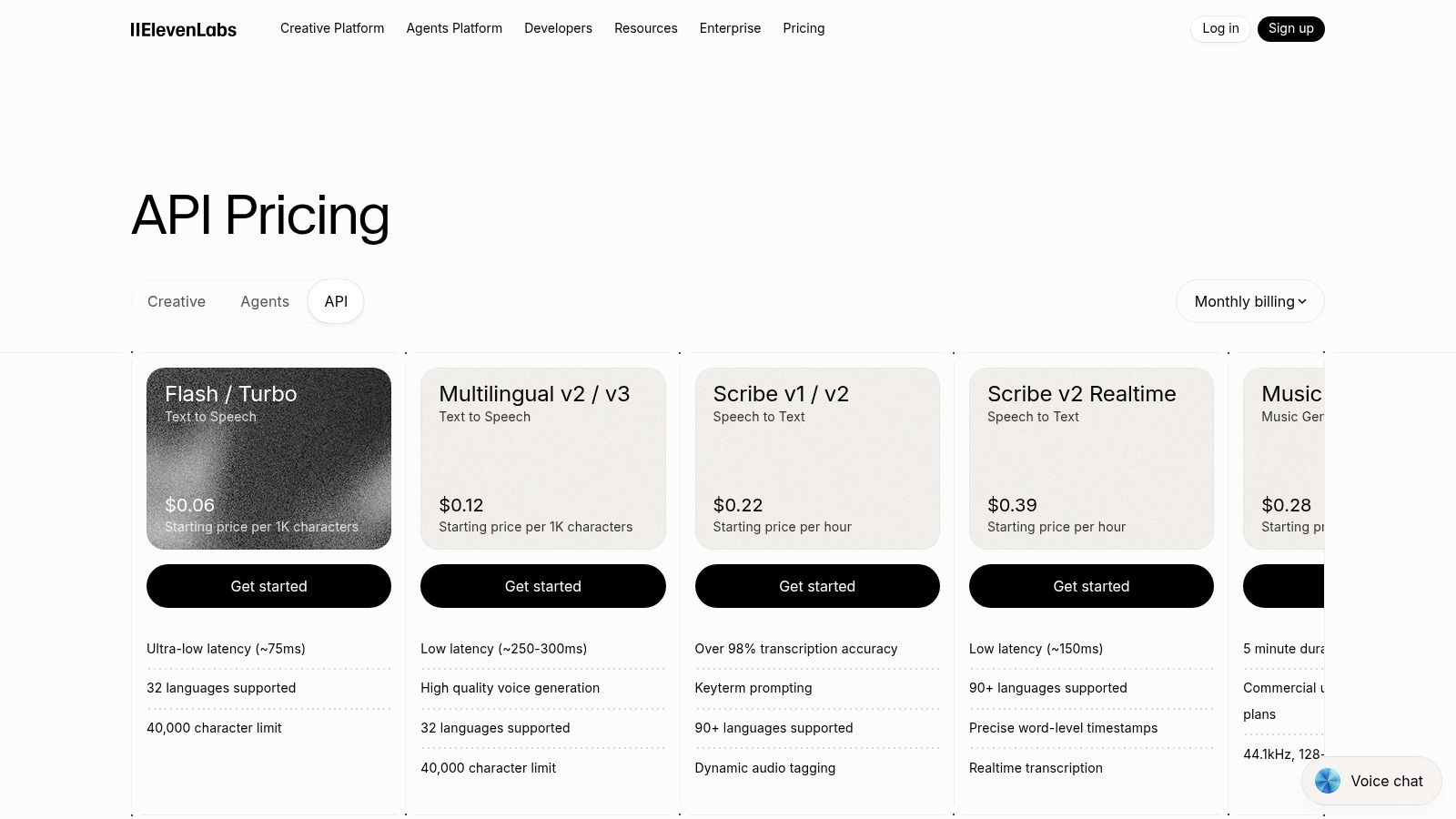
The platform’s standout feature is its powerful voice cloning technology, which allows users to create high-quality digital replicas of voices from just a few minutes of audio. Combined with its Projects workflow for long-form content and AI dubbing tools, ElevenLabs provides a comprehensive suite for advanced audio creation. Its clear, developer-friendly documentation and SDKs for Python and Node.js simplify integration into various projects.
ElevenLabs offers fine-grained control over voice outputs, allowing adjustments for stability and similarity to achieve the desired performance. The API is designed for both pre-rendering audio and low-latency streaming, catering to interactive applications. Pricing is structured in clear subscription tiers, offering a predictable cost model that scales from hobbyist projects to enterprise-level usage, with a free tier for initial testing.
| Feature | Details |
|---|---|
| Engine Types | Proprietary multilingual and expressive models |
| Languages | 29 languages with multilingual voice generation |
| SSML Support | Yes, for advanced speech synthesis control |
| Special Features | Instant & Professional Voice Cloning, AI Dubbing, Projects |
| Free Tier | 10,000 characters/month (non-commercial use) |
| Pricing | From $5/month for 30,000 characters + custom voices |
Pros:
Cons:
Website: https://elevenlabs.io/
Deepgram Aura is engineered for conversational AI, positioning itself as one of the best TTS APIs for real-time applications requiring minimal delay. Its primary strength lies in its low-latency streaming architecture, delivered via WebSocket, making it ideal for interactive agents, voice bots, and other scenarios where immediate vocal feedback is critical. By offering both Speech-to-Text (STT) and Text-to-Speech (TTS) in a unified stack, Deepgram allows developers to build seamless, end-to-end voice experiences.
The platform focuses on performance, particularly the time-to-first-byte, which ensures conversations feel natural and fluid. This specialization in real-time interaction sets it apart from general-purpose TTS services that may prioritize voice variety over speed. For teams building conversational products, Aura provides a powerful and focused toolset designed for responsiveness.
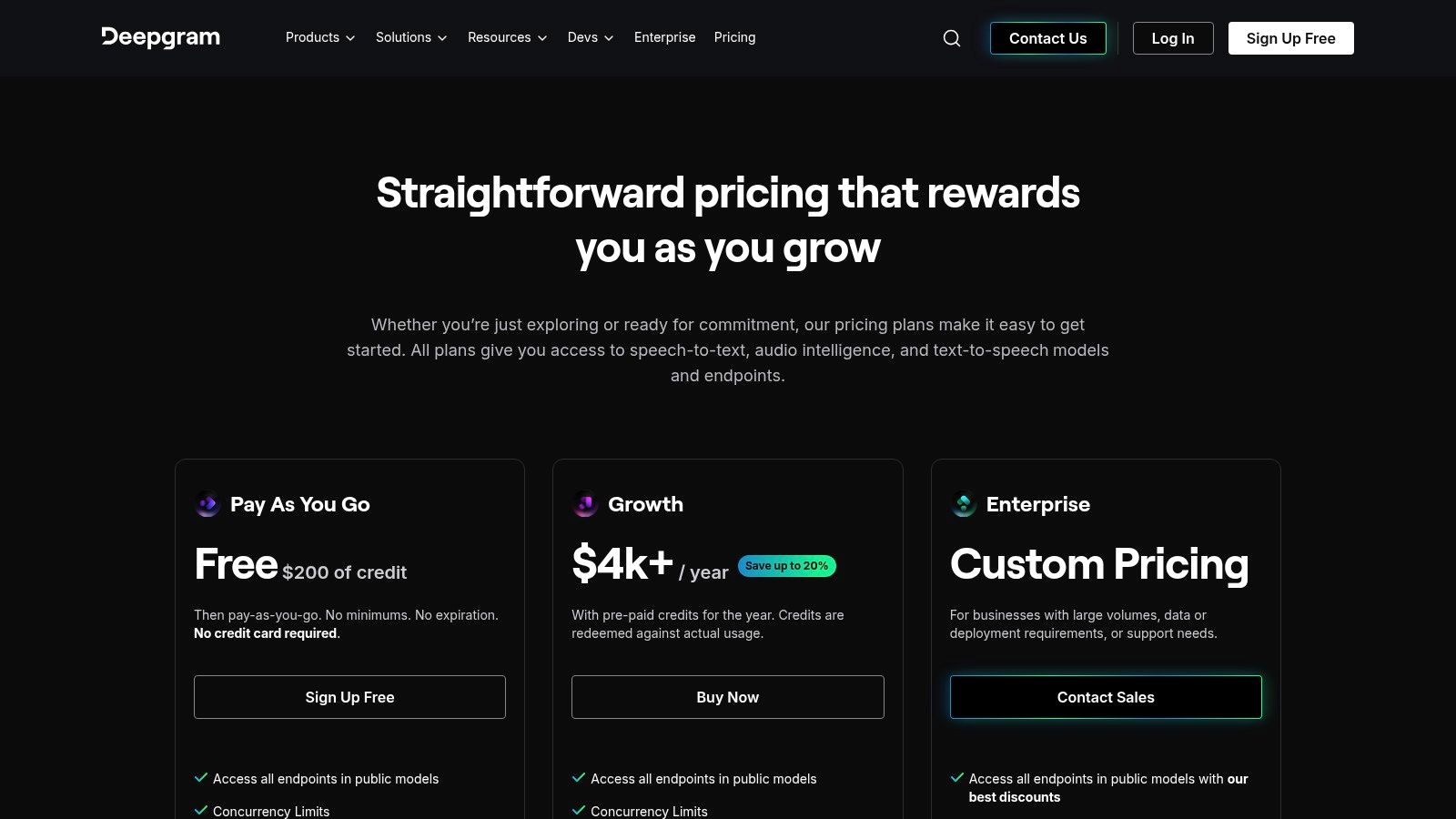
Deepgram's pricing model is straightforward and consumption-based, with generous free credits for new users to test the platform. The API supports both streaming and pre-recorded audio generation, but its core value is most evident in live, two-way communication use cases where its low latency provides a significant advantage.
| Feature | Details |
|---|---|
| Primary Use Case | Real-time conversational AI, low-latency streaming |
| Languages | Focused set, including English, Spanish, Hindi |
| API | WebSocket (streaming) & REST (pre-recorded) |
| Unified Stack | STT and TTS from a single provider |
| Free Tier | $200 in free credits upon signup |
| Pricing | From $0.0044 per 1,000 characters |
Pros:
Cons:
Website: https://deepgram.com/pricing
Play.ht bridges the gap between creator-focused tools and a powerful developer API, making it a strong contender among the best TTS APIs for content production workflows. It provides high-fidelity voices suitable for podcasts, video narration, and articles, all manageable through a user-friendly web application. For developers, its API offers a direct way to integrate these voices into applications, striking a balance between ease of use and technical capability.
The platform's primary advantage is its hybrid nature. Content teams can utilize the web app, plugins, and integrations for immediate use, while developers can leverage the API for custom solutions. This makes it an adaptable choice for businesses that need both a ready-made tool and a scalable backend service, with commercial licensing clearly available on paid tiers.
Play.ht provides access to a large library of premium voices and supports voice cloning on higher-tier plans. Developers can use SSML and a pronunciation library to fine-tune audio output. While its API pricing can vary by bundle and is subject to change, the platform offers a compelling package for teams that require high-quality audio without the complexity of an enterprise-only provider.
| Feature | Details |
|---|---|
| Engine Types | Standard & Premium AI voices |
| Languages | 100+ languages and accents |
| SSML Support | Yes, for granular control |
| Output Formats | MP3, WAV |
| Free Tier | Yes, limited characters with non-commercial license |
| Pricing | From $39/month (Creator plan with commercial use) |
Pros:
Cons:
Website: https://play.ht/
A cornerstone of IBM's AI offerings, Watson Text-to-Speech is an enterprise-focused service that converts written text into natural-sounding audio in various languages and voices. It's built for businesses prioritizing data governance, privacy, and deployment flexibility, offering cloud, hybrid, and on-premises options. Its robust APIs are ideal for integrating voice interactions into customer service applications, automotive systems, and other solutions where security and reliability are paramount.
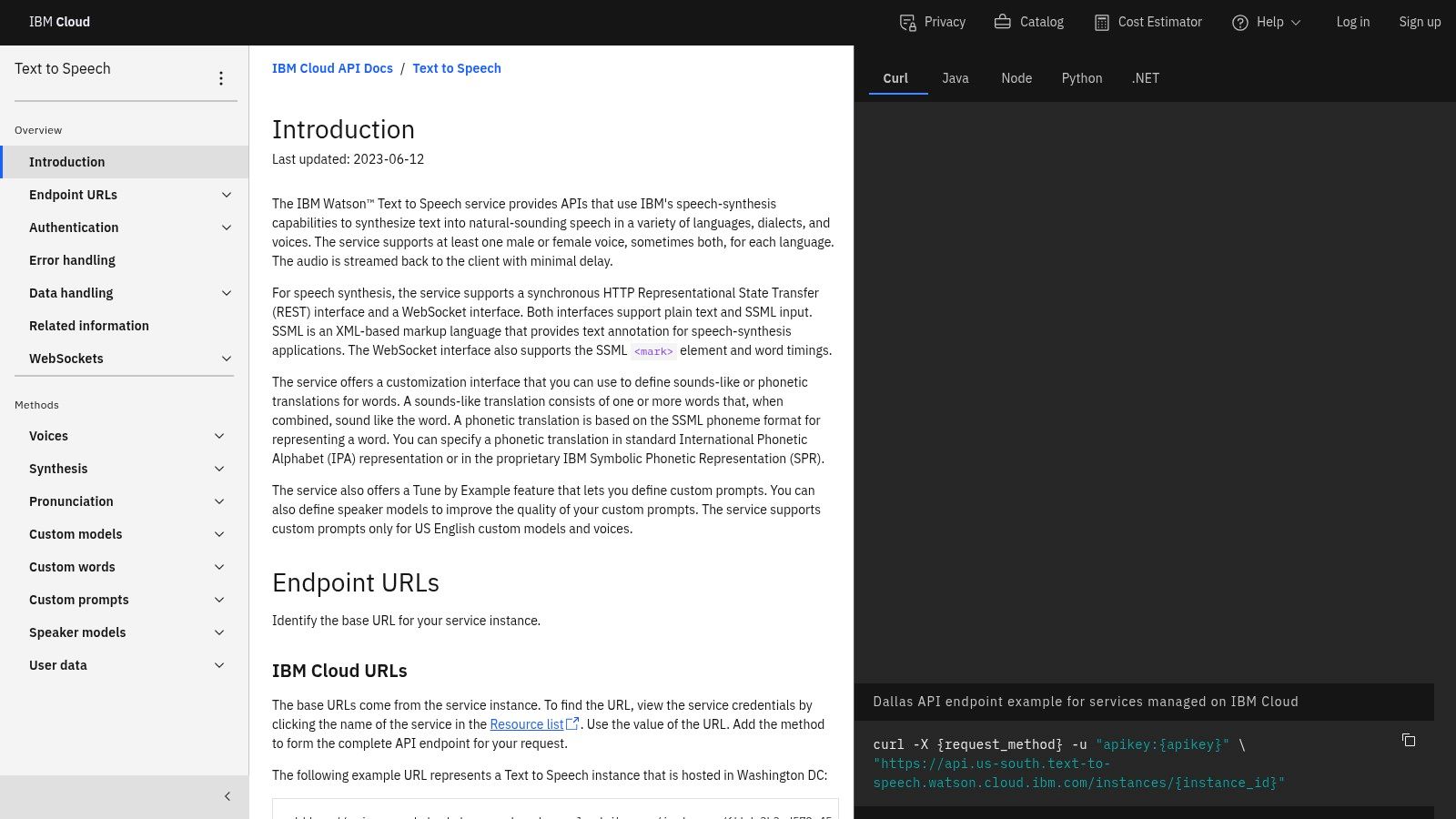
The key differentiator for IBM Watson is its enterprise-grade architecture. It provides both REST and WebSocket APIs for real-time synthesis and supports detailed pronunciation customization to handle brand-specific terminology or industry jargon. This makes it one of the best TTS APIs for large organizations that require a high degree of control over their voice outputs and data handling protocols.
The platform offers fine-tuned control over speech using SSML and allows users to create custom dictionaries to specify how unique words are pronounced. While its voices are clear and professional, the focus is less on creative or emotional styles and more on consistent, reliable performance for business applications.
| Feature | Details |
|---|---|
| Engine Types | Standard, Neural & Enhanced Neural voices |
| Languages | A wide variety of languages and voices available |
| SSML Support | Yes, with expressive tags and pronunciation customization |
| Output Formats | MP3, WAV, OGG, FLAC, and others |
| Free Tier | Lite plan includes 10,000 characters per month |
| Pricing | From $0.02 per 1,000 characters (Standard plan) |
Pros:
Cons:
Website: https://cloud.ibm.com/apidocs/text-to-speech
Resemble AI carves out a niche in the TTS landscape by focusing heavily on high-quality, custom voice cloning and speech-to-speech synthesis. It’s one of the best TTS APIs for developers and teams needing to create unique, branded voices or replicate specific individuals with remarkable accuracy. The platform is built around flexibility, offering a powerful editor and granular control over voice characteristics like emotion and pacing, making it ideal for dynamic applications in gaming, advertising, and entertainment.
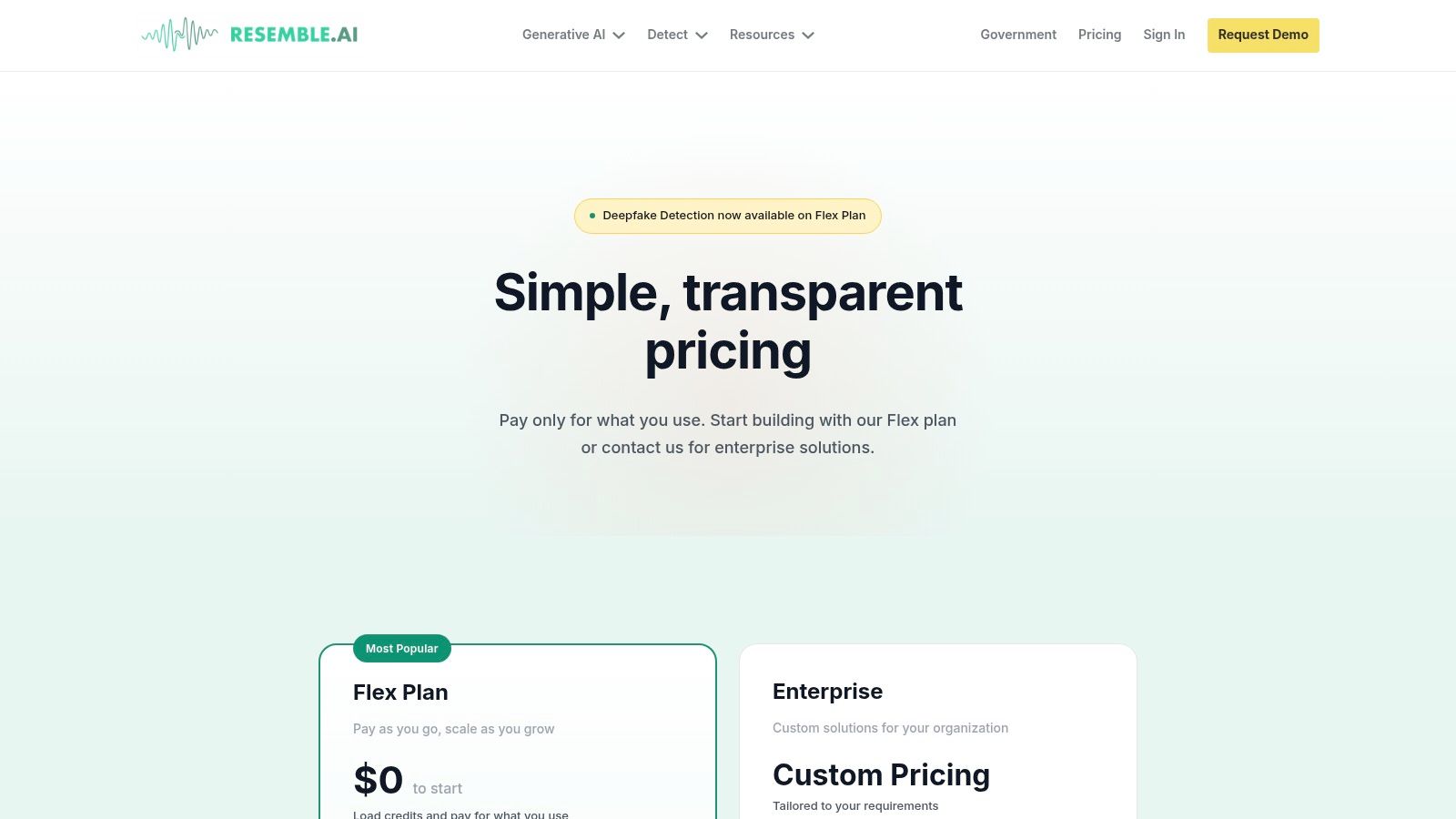
What sets Resemble AI apart is its unique per-second billing model, which can be more predictable for audio-length-based projects compared to character-based pricing. This approach, combined with enterprise-grade features like SOC 2 compliance and SSO/SAML support, positions it as a strong contender for businesses requiring both creative flexibility and stringent security.
The platform's core strength is its voice cloning technology, which requires only a small amount of audio data to generate a realistic synthetic voice. It also offers advanced speech-to-speech capabilities, allowing users to transform a recording into another voice while preserving the original intonation.
| Feature | Details |
|---|---|
| Engine Types | Custom Voice Cloning, Speech-to-Speech |
| Languages | 30+ languages for TTS and cross-lingual dubbing |
| SSML Support | Yes, with custom tags for emotion and style |
| Output Formats | MP3, WAV |
| Free Tier | Limited free trial available upon request |
| Pricing | From $0.006 per second of generated audio |
Pros:
Cons:
Website: https://www.resemble.ai/pricing/
ReadSpeaker is an established leader in the TTS space, particularly known for its strong focus on accessibility and integration within educational and enterprise environments. Instead of a typical pay-as-you-go API, it offers a suite of tailored solutions, including SDKs and hosted services, making it one of the best TTS APIs for institutions needing comprehensive, accessibility-first voice features. Its long history in the market translates to reliable, high-quality voices across a wide range of languages.
The platform's main differentiator is its business model, which is geared toward organizational procurement. ReadSpeaker excels at providing custom contracts, dedicated support, and deep integrations with Learning Management Systems (LMS) and other institutional platforms. This makes it a preferred choice for government agencies, universities, and large corporations that require predictable costs and solutions that meet strict accessibility standards like WCAG.
ReadSpeaker provides both cloud-based and on-premise deployment options, offering flexibility for organizations with specific data residency or security requirements. While it supports SSML for speech customization, its primary strength lies in its packaged solutions like webReader, which adds a "listen" button to websites with minimal development effort.
| Feature | Details |
|---|---|
| Deployment Options | Hosted (SaaS), On-Premise, Edge SDKs |
| Languages | 50+ languages, 200+ voices |
| SSML Support | Yes, for speech customization |
| Integrations | Web, LMS, Mobile SDKs, Accessibility toolbars |
| Free Tier | No, custom trials available upon request |
| Pricing | Quote-based; typically annual licenses or tailored contracts |
Pros:
Cons:
Website: https://www.readspeaker.com/pricing/
Leveraging its brand recognition in the consumer text-to-speech space, Speechify offers its powerful Simba TTS API for developers. It's designed for high-volume applications, particularly telephony, automated agents, and large-scale content narration. The platform stands out with aggressive per-character pricing and a simple, developer-friendly entry point, positioning it as a strong contender among the best TTS APIs for startups and businesses looking to scale voice features cost-effectively.
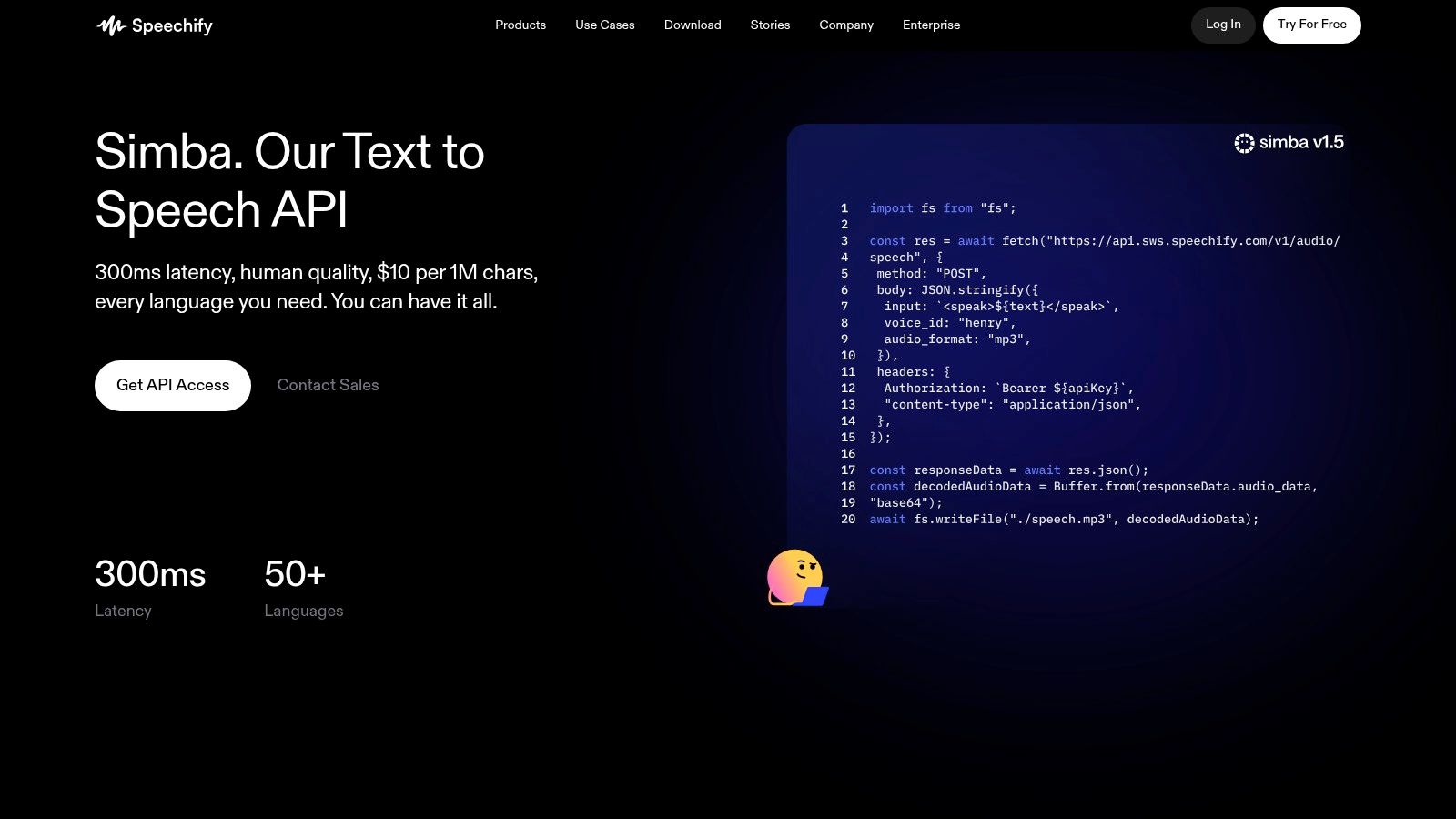
The primary appeal of the Speechify API is its combination of a vast voice library and a straightforward pricing model. It aims to reduce the complexity often associated with enterprise-grade TTS services, making it accessible for projects that require quality voices without a significant upfront investment or complex billing. Its focus on voice cloning on a pay-as-you-go basis also provides a flexible path for creating unique brand voices.
The API provides a large selection of preset voices across many languages and supports essential developer tools like SSML and speech marks for synchronization. While its marketing emphasizes significant cost savings, users should benchmark this against their specific usage patterns to validate the claims. Access to advanced features or deeper discounts may require enterprise-level commitments.
| Feature | Details |
|---|---|
| Engine Types | AI-powered TTS engine |
| Languages | 50+ languages, 1,000+ preset voices |
| SSML Support | Yes, for speech customization |
| Output Formats | MP3, WAV, PCM |
| Free Tier | Yes, includes a starter tier |
| Pricing | Pay-as-you-go per character, with volume discounts |
Pros:
Cons:
Website: https://speechify.com/api
| Product | Core features | Quality & UX (★) | Price / Value (💰) | Target & USP (👥✨) |
|---|---|---|---|---|
| Lemonfox.ai 🏆 | TTS + STT API, 100+ languages, speaker diarization, EU-hosted API, immediate data deletion | ★★★★★ — Whisper large-v3 accuracy, low latency | 💰 Cheapest on market; 1-month free (30h STT); $5/mo tier + low add-on credits | 👥 Devs & SMBs — ✨ cost-first, privacy-first, EU data residency |
| Amazon Polly (AWS) | Neural & standard voices, SSML, multiple formats, AWS integrations | ★★★★☆ — reliable, production-ready | 💰 Per-character billing; integrated AWS cost model | 👥 Enterprises/backends — ✨ compliance, global regions, AWS ecosystem |
| Google Cloud Text-to-Speech | WaveNet/Neural/Gemini voices, streaming, SSML, device tuning | ★★★★☆ — high-fidelity, strong SDKs | 💰 Model-level/token billing; some free tiers | 👥 Developers needing global scale — ✨ transparent model options, streaming |
| Microsoft Azure AI Speech | Real-time & batch TTS/STT, Custom Neural Voice, containers | ★★★★☆ — enterprise features, strong integration | 💰 Tiered/commitment pricing; custom quotes | 👥 Enterprises on Azure — ✨ on-prem/edge containers, compliance |
| OpenAI Audio/TTS | Real-time endpoints, multiple voices, simple HTTP/JSON | ★★★★☆ — low-latency, developer-friendly | 💰 Token-based pricing (minutes/tokens) | 👥 Developers using OpenAI — ✨ real-time TTS + unified platform |
| ElevenLabs API | Real-time TTS, expressive voices, voice cloning, dubbing | ★★★★★ — very natural & expressive | 💰 Subscription + credits; free testing credits | 👥 Creators & studios — ✨ top-tier naturalness, cloning options |
| Deepgram Aura (TTS) | Low-latency streaming, unified STT+TTS, concurrency tiers | ★★★★☆ — optimized for agents/streaming | 💰 Published per-1k-char pricing, free credits | 👥 Real-time agents & contact centers — ✨ unified speech stack |
| Play.ht | High-fidelity voices, web app, API, plugins | ★★★★☆ — good for content teams | 💰 Balanced pricing; commercial licensing options | 👥 Content teams & creators — ✨ web tooling + licensing |
| IBM Watson TTS | REST/WebSocket, SSML, pronunciation, hybrid/on-prem | ★★★★☆ — mature enterprise reliability | 💰 Quote-based / enterprise pricing | 👥 Enterprises & gov/edu — ✨ data governance & deployment flexibility |
| Resemble AI | TTS, speech-to-speech, voice cloning, per-second billing | ★★★★☆ — strong cloning & customization | 💰 Granular per-second pricing; credits, volume discounts | 👥 Teams needing custom voices — ✨ SOC2, SSO, granular billing |
| ReadSpeaker | SDKs, hosted/on-prem, accessibility & LMS integrations | ★★★★☆ — proven for education & accessibility | 💰 Annual licensing / quote-based | 👥 Institutions/OEMs — ✨ accessibility workflows, tailored contracts |
| Speechify API | 1,000+ preset voices, SSML, speech marks, cloning on paid tiers | ★★★★☆ — designed for scale & consumption | 💰 Aggressive per-character pricing; free starter tier | 👥 Content consumers & telephony — ✨ high-volume scaling options |
Navigating the crowded landscape of text-to-speech services can feel overwhelming. After a deep dive into the top contenders, from cloud giants like AWS and Google to specialized voice AI pioneers like ElevenLabs and Lemonfox.ai, one conclusion is crystal clear: the single "best tts api" does not exist. Instead, the optimal choice is deeply intertwined with your project's unique requirements, budget constraints, and technical architecture.
The journey to find the right API is a balancing act. You must weigh the pristine, human-like quality of premium voices against the per-character cost, the need for real-time, low-latency responses against the complexity of implementation, and the appeal of a vast language library against the importance of seamless integration within your existing cloud stack.
To simplify your decision, let's recap the core strengths of the platforms we've explored. This framework will help you create a shortlist based on your primary project driver.
For Unbeatable Cost-Effectiveness: If your primary concern is budget, especially for high-volume applications, your focus should be on providers with aggressive pricing models. Lemonfox.ai emerges as a standout leader here, offering a price point that significantly undercuts major competitors without a noticeable sacrifice in voice quality. Its generous free tier also makes it an ideal, risk-free starting point for startups and indie developers.
For Unparalleled Voice Realism and Cloning: When your application demands the most expressive, emotionally resonant, and natural-sounding voices, ElevenLabs is the undisputed market leader. Their proprietary models excel at capturing nuance, and their voice cloning capabilities are second to none, making them perfect for high-end audiobooks, character-driven gaming, and premium content creation.
For Seamless Cloud Ecosystem Integration: If your infrastructure is already built on AWS, Google Cloud, or Microsoft Azure, the path of least resistance is often the wisest. Amazon Polly, Google Cloud Text-to-Speech, and Azure AI Speech offer robust, enterprise-grade solutions that integrate flawlessly with their respective ecosystems. They provide reliability, extensive documentation, and the peace of mind that comes with using a major cloud provider.
For Low-Latency, Conversational AI: For applications requiring real-time, interactive voice, such as voice bots or live assistants, latency is the most critical metric. Deepgram Aura is engineered specifically for this use case, boasting some of the fastest response times in the industry, which is essential for creating fluid and natural-feeling conversations.
Theory and feature comparisons can only take you so far. The definitive test is how these APIs perform with your specific content and within your application's environment. The most crucial phase of your evaluation process starts now.
Ultimately, selecting one of the best tts apis is an investment in your user experience. The right voice can build trust, enhance engagement, and make your digital product more accessible and memorable. By taking a methodical, hands-on approach to your evaluation, you can confidently choose a partner that not only sounds great but also aligns perfectly with your business goals and technical roadmap.
Ready to experience premium TTS quality without the premium price tag? Lemonfox.ai is engineered for developers who need an affordable, high-quality, and easy-to-integrate solution. Get started in minutes with our generous free tier and see why we are a leading choice among the best tts apis for cost-conscious innovators at Lemonfox.ai.