
First month for free!
Get started
Published 2/8/2026
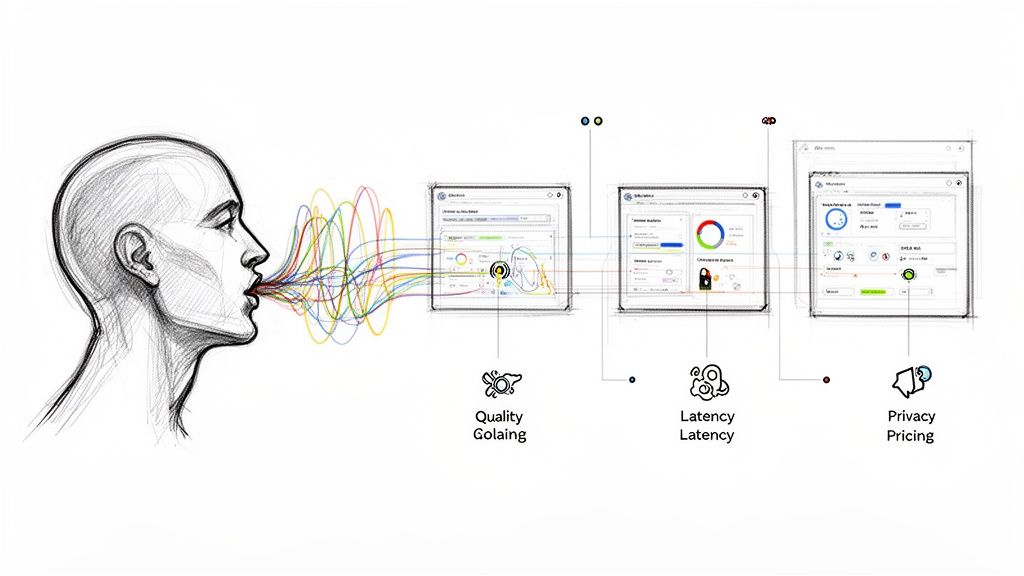
When a project needs high-quality audio at scale, the best voice cloning software is a non-negotiable. It has to deliver on realism, speed, and privacy. The leading platforms out there can now spin up incredibly lifelike synthetic voices from just a few minutes of audio, which has opened up the technology for developers, marketers, and creators in a big way.
Voice cloning, sometimes called voice synthesis, is a technology that uses artificial intelligence to create a digital copy of a person's voice. The process is pretty straightforward: a deep learning model analyzes a small audio sample, learns all the unique characteristics—pitch, tone, accent, cadence—and builds a model. From there, it can generate brand-new speech from any text you feed it.
This has become the backbone for all sorts of applications that need realistic audio without the hassle of a recording studio. The market for voice cloning software is exploding to meet this demand. It was valued at USD 1,931.5 million and is on track to hit USD 17,988.5 million by 2034, which is a compound annual growth rate of 25%. You can dig into the complete market analysis over at Market.us.
At its heart, voice cloning runs on neural networks. These have been trained on huge datasets of human speech, which teaches the AI to connect written text with the corresponding sounds, rhythm, and intonation that make a voice sound human. When you upload a sample, the AI essentially fine-tunes its massive, general model to match your specific vocal patterns.
This diagram gives a simple visual of how spoken words are converted into a digital voice model.
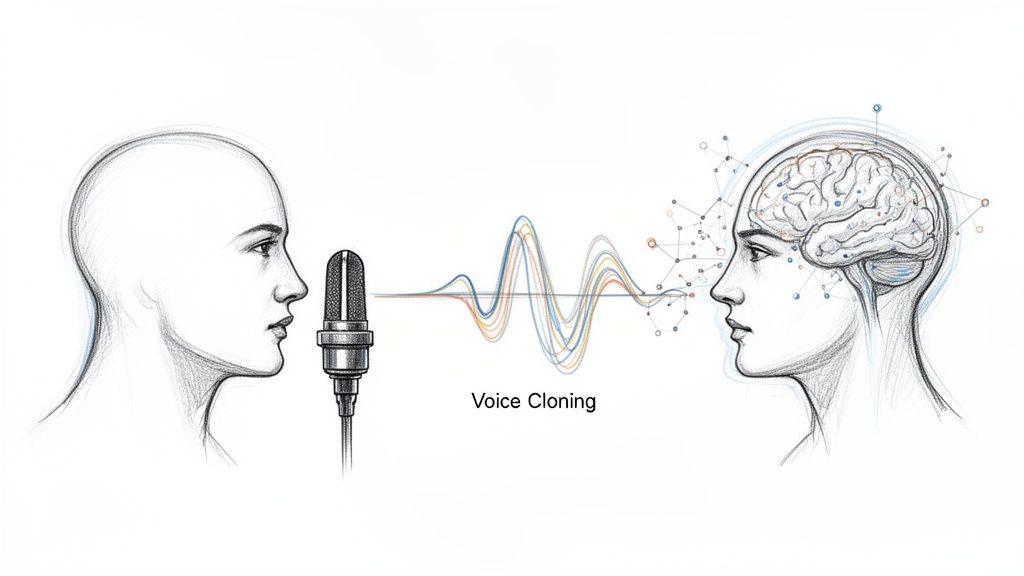
What you get is a flexible tool that can generate audio for any script you can dream up. A key feature of the best platforms is the ability to easily modify transcript and regenerate voice. This gives you precise control to iterate and make changes without ever having to re-record a single word.
The real-world uses for high-quality voice clones are growing fast, and they offer some serious advantages over old-school recording.
Voice cloning completely removes the logistical bottleneck that once existed between writing a script and getting the final audio. It lets creators produce content faster and more efficiently than ever before, turning what used to be hours of studio work into a task that takes just a few minutes.
When you're trying to find the right voice cloning software, a simple feature list doesn't tell the whole story. The real difference between a voice that sounds like a cheap text-to-speech reader and one that feels genuinely human is in the details. That’s why we dug deep and developed a solid evaluation framework to give you a clear, honest comparison.
We've built our methodology around six core pillars. Each one is crucial for different reasons, whether you're building a real-time chatbot or narrating an entire audiobook. Think of this as your practical guide for judging which tool actually lines up with what you need to accomplish.
Let's be honest, the most important thing is how the final audio actually sounds. Can you immediately tell it’s a synthetic voice, or does it have that natural, human feel? We listened closely for the things that make a voice sound real—the small hesitations, the natural rise and fall of speech—which is what separates the top-tier software from the pack.
A flat, robotic-sounding clone just won't work for anything meant to be engaging, like a podcast or video narration. We gave top marks to tools that could capture the unique rhythm and emotional tone of the original speaker. That’s the real test of truly advanced voice AI.
So, what does it take to get a great clone? Some platforms boast “few-shot” cloning, where they can whip up a decent voice from just a few seconds of clear audio. Others need more to work with, typically asking for 5 to 30 minutes of high-quality, clean recordings to produce professional-grade results.
We looked at the trade-offs here. Faster cloning is great for quick tests, but we found that giving the AI more data almost always results in a more realistic and expressive voice. The best tools give you options, letting you get a quick result for a prototype and then go deeper for the polished, final product.
The quality of your input audio is the single biggest factor in the quality of your output clone. A clean, quiet recording from a decent microphone will outperform a noisy sample on even the most advanced platform.
For anything interactive, like an AI agent or a live support bot, speed is non-negotiable. Latency—the lag between sending the text and getting the audio back—can completely ruin the user experience. Anything more than a few hundred milliseconds just feels clunky and unnatural.
We measured the total processing time for each tool, paying special attention to how they held up in real-time scenarios. This is a huge differentiator. A platform built for creating long-form audio isn't necessarily the right choice for an application that needs instant vocal responses.
The global reach of your project could hinge on the software's ability to handle different languages and accents. The leading solutions don't just generate speech in dozens of languages; they can also apply a cloned voice's characteristics to a different language. This feature, known as cross-lingual voice cloning, is a game-changer for creating a consistent brand voice for a worldwide audience. We checked out the breadth and accuracy of language support for every tool on our list.
Of course, cost is always a major factor. We broke down the different pricing structures we came across:
We looked beyond the advertised price to figure out the true cost as your project grows. A plan that looks cheap at first can get expensive fast if you’re constantly hitting character limits and paying overage fees.
Finally, and this is a big one, we looked at how each platform handles your data. This is non-negotiable. Any reputable provider must have strict policies that require explicit consent to clone a voice. We prioritized services that had clear privacy terms, robust security, and features like automatically deleting your data after processing. This isn't just about good practice—it's about innovating responsibly and keeping user trust intact.
Choosing the right voice cloning software isn't about finding a single "best" tool—it's about finding the right tool for your specific job. Instead of just listing features, we're going to dive into how the leading platforms perform in the real world, stacking them up against the key criteria we've already laid out. This way, you'll see exactly how they handle different challenges, from creating emotionally rich narrations to powering real-time conversations.
We’ll be looking closely at the top contenders, paying special attention to the subtle but crucial differences in audio realism, API performance, and data privacy. Whether you're building an interactive app or producing long-form content, understanding these nuances is what will make or break your project.
These three pillars—Quality, Speed, and Privacy—are what we consider the most important factors. They have to work in balance.
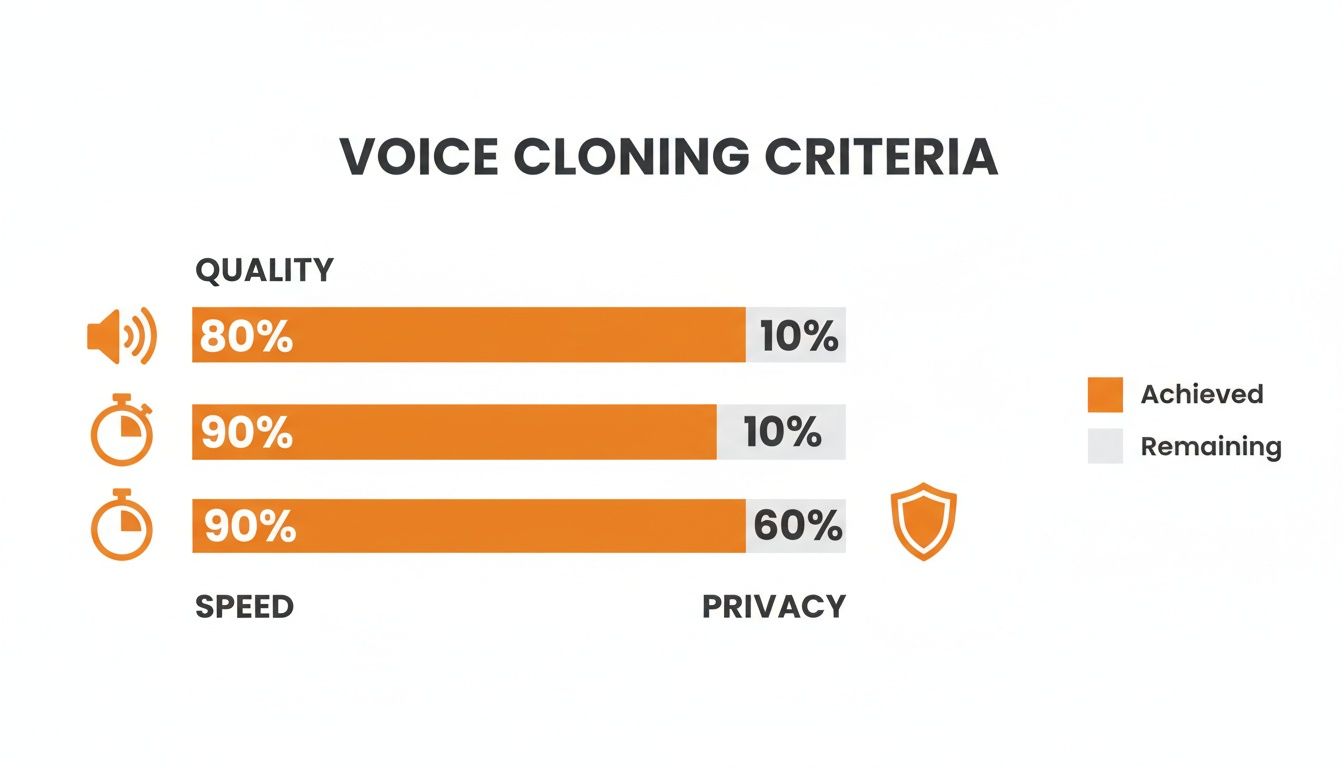
As you can see, a fantastic-sounding voice clone loses its shine pretty quickly if it's too slow for a real conversation or if its privacy practices are questionable.
Tool A has rightfully earned its reputation as the go-to for creators working on audiobooks, podcasts, and detailed video narrations. Its real magic lies in generating audio with genuine emotional depth and natural-sounding intonation. The AI is uncannily good at picking up on context, allowing it to inject the subtle inflections that make a voice sound truly human and engaged.
For instance, if you feed it a tense scene from a novel, its output doesn't just read the words; it conveys a consistent, suspenseful tone without ever sounding like a caricature. That’s a huge leap forward from competitors that often fall back to a flat, monotone delivery when they encounter longer or more complex text.
Key Differentiator: Tool A’s advanced contextual awareness makes it perfect for any project where emotional resonance is non-negotiable. It truly shines in maintaining a consistent character voice over hundreds of pages, which is a notorious headache in audiobook production.
But this incredible, high-fidelity audio comes at a price: speed. The processing time is noticeably slower, making it a poor fit for any kind of real-time application. If you’re building an IVR system or a live chatbot, the lag would almost certainly kill the user experience.
Its pricing also reflects its target audience. The subscription tiers are built for high-volume creators, offering massive character allotments. This is a great deal for dedicated producers, but it can feel overly expensive for developers or startups whose needs might be smaller or more sporadic.
Tool B is the complete opposite of Tool A. It's built for one thing: speed. The entire system is optimized for low-latency audio generation, which puts it at the top of the list for interactive applications. In our own tests, it consistently delivered audio in under 300 milliseconds—a crucial threshold for making conversations with AI agents and chatbots feel natural.
It’s no surprise this platform is a favorite among developers building voice-first user interfaces. For something like a customer service bot, Tool B generates responses so fast that the interaction feels fluid and conversational. It also supports audio streaming, so playback can start almost immediately while the rest of the clip is still generating, which cuts down on perceived wait time even more.
Of course, this focus on speed involves a slight trade-off in audio quality. The voices are perfectly clear and easy to understand, but they don't have the rich emotional range you get from Tool A. Clones can sound a bit flatter, which is totally fine for quick, transactional chats but less than ideal for immersive storytelling.
Privacy is a real strong suit for Tool B. They provide strong API controls and have transparent data handling policies, including options to have data deleted immediately after processing. This makes it a solid choice for applications that might handle sensitive user information.
Where Tool C really sets itself apart is with its incredible language and accent support. It works with over 50 languages, but its killer feature is cross-lingual voice cloning. You can clone a voice in one language, like English, and then use that same vocal identity to speak in a completely different language, like Japanese or Spanish.
This is a game-changer for global companies trying to maintain a consistent brand voice across different markets. Think about it: a company’s CEO, a native English speaker, could "deliver" a message to their German team in fluent German, but in their own recognizable voice. Tool C makes this a reality with impressive accuracy.
The quality of the cloned accents is also excellent. The AI does a fantastic job of keeping the original speaker's unique cadence while adapting it seamlessly to the phonetics of a new language.
Situational Recommendation: If your main goal is scaling content globally while keeping a consistent brand voice, Tool C is arguably the best voice cloning software you can find. That cross-lingual capability is a powerful and unique advantage.
The platform's API is clean and well-documented, making it easy for developers to integrate it into global applications. Its pricing is tiered based on language access and character usage, which lets companies scale their spending as they expand.
Lemonfox.ai has carved out a smart position in the market by focusing squarely on developers and startups who need a practical mix of quality, cost-effectiveness, and privacy. The most compelling part of its offer is a highly competitive pricing model that puts professional-grade voice cloning within reach, without needing a huge budget.
The audio quality is impressive and easily stands up to the more established players. It produces natural-sounding clones that work well for a huge range of uses, from e-learning courses to personalized video messages. While it might not capture the deep emotional nuance of Tool A, the realism is more than enough for most business and content needs.
Another big win for Lemonfox.ai is its developer-first mindset. The API is refreshingly straightforward and designed to be implemented quickly. This focus on ease of use means you can get high-quality voice features into your app with less development overhead.
Most importantly, Lemonfox.ai takes data privacy and security seriously. It provides an EU-based API endpoint and guarantees that user data is deleted immediately after processing. This commitment is absolutely essential for any project that needs to be compliant with strict regulations like GDPR.
The entire voice cloning industry is moving to the cloud, and that's great news for developers. Cloud platforms already make up a 42.80% revenue share ($1.03 billion) and are expected to grow at an incredible 29.82% CAGR through 2031. This trend is all about the flexibility, scalability, and lower costs that cloud infrastructure offers over old-school on-premise setups. You can read more about these market shifts in this comprehensive report from Mordor Intelligence.
For a developer, this means you get access to powerful voice models with low latency, support for over 100 languages, and usage-based pricing that can be as low as $0.17 per hour for related services like transcription. This model, which services like Lemonfox.ai are championing, also puts privacy first with features like instant data deletion, making it a perfect fit for secure, compliant projects.
To give you a simple, at-a-glance comparison, the table below sums up the key strengths of the platforms we've covered. It’s a quick way to see how each one measures up against our core evaluation criteria.
| Feature | Tool A | Tool B | Tool C | Lemonfox.ai |
|---|---|---|---|---|
| Primary Use Case | Audiobooks, Narration | Chatbots, IVR | Global Content | General Purpose API |
| Audio Realism | Exceptional (Emotional) | Good (Clear) | Very Good (Accent-Rich) | High Quality (Natural) |
| Latency | High | Very Low (<300ms) | Moderate | Low |
| Language Support | Moderate | Good | Excellent (50+ languages) | Excellent (100+ languages) |
| API Access | Yes | Yes (Optimized) | Yes (Well-documented) | Yes (Developer-First) |
| Data Privacy | Standard | Strong (Instant Delete) | Good | Excellent (EU-Compliant) |
| Pricing Model | High-Volume Subscription | Pay-as-you-go / Tiers | Tiered by Language | Highly Affordable |
This breakdown makes it clear that there's no single "best" platform for every person and every project. The right choice is the one whose strengths perfectly align with the unique demands of what you're trying to build.
There's really no such thing as the "best" voice cloning software. The right tool is the one that fits what you're trying to accomplish. A platform that's brilliant at creating emotionally rich audiobook narrations will almost certainly fall flat in a real-time, conversational AI setting.
To make a smart choice, you have to match a platform’s core strengths to your project’s must-haves. Instead of just listing features, let's walk through four common scenarios to see how different priorities—from speed to emotional depth—should point you to the right solution. This way, you can be sure you're investing in a tool that actually works for you.
When you're building a conversational AI, latency is everything. Even a tiny delay between a user's question and the AI's spoken reply can break the illusion of a natural conversation. For these kinds of projects, your top priority has to be real-time performance, aiming for audio delivery in under 300 milliseconds.
This single requirement cuts down your options significantly. You need to be looking at software with a solid, low-latency API and features like audio streaming, which lets the voice start playing before the entire clip has been generated. While you don't need a Hollywood-level performance, the voice still has to be clear and consistent. The goal isn't drama; it's a quick, understandable response that keeps the user locked in.
Here, the script is flipped entirely. For long-form content like audiobooks and podcasts, emotional consistency and nuance are what matter most. A clone has to do more than just speak the words; it must carry the tone, inhabit a character, and build suspense for hours on end. A flat, robotic voice will have listeners tuning out in minutes.
For this kind of work, you need a tool that has a sophisticated understanding of context. Look for platforms that can pick up on the underlying sentiment of a script and add subtle, natural-sounding inflections. Speed is far less important since the audio is created in big batches and edited offline. The real trick is finding a tool that can hold a believable persona across thousands of words without sounding monotonous.
The biggest headache in long-form audio is keeping a character's voice consistent. A high-end tool can save you countless hours in post-production by getting the tone right on the first try—something that’s nearly impossible with cheaper clones.
Picture this: you're sending thousands of personalized video messages, and each one greets the recipient by name in your brand’s signature voice. Pulling this off requires a platform built for scalability and a rock-solid API. The software has to juggle a high volume of simultaneous requests without crashing or lagging.
When evaluating your options, focus on the quality of the API documentation, how easy it is to integrate, and its reliability under pressure. High-quality audio is definitely important for your brand's image, but the technical muscle to generate all those personalized clips at scale is the make-or-break factor. Keep an eye out for flexible, pay-as-you-go pricing models that make sense for campaign-based work, helping you keep costs under control.
Creating corporate training materials is often a balancing act between quality, consistency, and budget. For this job, the ideal tool offers ease of use and cost-efficiency. The people creating this content are often instructional designers, not developers, so a simple, user-friendly interface for generating and tweaking audio is a must.
The voice clone needs to be clear, professional, and sound the same across dozens—or even hundreds—of modules. This guarantees a uniform experience for every employee. It doesn't need the dramatic flair of an audiobook narrator, but it has to be engaging enough to keep learners from zoning out. Platforms that offer a good mix of quality and affordable subscription plans are usually the perfect fit here, giving you predictable costs for ongoing content creation.
While many platforms are built for big-budget content creators or massive enterprises, developers and startups are often left searching for a tool that fits their unique needs. They need a sweet spot: high performance, predictable pricing, and serious privacy, all without a punishing learning curve. This is exactly the gap Lemonfox.ai was built to fill.
It’s designed with a developer-first mindset, focusing on what truly matters when you're moving fast: a clean API, straightforward pricing, and data security that you don't have to second-guess.

For startups and solo developers, every dollar counts. Lemonfox.ai tackles this reality head-on with a pricing model that’s refreshingly simple and incredibly competitive, making professional-grade voice synthesis accessible to everyone. Instead of confusing subscription tiers that hide key features, its pay-as-you-go structure lets you scale without hitting a financial wall.
This is a game-changer for projects just getting off the ground or those with fluctuating demand. You’re not paying for enterprise-level overhead; you’re just paying for what you use.
We’ve all been there—wrestling with a clunky API and confusing documentation. Lemonfox.ai knows developer time is your most valuable asset, so its API is built for speed and simplicity. The documentation is clean and gets straight to the point, meaning you can go from signing up to generating your first audio clip in a matter of minutes.
The implementation path is as simple as it gets:
That’s it. This no-nonsense workflow eliminates the usual friction of integrating a third-party service, letting you stay focused on your product, not on deciphering someone else's code.
Lemonfox.ai’s true strength is its pragmatism. It delivers high-quality, reliable voice cloning through an API that just works, removing the financial and technical barriers that often slow down innovation for smaller teams.
In today's world, privacy isn’t just a feature—it’s a fundamental requirement. Lemonfox.ai puts security and trust at its core, offering protections that are particularly crucial for any business with users in Europe.
It provides a dedicated EU-based API endpoint, which keeps data processing within the region and makes GDPR compliance much simpler. More importantly, the platform guarantees that all user data is deleted immediately after processing. There’s no ambiguity. This commitment gives you and your users peace of mind, knowing sensitive information isn't lingering on some third-party server.
This sharp focus on privacy makes Lemonfox.ai a safe and reliable partner for any application, especially those handling personal data or user-generated content. It’s a practical, secure, and budget-friendly solution for teams ready to build the next wave of voice-powered products.
As you narrow down your choices, a few common questions always pop up. Let's clear the air on some of the most critical details—audio requirements, legal responsibilities, and API integration—so you can move forward with confidence.
The amount of audio needed to get a great clone really depends on the platform, but one thing is constant: the more high-quality audio you feed the AI, the better the result will be.
You'll see some tools advertising "instant" cloning from just a few seconds of speech. It's impressive tech, for sure, and great for a quick test drive. But for any professional work, that's rarely going to cut it.
If you're creating something like audiobook narration or polished e-learning content, you should aim for 5 to 30 minutes of clean, consistent audio. That's the sweet spot. A larger dataset gives the AI enough material to truly learn the unique cadence, pitch, and subtle intonations of a person's voice, which makes all the difference between a robotic clone and a truly lifelike one.
Here's a pro tip: The quality of your source audio is everything. A crisp recording with zero background noise, echo, or music will give you a better clone than a more advanced platform fed with a poor-quality sample.
When it comes to the legal and ethical side of voice cloning, it all boils down to one simple word: consent. You absolutely must have explicit, provable permission from the person whose voice you want to clone. No exceptions. Using someone's voice without their sign-off can land you in serious legal trouble over everything from identity theft to privacy violations.
Ethically, the stakes are even higher. The potential to create deepfake audio for spreading misinformation or committing fraud is very real. That's why any reputable voice cloning provider will have strict consent policies. Many platforms also flat-out prohibit cloning public figures to head off any malicious use before it starts.
For developers looking to build voice cloning into an application, the process is generally pretty straightforward using a REST API. Most professional-grade services, Lemonfox.ai included, use a similar, developer-friendly workflow.
It usually looks something like this:
While that's the standard flow, always keep the provider's official API documentation handy. It’ll have the specific code examples and parameters you need to get everything running smoothly from day one.
Ready to bring your project to life with realistic, high-quality audio? Lemonfox.ai offers a developer-first API that is powerful, affordable, and privacy-focused. Get started today and see how easy it is to integrate premium voice technology at a fraction of the cost. Visit https://www.lemonfox.ai to learn more.