
First month for free!
Get started
Published 11/13/2025
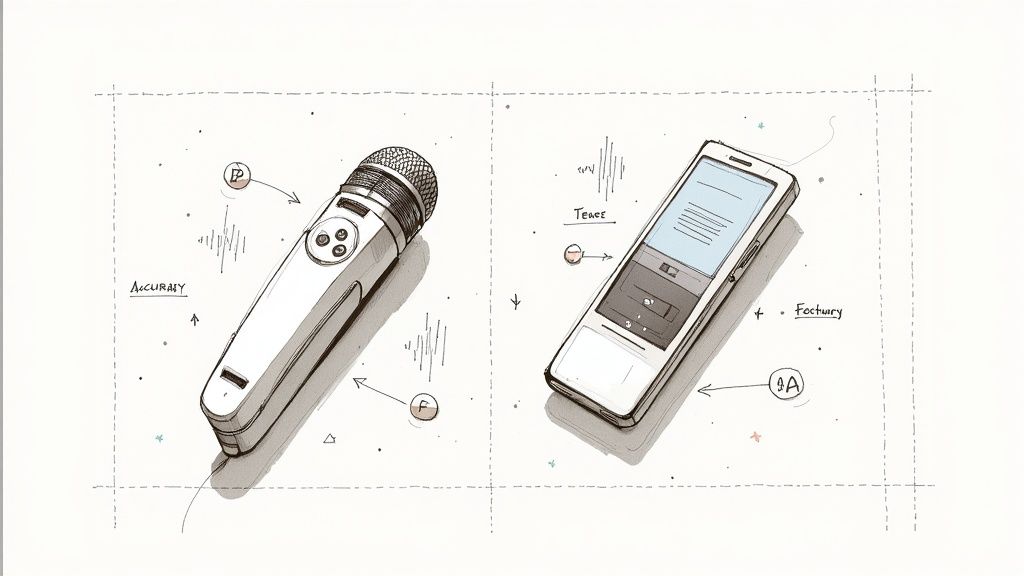
When you’re looking for the best voice recorder with transcription, the smartest move is often to pair a dedicated hardware device with a specialized AI service. Think of it this way: use something like the excellent Sony ICD-UX570 to capture crystal-clear audio, then upload it to an accurate and affordable service like Lemonfox.ai for the text conversion. This two-step approach gives you the best of both worlds—pristine recordings and fast, reliable transcripts—without locking you into a single, often overpriced, ecosystem.
Finding the right setup to turn spoken words into text isn't just about picking a gadget. It’s about building a workflow that actually saves you time. Whether you're a student recording lectures, a journalist interviewing sources, or a professional needing to document meetings, the objective is always the same: capture flawless audio and get it transcribed accurately with the least amount of hassle.
This guide isn’t just another list of products. We're going to break down the real differences between all-in-one hardware and more flexible software-based solutions. The goal is to help you find the perfect match for what you actually do, day in and day out.
Let's start with a quick look at the main players. This table shows how different tools are built for very different people, from a professional who needs advanced dictation features to a student who just needs to reliably record a class.
You'll notice that every option involves a trade-off between convenience, audio quality, and the final cost of transcription. Getting a handle on these differences is the first step to making a smart choice.
| Recorder Option | Best For | Key Strength | Price Point |
|---|---|---|---|
| Sony ICD-UX570 | Interviews & Lectures | Exceptional audio quality in a compact, user-friendly design. | $$ |
| Olympus DS-9000 | Professional Dictation | Advanced features like overwrite and insert for precise editing. | $$$$ |
| Smartphone App | Casual Use & Convenience | Always available, no extra hardware needed for quick notes. | $ |
| Zoom H1n | Researchers & Podcasters | High-fidelity stereo recording, ideal for capturing nuanced audio. | $$ |
This table gives us a starting point for a deeper dive. As we go through each category, keep your primary use case in mind—what are you really going to be recording?
The single most important factor for accurate transcription isn't the software—it's the quality of the original audio file. A great recording makes any transcription service shine and will save you countless hours of painful editing down the line.
At the end of the day, the best voice recorder with transcription is simply the one that slots perfectly into your workflow, whether that's a professional-grade device or just a simple app for capturing thoughts on the fly.
What really makes one voice recorder stand out from another? It’s not just the logo on the case or the number on the price tag—it’s the tech humming away inside. Getting a handle on these core components is crucial because they're what will make or break the quality of your audio and, ultimately, the accuracy of your transcript.
Everything starts with the microphone. The type of mic in a recorder determines how it captures sound, and that’s a big deal depending on where you're recording. You can think of it like picking the right lens for a camera; you wouldn’t use a wide-angle lens for a portrait, and the same principle applies here.
The choice usually boils down to two main types: omnidirectional and unidirectional.
An omnidirectional microphone is designed to pick up sound equally from every direction. This makes it perfect for recording a group conversation, like a team meeting around a conference table or a focus group. You can place it in the middle and be confident it’s catching what everyone has to say, no matter where they're sitting.
Of course, that all-encompassing nature has a downside. Because it hears everything, it also captures every little background noise—the air conditioner kicking on, papers shuffling, or someone coughing in the next room.
On the other hand, a unidirectional microphone (often called a cardioid mic) is built to capture sound from directly in front of it while ignoring noise from the sides and back. This is your go-to for one-on-one interviews, personal dictation, or recording a presenter at a loud event.
By focusing on a single source, it delivers a much cleaner audio file. That clean audio is a massive help for transcription software, leading to far more accurate results.
The microphone is the first, and most important, link in the chain. High-quality audio is the absolute foundation for accurate transcription. If you feed the software garbage audio, you'll get garbage text back—no matter how smart the AI is.
This push for better audio is a big reason the market is growing so quickly. The global digital voice recorder market is projected to jump from USD 2.4 billion in 2025 to USD 7.2 billion by 2035. This growth is fueled almost entirely by the demand for reliable, built-in transcription. As more people depend on these tools, the tech inside matters more than ever. You can read more about these projections in the full report on digital voice recorder growth.
Beyond the basic microphone type, advanced noise cancellation is what separates the good from the great. The best modern recorders use complex algorithms to intelligently identify and filter out ambient noise, making the speaker’s voice pop. This is the technology that lets you get a clean recording in a noisy coffee shop or on a windy day.
The recorder's internal hardware, like its processor and microphone setup, is carefully designed to pack powerful audio features into a portable device.
Finally, you have to think about where the actual transcription happens. Some devices use on-device AI processing, meaning the audio is converted to text right on the hardware itself. This is great for privacy and lets you work offline. Others use cloud-based AI, sending your audio files to powerful remote servers for processing. This often gives you access to more sophisticated AI models but requires an internet connection and brings up potential data privacy questions.
Knowing a bit about these technical details helps you see past the marketing fluff and choose a device based on the specs that actually matter for your work.
When you start looking for the best way to record and transcribe audio, you’ll quickly find yourself at a fork in the road. One path leads to an all-in-one hardware device that does both jobs. The other, more flexible route, involves pairing a high-quality digital recorder with a separate, dedicated AI transcription service. Each approach has its own set of pros and cons, really depending on what you value most—convenience, accuracy, or cost.
An integrated device, like a professional dictaphone, is all about simplicity. You record, you hit a button, and you get a transcript, often right on the device itself. It’s a straightforward workflow perfect for someone who just wants a single tool to get the job done without messing with multiple files or services.
But if top-notch quality is what you're after, the separate-components approach almost always wins. By pairing a great recorder from a brand like Sony or Zoom with a powerful AI engine like Lemonfox.ai, you get the best of both worlds. You're not stuck with the compromises of an all-in-one gadget; you can pick the best hardware for capturing sound and the best software for turning it into text. For professionals, that flexibility is everything.
The first big difference comes down to the quality of the recording itself. Dedicated hardware, especially the pro-grade stuff, often comes packed with features like directional microphones designed to cut through noise. They're built from the ground up for one thing: capturing a clear voice.
On the other hand, using a separate digital audio recorder gives you far more control. You could grab a device with specific microphone capsules, like the stereo mics on a Zoom H1n, to get rich, detailed audio for an interview. Your goal becomes capturing the purest sound possible, knowing that a high-quality file will give any transcription AI the best chance to succeed.
This infographic is a great guide for matching a microphone to your recording space.
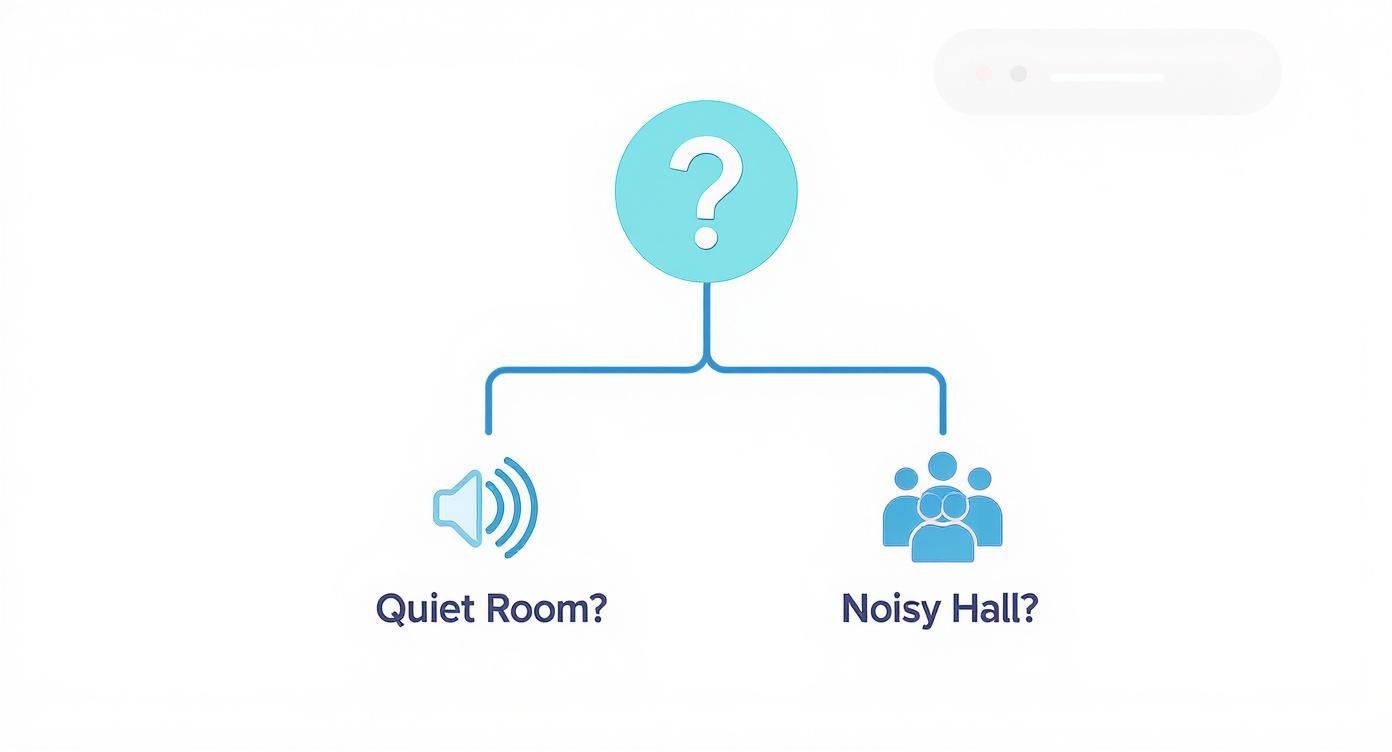
As you can see, where you record is probably the single most important factor in getting clean audio.
This is where the software really shines. An all-in-one recorder typically relies on its own built-in AI. While that’s convenient and secure, the AI is limited by the device’s processing power and might not get updated as often as cloud-based services.
A standalone AI transcription service, however, has the full power of the cloud behind it. This allows for much more sophisticated algorithms that can untangle different accents, handle industry-specific jargon, and identify multiple speakers with ease. A service like Lemonfox.ai is constantly refining its models, so its accuracy is always improving—a huge advantage over a static piece of hardware.
Key Insight: Think of transcription accuracy as a simple equation: Audio Clarity × AI Power. The two-part approach lets you maximize both sides of that equation independently.
Splitting the tasks of recording and transcribing is the secret to getting the highest accuracy, which means you’ll spend far less time editing and correcting the final text.
At a glance, an all-in-one device seems like a simple, one-time purchase. But these recorders can be quite expensive upfront, and some even sneak in ongoing subscription fees for full transcription features or cloud storage. Over time, the total cost can really add up.
The combined approach is usually more budget-friendly. You can buy an excellent digital recorder for a fair price, and then you only pay for transcription services when you actually need them. Services like Lemonfox.ai offer incredibly low per-hour rates, making this pay-as-you-go model a smart long-term investment, especially if your needs vary. Best of all, you’re not locked into one company’s system.
To really lay it all out, let's compare these two approaches head-to-head. It’s not just about which is "better," but which is better for you and the work you do. This table breaks down the key differences to help you decide.
| Feature | Dedicated Hardware (e.g., Olympus DS-9500) | Recorder + AI Service (e.g., Zoom H1n + Otter.ai) | Recommendation Context |
|---|---|---|---|
| Workflow | Simple & Unified. Record and transcribe with one device. | Flexible & Powerful. Requires file transfer but offers superior quality. | Go with hardware for pure convenience; pick the modular path for ultimate control and accuracy. |
| Audio Quality | Good to Excellent. Optimized for voice capture in specific settings. | Potentially Superior. You can choose the best possible recorder for any situation. | Researchers and podcasters will get the most out of the modular approach's audio fidelity. |
| Accuracy | Good. Limited by on-device processing power. | Excellent. Leverages powerful, constantly updated cloud AI. | For critical legal or medical work, the accuracy of a specialized AI service is essential. |
| Cost | High Upfront. May include hidden subscription fees. | Low Upfront. Pay-as-you-go for transcription is more economical. | The modular approach offers the best financial value and prevents vendor lock-in. |
| Security | High. On-device processing keeps data local and private. | Varies. Choose a service with strong privacy policies, like deleting data post-processing. | For highly sensitive data, on-device processing provides a clear security advantage. |
Ultimately, the choice comes down to your priorities. If you need a fire-and-forget solution for quick notes, an all-in-one device is hard to beat. But for anyone who depends on crystal-clear audio and highly accurate transcripts, building your own system with a top-tier recorder and a specialized AI service is the way to go.
Artificial intelligence is the engine behind modern transcription, but it's important to know that not all AI is created equal. The difference between a jumbled, barely usable transcript and one that’s nearly perfect often boils down to the sophistication of the machine learning model doing the work. These systems are the reason we can turn audio into text in minutes, not days.
At its heart, AI transcription is about pattern recognition. These complex algorithms are trained on enormous libraries of spoken language—countless hours of speech from people with different accents, talking speeds, and vocabularies. The more varied and comprehensive this training data is, the better the AI gets at converting your spoken words into accurate text, even when the recording conditions are less than ideal.
The true measure of a transcription AI isn't how it handles a pristine, studio-quality recording of one person speaking. Real-world audio is messy. It’s full of background noise, people talking over each other, and highly specific jargon. This is where you really see the quality of an AI model shine.
The best systems are deliberately trained to navigate this chaos:
This kind of detailed training is a huge reason the transcription market is booming. The industry is projected to skyrocket from USD 4.5 billion in 2024 to a staggering USD 19.2 billion by 2034. A lot of that growth is coming from North America, where fields like healthcare and law rely on the kind of high-stakes accuracy these advanced AI models can deliver. You can dive deeper into these trends in the full industry analysis.
Even with all these incredible advancements, AI isn't flawless. The best services on the market will quote accuracy rates around 95%, but that’s under perfect recording conditions. That number can, and will, drop when the audio quality takes a hit.
A few key factors will always influence the final accuracy of your transcript:
Key Takeaway: Think of your voice recorder and transcription service as a team. The recorder’s job is to feed the AI the cleanest possible audio. The better the input, the better the output. It’s the classic “garbage in, garbage out” principle.
Understanding these limitations helps you set the right expectations. Don’t expect a 100% perfect document straight out of the machine. The goal is to get a high-quality draft that only needs a quick proofread. By focusing on capturing clean audio from the start, you give the AI its best shot and save yourself a ton of time on edits later.
Let’s get one thing straight: there's no single "best voice recorder with transcription." The perfect tool for you is completely situational, defined entirely by the work you do. A journalist on a tight deadline in the field needs something vastly different from a lawyer who is meticulously documenting a deposition.
This is where context is everything. Forget chasing the latest shiny features. The real goal is to match the technology to your specific workflow. Once you analyze how you'll actually use the device, you can zero in on the features that matter and skip overpaying for capabilities you’ll never touch.
If you're a student or an academic, your main goal is capturing lectures and interviews reliably and without a fuss. Clarity and ease of use are paramount, especially when you’re working on a tight budget. You need something you can set up in seconds and trust to record for hours without a hiccup.
In a massive lecture hall, a recorder with a highly sensitive, low-noise microphone is a must for picking up the speaker's voice from a distance. For one-on-one research interviews, a device with a dedicated interview mode or an input for an external lavalier mic will give you that pristine audio quality you need.
In the corporate world, recordings of meetings, brainstorming sessions, and client calls are incredibly valuable assets. Here, the priorities shift to reliability, discretion, and the ability to capture multiple speakers clearly. Your recorder needs to sit in the middle of a conference table and successfully distinguish between all the different voices in the room.
The need for accurate transcription in business is huge and still growing. The U.S. general transcription market was valued at over USD 32 billion in 2025, which really highlights how critical this is for professional sectors. You can find more insights on the growth of the general transcription market to see just how widespread this is. For today's professionals, a solid recorder and transcription setup isn't a luxury—it's a core productivity tool.
When you’re picking a recorder for meetings, make omnidirectional microphone performance your top priority. The ability to clearly capture 360-degree audio is completely non-negotiable if you want an accurate transcript of a group conversation.
For most business professionals, combining superior hardware with a powerful and secure AI transcription service will deliver the best all-around results.
In legal and medical fields, accuracy and security are absolutely paramount. Dictations, client interviews, and patient notes have to be captured perfectly and handled with total confidentiality. This is where professional-grade dictaphones shine.
These devices offer features you just can't do without in this line of work, like the ability to overwrite, insert, and append audio on the fly. This lets you precisely edit your dictations before they even go out for transcription. On top of that, robust encryption is a must-have to protect sensitive information.
Journalists, podcasters, and other content creators need one thing above all else: versatility. One day you’re in a quiet studio for a one-on-one interview; the next, you're trying to capture usable audio at a loud, chaotic event. Your gear has to be able to adapt.
For this kind of work, a recorder with high-fidelity audio and manual controls is essential. The ability to plug in different external microphones—like a shotgun mic for directional sound or a lavalier for an interview—is a complete game-changer. The audio quality is the very foundation of your work, so it pays to invest in a recorder that delivers clean, rich sound.
The Zoom H1n is a long-time favorite for creators, largely because of its excellent stereo X/Y microphones and its mic/line input. It gives you the flexibility to handle just about any recording situation with professional-sounding results.
When you're diving into voice recorders and transcription, a few questions always pop up. It's totally normal to wonder about using your phone, how accurate AI really is, or what features actually matter. Let's get you some straight answers so you can pick the right tools for the job.
Sure, you can use your phone, and in a pinch, it's better than nothing. But if clarity is what you're after, a dedicated voice recorder wins every time. It’s a classic case of a specialized tool doing a specialized job better.
Think about it: dedicated recorders are built from the ground up for one thing—capturing clean audio. They have far superior microphones and noise-cancellation tech that your phone just can't match. For any professional work where you need a spot-on transcript, investing in a real recorder pays for itself by dramatically cutting down on errors and editing time.
In a perfect world—a quiet room, one clear speaker, no heavy accent—the best AI transcription services can hit 95% accuracy or even a bit higher. That’s impressive. But the real world is messy. Toss in some background noise, multiple people talking over each other, or thick accents, and that accuracy number starts to slide.
A human transcriptionist, on the other hand, consistently delivers 99%+ accuracy. People are just better at understanding context, deciphering industry jargon, and untangling a conversation where everyone is excited and talking at once. For legal depositions or critical medical notes, that human touch is still the undisputed champion.
Easy. It's the quality of the original audio recording. This is the one thing you can't compromise on. You could have the most advanced transcription software on the planet, but if you feed it a muffled, noisy recording, you're going to get a garbled mess back. It’s the ultimate "garbage in, garbage out" scenario.
Investing in a voice recorder with great microphones isn't just a feature—it's the foundation for everything that follows. It's the single biggest move you can make to guarantee a clean, accurate transcript.
Getting this right from the start saves an incredible amount of time and frustration later. Clean audio is what allows any transcription service, whether AI or human, to do its best work.
Yes, it’s a smart thing to be concerned about, especially if you’re recording sensitive conversations. When you upload your audio to a cloud service, you're handing your data over to a third party, and you need to trust that they'll handle it responsibly.
Before committing to any service, dig into their privacy policy and security measures. Look for key features like end-to-end encryption and compliance with standards like HIPAA or GDPR if you handle that kind of data. For ultimate peace of mind, some professionals use recorders that transcribe everything locally on the device, meaning the audio never even touches the internet. Another solid option is to use a service that contractually agrees to delete your data immediately after the transcript is done.
Once you've captured that crystal-clear audio, you'll need a transcription service that's fast, accurate, and won't break the bank. The Speech-to-Text API from Lemonfox.ai delivers outstanding results for less than $0.17 per hour. Give Lemonfox.ai a try and see how much of a difference it makes.