
First month for free!
Get started
Published 1/20/2026
Think about this: what if you could have a super-powered assistant listening in on every single customer call, video meeting, and support chat your company has? Not to spy, but to understand. This assistant would instantly digest every conversation, pinpoint crucial moments, and hand you a report full of actionable insights. That's exactly what conversation analytics software does. It acts as your company's ears, translating the messy, unstructured data of human conversation into clear, valuable business intelligence.
At its heart, conversation analytics is a technology that automatically records, transcribes, and analyzes customer interactions, no matter where they happen. It uses artificial intelligence (AI) to make sense of all that raw, conversational data, turning it into something your business can actually use. This goes way beyond just getting a transcript; it’s about understanding the why behind every customer conversation.
Your customer conversations are a goldmine of unfiltered feedback. The problem is, trying to manually sift through thousands of hours of audio to find those golden nuggets is a fool's errand. This software automates that entire process, acting like an AI-powered prospector that reliably finds the gold for you. It spots trends, gauges customer sentiment, and flags important topics, all without a human having to press play.
The true power here is the software’s ability to pull out deep, contextual insights. It doesn’t just tell you what was said. It also tells you who said it and how they said it. This unlocks a level of understanding that manual spot-checks could never hope to achieve.
For example, the software can easily tell the difference between a customer and a support agent, tracking things like talk-time ratios to see if your agents are actually listening or just talking over people. It can also detect a customer's emotional state, flagging a call where someone sounds frustrated long before they ever say the words, "I'm angry."
The fundamental problem conversation analytics solves is the inability to scale human listening. It allows a business to have its 'ears' on every customer interaction, extracting insights that were previously lost in the noise of high-volume communication.
Ultimately, this technology is built to tackle critical business challenges by using the data you already have. By analyzing conversations at a massive scale, companies can get to the root of problems that directly affect their bottom line.
Here’s what that looks like in the real world:
This marks a huge shift from being reactive to proactive. You’re no longer relying on anecdotal feedback or post-call surveys. Instead, you're making smarter, faster decisions based on the authentic, unfiltered voice of your customers from every single interaction.
Let's pop the hood on conversation analytics software to see what makes it tick. Think of it less like a single tool and more like a team of highly specialized analysts, each with a critical job. Together, they turn a simple audio file into a goldmine of business intelligence.
This isn't just about recording calls anymore. It's about breaking down every interaction to understand not just what was said, but who said it, how they felt, and what it all means for your business. Each piece builds on the last, painting a complete picture of your customer conversations—something you could never do by hand.
Everything starts with Speech-to-Text (STT). This is the bedrock of the whole operation, converting every spoken word from an audio or video call into a written transcript. If this first step isn't accurate, everything that follows will be flawed.
Imagine trying to read a book where half the words are misspelled or missing entirely. You'd lose the plot pretty quickly. The same principle applies here. A high-quality STT engine acts like a flawless court reporter, capturing the conversation precisely so the other AI models have clean, reliable data to work with. It's the critical first step that turns messy, unstructured audio into clean, structured text ready for analysis.
Once you have the transcript, the next question is obvious: "Who said what?" This is where Speaker Recognition (sometimes called speaker diarization) steps in. It’s the technology that meticulously separates and labels each person's voice in the conversation.
This is absolutely essential for getting any meaningful insights. It's what allows the software to tell the difference between your customer and your sales rep, which in turn lets you analyze crucial metrics like:
Without attributing the right words to the right person, you’re just looking at a wall of text. You lose all the context of the back-and-forth dynamic that defines a conversation.
By separating the voices, speaker recognition unlocks the ability to analyze the interaction's flow and balance. You move from simply knowing what was said to understanding how the conversation actually unfolded.
Knowing the words is one thing, but understanding the emotion behind them is a whole different ballgame. Sentiment analysis acts as an emotional barometer for the call, detecting the tone and feeling in a customer’s voice and their word choices.
The AI analyzes the language and vocal cues to label parts of the conversation as positive, negative, or neutral. This is way more sophisticated than just looking for keywords. For example, the system can tell the difference between a customer saying "That's great" with genuine enthusiasm versus dripping with sarcasm.
This lets you instantly flag calls where a customer is getting upset, even if they never say the words "I'm angry." Finding these moments as they happen creates huge opportunities for service recovery, targeted coaching for your agents, and a much clearer view of the friction points in your customer journey. With over 70% of companies citing customer experience as a top priority, sentiment analysis gives you a direct line into how your customers are truly feeling.
Your teams handle thousands of conversations every single day. Trying to categorize them all manually would be an impossible task. Topic detection solves this by automatically identifying and tagging the main subjects discussed in every single interaction. It’s like having an AI librarian instantly read and sort every transcript for you.
Using natural language processing (NLP), the software can spot mentions of specific products, competitor names, billing questions, feature requests, or reasons for churn. This allows you to spot and measure trends with incredible precision.
Imagine a product manager getting an alert that "requests for a mobile app integration" have jumped by 30% in the last month. That's a data-driven insight that’s far more powerful than hearing a bit of anecdotal feedback from a few reps. It lets you prioritize what to build next based on what your customers are actually asking for, over and over again.
Theory is great, but conversation analytics software really comes alive when you see it in action. This isn't just about collecting data; it's about turning raw voice conversations into a powerful asset that multiple teams can use to hit their specific goals. Think of it as a single source of truth, built directly from your customer’s own words, that gets everyone from support to sales on the same page.
This wide-ranging impact is why the market is booming. The global conversation intelligence software space was valued at USD 1.42 billion in 2025 and is expected to climb to USD 1.6 billion in 2026. This isn't just a startup trend—by 2023, around 72% of Fortune 500 companies were already using this tech to sharpen their sales and support operations. You can dig deeper into these numbers in the full market report.
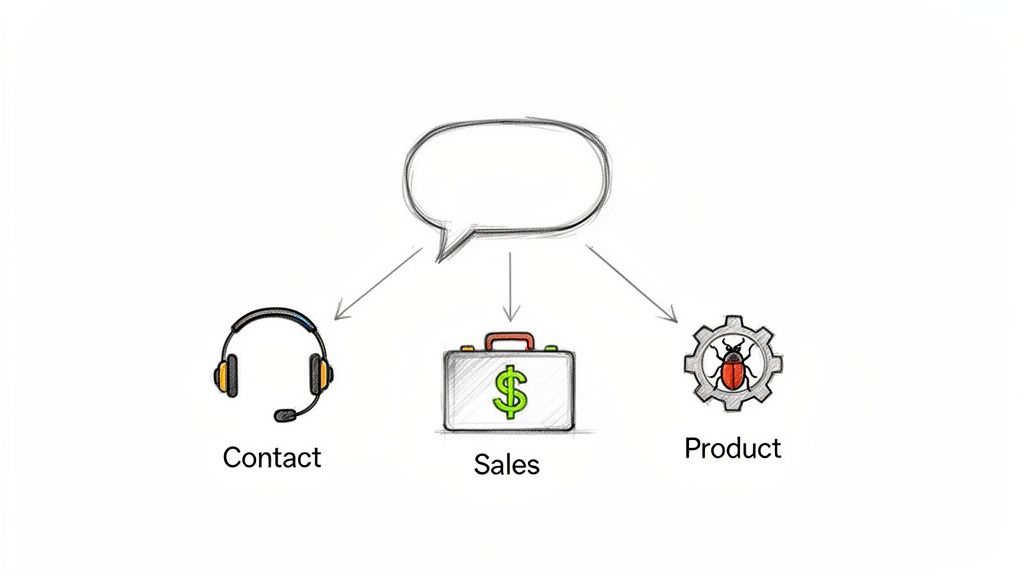
For contact centers, this software is a game-changer for quality assurance (QA). The old-school method was to have managers listen in on a tiny, random sample of calls—maybe just 1-2%—hoping to stumble upon a coachable moment. It was slow, riddled with bias, and missed almost everything that was actually happening.
Conversation analytics flips that model on its head by analyzing 100% of calls automatically. It can instantly:
This means every agent gets fair, data-driven feedback on every call, not just the lucky few a manager had time for. The result is quicker ramp-up times for new hires, better first-call resolution rates, and a massive drop in compliance risk.
By analyzing every interaction, conversation analytics shifts quality assurance from a reactive spot-check to a proactive, continuous improvement engine. It ensures consistency and excellence across the entire team.
Every sales manager asks the same question: "What are my top performers doing that everyone else isn't?" Conversation analytics finally gives you the answer, creating a data-backed playbook for success. It listens to the best reps and deconstructs what they say and do to close deals.
Managers can dive into conversations to find patterns in how their stars:
This turns sales coaching from gut-feel advice into a repeatable science. Instead of saying, "Just be more confident," a manager can point to a transcript and say, "See how Sarah confirms the value before she talks about budget? Let's work on that." This is how you replicate winning habits across the entire team and lift everyone's performance.
For product and marketing folks, this is like having a direct line into the customer’s brain. Surveys and focus groups have their place, but they capture planned, often filtered feedback. Real conversations are where you find the raw, unsolicited truth.
Product managers can sift through thousands of support calls and sales demos to automatically tag and count every mention of:
This creates a powerful, always-on feedback loop. Instead of relying on a few anecdotes from the sales team, product leaders get hard data on what customers want. It allows them to build a roadmap that solves real problems and prioritize features that will actually make a difference in the market.
Choosing the right conversation analytics software can feel overwhelming. Every vendor promises the moon, but finding a platform that actually delivers requires a clear-eyed look at what truly matters for your business. This isn't just about ticking boxes on a feature list; it's about finding a strategic partner that fits your workflow, meets your compliance needs, and can grow with you.
The buzz around this technology isn't just hype. The conversational AI market, which is the engine behind analytics, was valued at USD 14.79 billion in 2025 and is expected to rocket to USD 82.46 billion by 2034. That's a staggering 21.00% compound annual growth rate. This incredible momentum, detailed in this market analysis, shows how vital it is to pick a platform built for the long haul.
Let’s be blunt: the entire value of any conversation analytics platform hinges on its transcription quality. If the core Speech-to-Text (STT) engine is inaccurate, then every single insight derived from it—sentiment scores, topic trends, you name it—is built on a foundation of sand. It's the classic "garbage in, garbage out" problem.
You need a provider that can prove its accuracy, especially in the messy real world of industry jargon, thick accents, and noisy call center floors. Just as important is latency, which is the delay between when something is said and when it's processed. For real-time use cases like live agent coaching or instant fraud alerts, even a few seconds of delay can make the feature useless.
If your business operates globally, your customers aren't all speaking the same language. Your analytics software needs to keep up. Take a hard look at the platform’s multilingual capabilities.
Does it just cover the basics, or can it accurately handle regional dialects and local accents? True global support is essential for getting a complete picture of your customer interactions and ensuring quality standards are consistent everywhere you operate.
Customer conversations are packed with sensitive data. This makes privacy and compliance non-negotiable pillars of your evaluation. A single data breach can lead to massive fines and, even worse, shatter the trust you've built with your customers.
Make sure any vendor you consider can demonstrate rock-solid adherence to the regulations that matter to you.
Insist on features like the automatic redaction of personally identifiable information (PII) from both transcripts and audio recordings. This isn't just a nice-to-have; it's a critical safety net for you and your customers.
Pricing is often where things get confusing. Models vary wildly, and a low initial price can quickly balloon as your usage grows. The trick is to find a model that aligns with how you'll actually use the software.
Always ask for a clear breakdown of what's included. Hidden fees for things like data storage, API calls, or priority support can turn a great deal sour.
No tool is an island. The real magic happens when you pipe conversation insights directly into the systems your teams already use every day. For that, you need a robust, well-documented API.
Can the platform easily connect to your CRM, your helpdesk software, or your business intelligence tools? A seamless integration means the data doesn't just live in a separate dashboard; it actively enriches customer profiles, automates support tickets, and informs strategic decisions across the entire company.
To help you stay organized during your evaluation, we've put together a simple checklist. Use this to compare potential vendors side-by-side and ensure you're asking the right questions.
| Evaluation Criterion | What to Look For | Why It Matters |
|---|---|---|
| Transcription Accuracy | Word Error Rate (WER) below 10-15% for your specific use case (e.g., industry terms, accents). Ask for a proof-of-concept. | Inaccurate transcripts lead to flawed analytics. All other features depend on this foundation. |
| Latency | Sub-second processing for real-time applications. Clarity on batch processing turnaround times. | Low latency is non-negotiable for live coaching, alerts, and real-time agent assists. |
| Language Support | Broad coverage of languages, dialects, and accents relevant to your customer base. | You can't analyze what you can't understand. Essential for global operations and diverse customer bases. |
| Core AI Features | High-quality speaker diarization, sentiment analysis, topic detection, and summarization. | These are the core engines that turn raw conversation into actionable business intelligence. |
| Privacy & Compliance | Certifications (GDPR, HIPAA, CCPA, SOC 2). Features like PII redaction and data residency options. | A single compliance failure can result in huge fines and irreparable damage to your brand's reputation. |
| Pricing Model | Transparent, predictable costs. Models that align with your usage (per-minute vs. per-seat). No hidden fees. | A confusing or misaligned pricing model can quickly erase your ROI and create budget problems. |
| API & Integrations | Well-documented REST APIs, webhooks, and pre-built connectors for key platforms (CRM, BI tools). | The software's value multiplies when it's integrated into your existing workflows, not isolated in a silo. |
Ultimately, the best platform is the one that not only has the strongest technical capabilities but also functions as a reliable partner. Due diligence upfront will save you headaches and ensure you get the maximum return on your investment.
Picking the right conversation analytics software is a great start, but the real magic happens when you weave it into your daily workflow. It's often more straightforward than you’d think. Let's break down the technical side into a few clear steps so your team knows exactly what to expect.
First things first: you need to set up solid data pipelines. Think of these as the plumbing that carries your raw audio—call recordings, Zoom meetings, you name it—from where it lives now into your new analytics platform. This initial step is the bedrock for everything else.
The evaluation process itself lays the groundwork for a smooth implementation. You're not just buying software; you're building a system that relies on accuracy, security, and clean integrations.
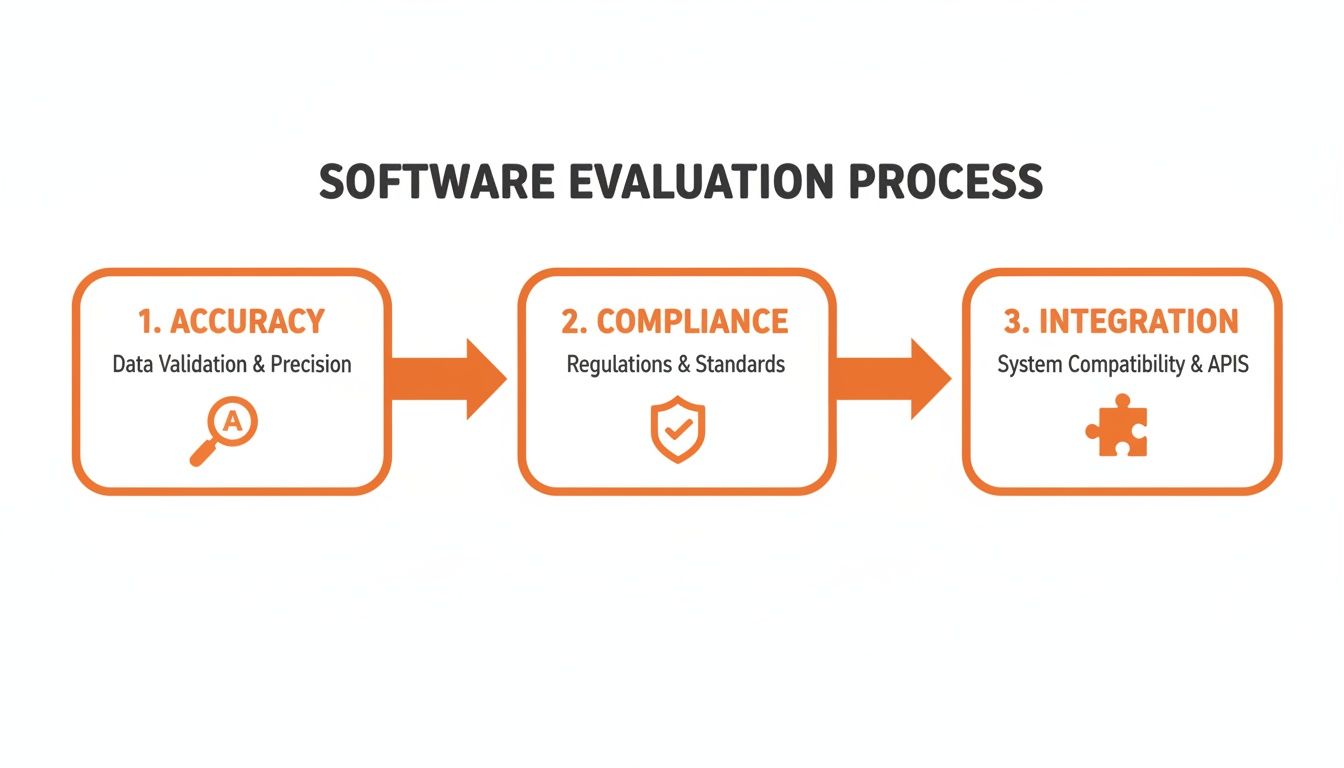
As this shows, a successful project hangs on getting accurate data, handling it securely, and making sure it connects effortlessly with the tools you already use.
One of the first big decisions you'll make is whether you need real-time or batch processing. They serve very different needs, and the right answer really depends on what you're trying to achieve.
Honestly, most companies end up using a mix of both. They use real-time for in-the-moment actions and batch analysis to inform their bigger strategic moves.
The core difference comes down to intent. Real-time is about reacting in the moment. Batch is about reflecting on patterns to get better over time.
It helps to understand how the data actually moves through the system. Once you see the flow, the whole process becomes much less of a black box. It’s really just a logical chain of events, where each piece of the puzzle turns raw audio into something you can actually use. This is all stitched together with APIs connecting specialized services.
Here’s a simple look at a typical setup:
This API-first design is what makes modern conversation analytics so powerful and adaptable. The demand for these kinds of integrated systems is exploding. Projections show the conversation intelligence software market rocketing from USD 21.92 billion in 2025 to a staggering USD 92.54 billion by 2035. You can dig into these industry growth forecasts yourself. That kind of growth sends a clear signal: turning conversations into data is no longer a nice-to-have, and a well-planned integration is your ticket to getting the most out of it.
Let's be honest: buying new software is the easy part. The real challenge is proving it was worth the investment. With conversation analytics, this isn't about fuzzy feelings or vague improvements. It's about tracking hard numbers that directly connect the dots between your customer conversations and your bottom line.
This is how you move from thinking your team is getting better to knowing it for a fact. Forget vanity dashboards; we're talking about key performance indicators (KPIs) that translate raw conversation data into real business value. Without this, your fancy new platform is just a very expensive tape recorder.
To get buy-in from leadership and justify the spend, you need to focus on metrics that tell a clear financial or operational story. Here’s where the rubber meets the road.
Getting long-term value from conversation analytics is about more than just watching numbers on a screen. It requires a commitment to turning insights into action.
The technology gives you the data, but your process is what drives the results. The best companies create a continuous feedback loop: insights from the software are used to coach agents, refine sales scripts, and make the business smarter.
To make sure this actually happens, don't try to boil the ocean. Start small. Pick one specific, high-impact problem—like figuring out the top three reasons customers churn—and nail it. A quick win builds momentum and proves the concept.
Always keep data privacy top-of-mind; customer trust is everything. And remember to continuously teach the system your company’s unique lingo and product names to keep improving its accuracy. This cycle of analysis, action, and refinement is what transforms conversation analytics from just another tool into a true engine for business growth.
Jumping into conversation analytics can feel a bit overwhelming, so let's clear up a few common questions. This should give you a better feel for how this technology works and what it can do for your business.
It's easy to see why people use these terms interchangeably, but they serve two distinct purposes.
Think of conversation analytics as the raw detective work. It listens to a call and tells you what happened—which keywords were used, what topics came up, and what the general sentiment was. It's the fact-finding mission.
Conversation intelligence, on the other hand, is the strategic advice that comes after the facts are gathered. It tells you what to do next. It might flag a deal at risk, suggest a coaching moment for a new sales rep, or identify a trend in customer complaints. Analytics uncovers the data; intelligence makes it actionable.
Analytics gives you the "what." Intelligence gives you the "so what." One finds the patterns, the other tells you how to use them to get better.
This is the million-dollar question. In a perfect world with crystal-clear audio, top-tier platforms can hit 85–95% accuracy. But reality is often messy. Things like background noise, heavy accents, spotty connections, and your own company's jargon can all lower that number.
The best systems have a few tricks up their sleeve to stay accurate:
My advice? Always run a trial. Test any software with your own call recordings to see how it performs in your specific environment before you make a decision.
Yes, but this is definitely not a one-size-fits-all feature. Most modern tools do a great job with major languages like English, Spanish, and French. The real test comes when you need support for less common languages or specific regional dialects.
If you're running a global team, you need to dig deeper. Don't just look for a checkmark on a feature list. Ask for a platform's accuracy scores for the specific languages you operate in. You need to know you're getting reliable insights in every market, not just your primary one.
Ready to turn your conversations into actionable insights with industry-leading accuracy? Lemonfox.ai offers a powerful and affordable Speech-to-Text API that supports over 100 languages. Start your free trial today and discover what your customers are really telling you.