
First month for free!
Get started
Published 2/2/2026
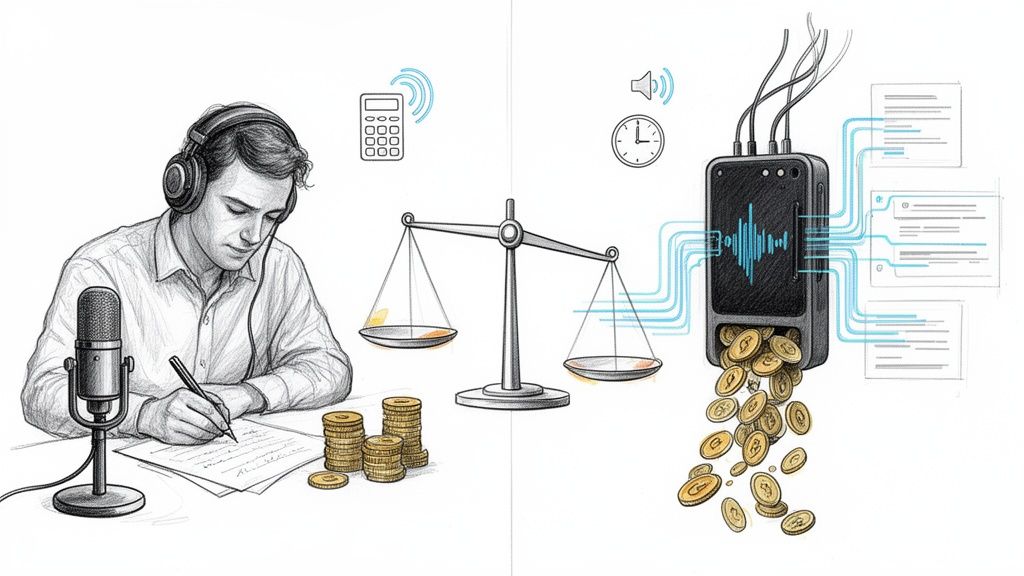
Let's get straight to the point: transcription costs can be all over the map. You might pay as little as $0.20 per audio hour for a quick AI service or upwards of $150 per hour for a highly specialized human transcriber.
The final bill really boils down to one key question: do you need the nuanced, near-perfect accuracy only a human can provide, or is the speed and scale of an automated system a better fit? Nailing down that answer is the first step to making a smart choice for your project and your budget.
Trying to figure out transcription pricing can feel like comparing apples and oranges. On one side, you have human-powered services—think of them as skilled artisans carefully crafting a perfect document. On the other, you have AI-driven platforms, which are more like a high-speed factory churning out text at an incredible scale.
Neither one is flat-out "better." They just serve different purposes and, as you'd expect, have completely different price tags.
A human transcriptionist's real value is their ability to grasp context, decipher tricky audio with heavy accents or background noise, and deliver a transcript that’s virtually flawless. This kind of precision is non-negotiable for legal depositions, critical medical records, or in-depth research where every single word counts. That intensive, manual work is reflected in the price, which is almost always billed by the audio minute.
In contrast, AI transcription is the star player when you need speed, volume, and affordability. For turning straightforward meetings or interviews into text, or just making a huge audio archive searchable, automated services are a game-changer. These platforms have opened the door to projects that would have been way too expensive to even consider just a few years back.
Before we get into the nitty-gritty, it helps to know what actually moves the needle on your final bill. It’s not just a simple choice between a person and a program. Several key variables will always come into play:
To give you a quick lay of the land, here’s a simple table breaking down what you can generally expect from both types of services.
This table provides a high-level look at the costs and best-fit scenarios for human and AI transcription, helping you quickly identify which path makes the most sense for your needs.
| Service Type | Typical Cost Per Audio Hour | Best Use Case |
|---|---|---|
| Human-Powered | $60 - $150+ | Legal depositions, medical dictation, complex multi-speaker interviews, qualitative research |
| AI-Powered | $0.20 - $15 | Meeting notes, content creation, podcasts, academic lectures, general business use |
Ultimately, this gives you a starting point. Your specific audio and project requirements will determine the final cost, but knowing these general ranges helps you set a realistic budget from the get-go.
To get a real handle on the cost for transcription services, you need to understand that you're dealing with two completely different approaches. Think of it as the difference between commissioning a custom piece of furniture from a master craftsman and buying a high-quality, flat-pack piece from a modern factory. Both get the job done, but the process, price, and final product are worlds apart.
Human transcription is the artisan approach. It's meticulous, precise, and priced for the expert skill involved. AI transcription, on the other hand, is the factory—built for speed, scale, and incredible efficiency, which is reflected in its much lower cost.
When you hire a human to transcribe your audio, you’re paying for their trained ear, their ability to navigate tricky accents, and their grasp of context and nuance. The pricing model here is tried-and-true, having been the industry standard for decades.
Typically, human services charge by the minute of audio. You can expect to see rates anywhere from $1.00 to over $2.50 per minute. Do the math, and that works out to $60 to $150+ per hour of recorded audio. The final price tag will wobble depending on things like poor audio quality or a tight deadline, which we'll get into later.
For specialized work, like legal or medical transcription, you’ll always be on the higher end of that scale. Getting a court-admissible transcript right requires a certified professional who can guarantee near-perfect accuracy, and that expertise comes at a premium.
This model is wonderfully predictable for one-off projects. You have a 30-minute audio file, the rate is $1.50 per minute, so you know your cost is $45. Simple. The entire value proposition is built on trust and reliability.
This is where everything gets turned on its head. AI-powered services didn't just lower the price; they completely changed the economic model. Instead of charging for an expert's time, they operate on a high-volume, low-margin model that makes transcription accessible for projects that would have been financially impossible just a few years ago.
The infographic below really nails the core difference between the two and what pushes the final cost up or down.
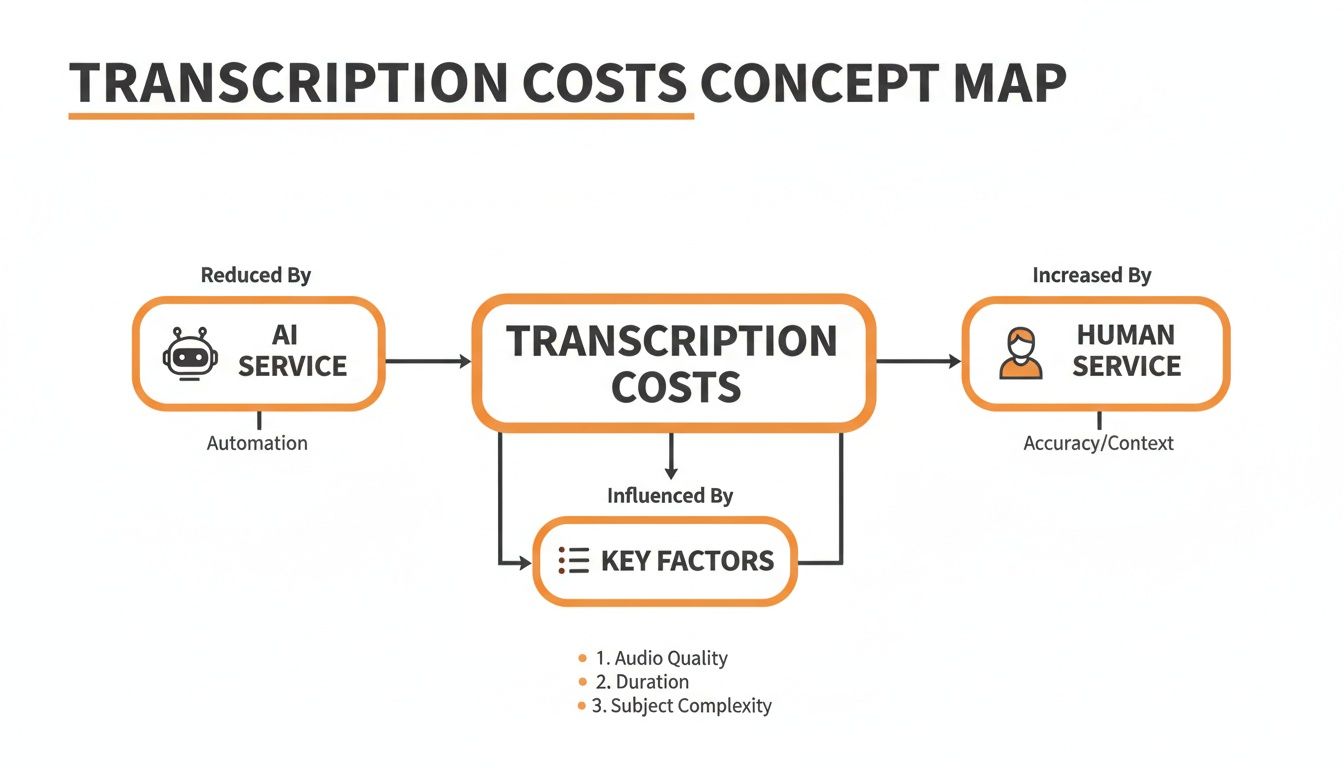
As you can see, AI fundamentally drives costs down while human involvement drives them up, with factors like audio quality and turnaround time affecting both.
The pricing for AI services is way more granular. Many platforms, especially those built for developers like Lemonfox.ai, have ditched per-minute billing entirely and moved to a per-second model. This is a bigger deal than it sounds for a few reasons:
This incredible efficiency is how some AI services can offer rates under $0.20 per audio hour. That's not just a discount; it's a completely different reality compared to the world of human transcription.
So, how do you choose? It all comes down to your project. Do you need the certified, courtroom-ready accuracy that only a human expert can provide? Or do you need the raw speed, scale, and jaw-dropping affordability of an AI system? Answering that question is your first step to finding the right service at the right price.
Figuring out the cost for transcription services is a bit like planning a road trip. The price you see for the car rental is just the start. The final cost really depends on how far you're going, how fast you need to get there, and what kind of roads you'll be on. It's the same with transcription—that per-minute rate is just your starting point. Several key factors can, and often do, push your final bill much higher.
If you can get a handle on these cost drivers, you're in a much better position to manage your budget. You can see the costs coming, make a few smart tweaks to your audio, and dodge any nasty surprises when the invoice lands. So, let's break down the five things that have the biggest impact on what you'll pay.
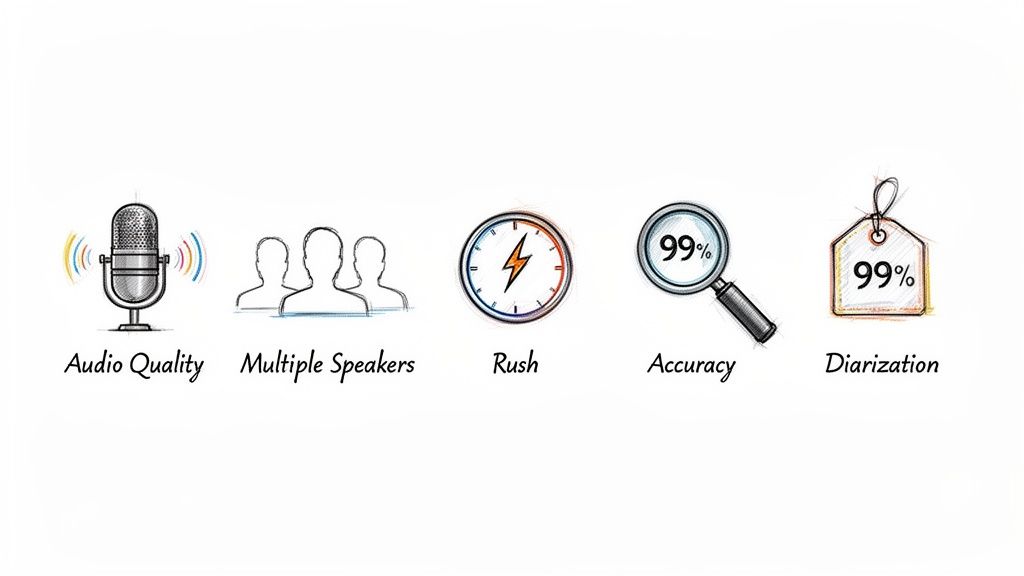
This one is the big kahuna. Honestly, it's the single most important factor. Think of it like trying to have a conversation. A clear, one-on-one chat in a quiet room? Simple. Trying to understand what someone's saying at a loud concert with music blaring everywhere? Nearly impossible.
When audio quality is poor, it creates a ton of extra work, whether for a human ear or an AI algorithm. That extra effort costs money.
Here's what messes up audio quality and hikes up the price:
A crisp, clean recording of one person speaking is the gold standard for keeping costs low. On the flip side, a chaotic recording of a ten-person focus group in a noisy room is a worst-case scenario that will always command a premium.
The complexity of a recording grows exponentially with every person you add to the conversation. A simple monologue is a walk in the park. A panel discussion with five different people is a whole different ballgame. That’s why you’ll often see a surcharge for audio with multiple speakers, for both human and AI services.
The extra work comes from something called speaker diarization—the technical term for figuring out who is speaking and when. It involves telling one voice from another, which adds a serious layer of complexity to the whole process.
So, a solo podcast episode will always be cheaper to transcribe than a roundtable debate of the same length. The more voices in the mix, the more you should expect your bill to climb.
How fast do you need it? This question puts you at a classic crossroads: speed vs. price. If you need a transcript back in a couple of hours, you're asking for a rush job, and that priority service comes at a premium.
It’s just like paying for express shipping. A faster transcription turnaround means the provider has to drop other things and prioritize your file. This expedited service always comes with an added fee, sometimes bumping up the base cost by 25% to 100%.
If you can wait, the standard turnaround times (often 24 to 48 hours for human services) are your most budget-friendly option. If your project isn't time-sensitive, just choosing a standard delivery window is one of the easiest ways to keep your costs in check. Of course, this is where AI shines, often delivering transcripts in minutes, which is a huge part of its appeal.
Everyone wants an accurate transcript, but the jump from "mostly right" to "perfect" is where the costs can really add up. A standard AI transcript might get you 95% accuracy, which is perfectly fine for your internal meeting notes or rough content drafts.
But if you need 99% or higher accuracy for something like legal evidence or medical documentation, that requires a human to meticulously review and proofread the text. That final polish—catching tricky terminology, fixing grammar, and correcting speaker labels—is labor-intensive, and you'll pay for that expertise. For legal work, transcribers often need special certifications, and that skill is definitely reflected in their rates.
Finally, anything you ask for beyond a simple block of text will likely add to your bill. These bells and whistles can make your transcript much more useful, but they all require extra processing or manual work.
Common add-ons that influence the cost for transcription services include:
By keeping these five factors in mind, you can get a much better feel for what your project might cost. It gives you the foresight to estimate your budget more accurately and make smart choices to get the most value out of whichever transcription service you choose.
Theory is great, but let's see how these pricing models and cost drivers actually play out in the real world. The final price you pay is never just a simple per-minute rate; it’s a direct reflection of your project's unique demands.
We'll walk through three common scenarios to show you how different needs can dramatically change the final bill. These examples should help you get a much clearer picture of what your own project might cost.
Let's start with Alex, who runs a weekly tech podcast. Each episode is about 60 minutes long and features a straightforward interview with one guest. Alex needs the transcripts to create blog posts, which is a fantastic way to boost SEO and make the content more accessible.
Alex produces four episodes a month, which adds up to 240 minutes of audio. The sound quality is top-notch—they use good mics in a quiet space. Speed isn't a life-or-death matter, so a 24-hour turnaround works just fine.
How would the costs stack up?
The difference is staggering. For a podcaster with clean audio and standard needs, switching from a human service to an AI API can slash transcription costs by over 99%. That’s a game-changer, freeing up hundreds of dollars for marketing, new gear, or other growth efforts.
Next up is Sarah, a developer building a new productivity app. She wants to add a cool feature that transcribes users' voice notes on the fly. This means she needs an API that’s not just fast and scalable but also affordable enough to offer the feature to thousands of people.
Her main challenge isn't a one-off project but handling a constant, high volume of short audio clips with almost zero delay. Plus, the audio quality will be all over the place, depending on where her users are recording.
Let's say her app processes around 5,000 minutes of voice notes every month.
A human service is a non-starter here. It’s too slow for real-time needs, and the cost would be astronomical. The only path forward is a developer-focused API. With its per-second billing, the cost scales perfectly as her app grows. For 5,000 minutes (about 83.3 hours), an AI service priced around $0.17 per hour would cost her roughly $14.16 a month.
This is a perfect example of how affordable AI opens the door to new innovation. The incredibly low, scalable cost makes it possible for Sarah to build transcription right into her product without having to pass a huge cost on to her users.
Finally, imagine a law firm in the middle of a high-stakes corporate lawsuit. They need a two-hour court deposition transcribed to be used as evidence. The recording is a mess—there’s background noise, multiple people are talking over each other, and it’s filled with dense legal jargon.
In this situation, accuracy is everything. A single mistake could have serious consequences, so the transcript must be verbatim, certified, and 100% reliable for use in court.
This is a classic case where the cheapest option is absolutely the wrong option.
Here, that $540 isn't just an expense; it's a critical investment in the integrity of their case. It proves that when the stakes are high, the value of guaranteed, professional accuracy is well worth the premium price.
Shelling out for transcripts doesn't have to break the bank, and cutting costs shouldn't mean you're stuck with a shoddy result. Honestly, some of the smartest ways to manage the cost for transcription services are about working smarter, not just cheaper. A few tweaks to your process can deliver fantastic transcripts while keeping your budget happy.
The secret is focusing on what you can control before the transcription even starts. By improving your audio at the source and being strategic about your workflow, you can slash the time and effort needed to get a great transcript. That translates directly to savings, whether you’re using a human or an AI.
If there's one thing you can do to dramatically lower your transcription bill, it’s this: record better audio. Clean, crisp sound is incredibly easy for both people and algorithms to process. Think of it as paving a smooth road for your transcriber instead of sending them on a bumpy, off-road detour.
Here are a few simple but powerful ways to do just that:
These steps might seem basic, but they tackle the biggest culprits that drive up transcription prices.
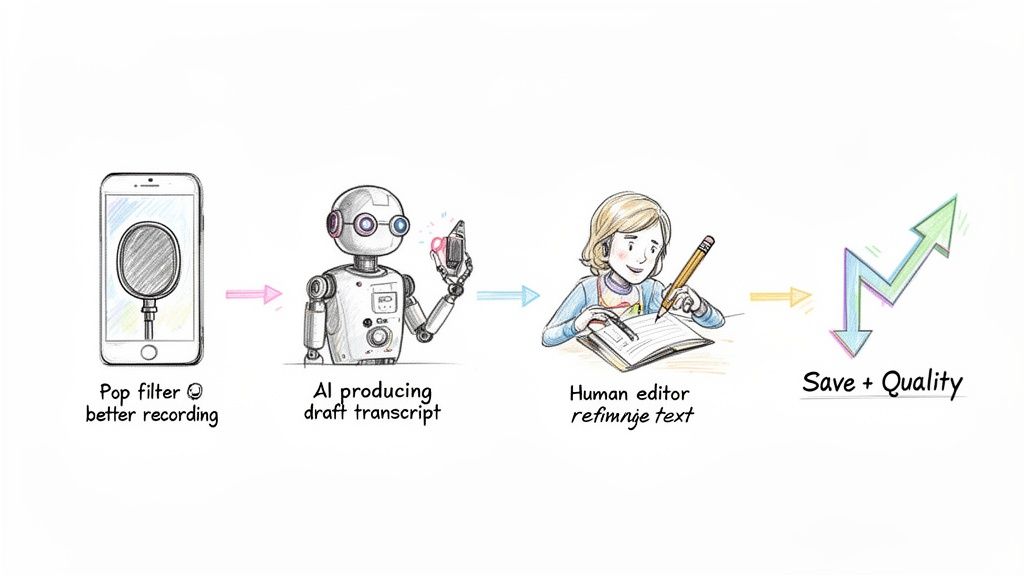
You don’t have to get locked into a choice between the high precision of a human and the blazing speed of an AI. A hybrid approach often hits the sweet spot, giving you an ideal mix of quality, speed, and affordability. It lets you get a solid first draft in your hands almost instantly, then use a human touch only where it counts.
The workflow is surprisingly simple and incredibly effective:
This two-step process is a powerful cost-saving strategy. You’re letting the AI do all the heavy lifting and saving your human expert for the final, critical polish. This dramatically reduces your overall cost without compromising the final quality.
At the end of the day, the most cost-effective solution is the one that’s right for the job. Overpaying for features you don't need is just as wasteful as picking a tool that can't deliver the quality you require.
Think carefully about what you’ll be using the transcript for. If it’s for internal meeting notes or just creating a searchable archive, a pure AI tool like Lemonfox.ai is often the perfect fit. Its speed and low price are unbeatable for high-volume work where "good enough" is all you need.
But if you’re transcribing a legal deposition or creating content for your customers, every single word has to be perfect. In those cases, paying for a human-verified transcript is a non-negotiable investment. By understanding this distinction, you can put your budget where it matters most—paying for precision only when you absolutely need it and saving money everywhere else.
You've got the numbers down and understand the pricing models. But picking a transcription partner is about more than just finding the lowest price—it's about trust. A cheap service that mishandles your data or can't meet a deadline isn't a bargain; it's a liability.
The real decision comes down to finding a service that fits your needs for security, reliability, and how you actually work. So, before you sign up, it’s time to peek behind the curtain.
Start with their data privacy and security policies. This isn't just fine print; for anyone handling sensitive information, it's the most important part. You need to know they have ironclad protocols for protecting your data, especially if you're navigating strict compliance rules like HIPAA or GDPR.
To get past the marketing fluff, you need to ask a few pointed questions. Think of this as your final vetting checklist to make sure a service is the right fit long-term, not just a good deal today.
How do you handle my data? Don't settle for vague promises. Ask about specifics like end-to-end encryption, SOC 2 compliance, and their policy on deleting files after transcription. If they can't give you a straight answer, walk away.
Can I try it for free? The only way to know if a service is truly accurate is to test it with your own audio. A company that stands by its quality will be more than happy to offer a free trial.
How good is your API? If you're a developer, this is everything. A clunky, poorly documented API can turn a simple integration into a massive headache. Look for clear documentation and a straightforward setup.
At the end of the day, you're looking for that sweet spot where affordability, security, and performance meet. The goal isn't just to find a tool that fits the budget, but one that genuinely makes your workflow smoother and keeps your data safe.
The best transcription service isn't the cheapest one. It's the one that delivers the most value for what you need. That means balancing the cost for transcription services with the peace of mind that comes from solid security, dependable accuracy, and an experience that just works.
By weighing these factors, you can find a partner that does more than just transcribe your audio—it supports your goals and makes your investment a smart one.
When you're trying to figure out your budget, the details of transcription pricing can feel a little fuzzy. Let's clear the air and tackle some of the most common questions people have about transcription costs and what to expect.
The billing model really boils down to one simple question: is a human or a machine doing the work?
Human transcription services almost always charge by the audio minute or audio hour. It’s a clean, predictable model. If a service charges $1.50 per minute, you know your 30-minute audio file will cost you exactly $45. No surprises.
AI services, on the other hand, especially APIs built for developers, get way more granular. They often bill by the second of audio. This means you're not paying for a rounded-up minute; you're paying for the precise length of your file. For anyone transcribing a massive amount of audio, those saved seconds add up to serious cost savings.
For most professions, absolutely. A high-quality AI can hit 95% accuracy or better on clear audio, which is more than enough for a ton of professional use cases.
It’s a perfect fit for things like:
But, and this is a big "but," if you're in a field like law or medicine where a single mistake can have major consequences, you'll still want a human-verified transcript. For those situations, 100% accuracy isn't just a goal; it's a requirement.
If your main goal is to keep costs low, an automated AI platform is your best bet. By cutting out the manual labor, these tools bring the price down to a level that human services just can't match.
For companies or developers with a constant stream of audio to process, an API is the undisputed king of cost-efficiency. With per-second billing, you can churn through thousands of hours for a tiny fraction of the traditional cost, making huge transcription projects finally affordable.
This direct-access approach gives you the raw power of transcription AI at an incredibly low price, delivering the best bang for your buck on most general transcription jobs.
Ready to see just how affordable AI transcription can be? The Lemonfox.ai Speech-to-Text API offers incredibly accurate transcription for under $0.17 per hour. Start your free trial and get 30 hours of transcription on us today.