
First month for free!
Get started
Published 1/13/2026
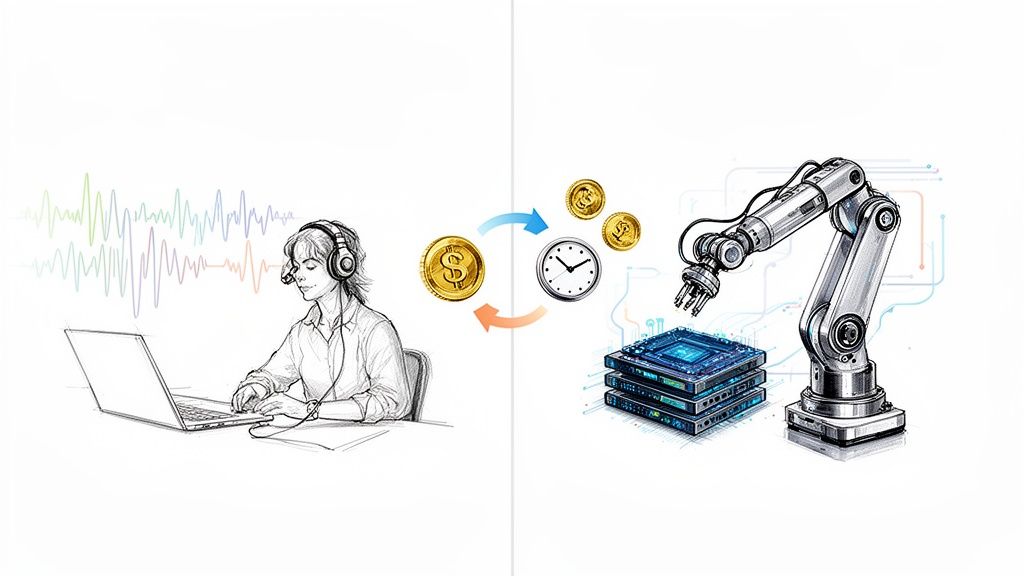
The real cost of turning your audio into text can be a tricky thing to pin down. It can swing wildly from over $60 per hour for specialized human services to less than $0.20 per hour with a modern AI. The right choice for you really boils down to what you need: accuracy, speed, or a tight budget.
Think of it like choosing how to get across town. A human transcriber is your personal taxi service—meticulous, able to navigate tricky routes like heavy accents or noisy backgrounds, and offering a premium, hands-on experience. On the other hand, an AI service is like a city's public transit system—incredibly fast, massive in scale, and costs just a fraction of the price.
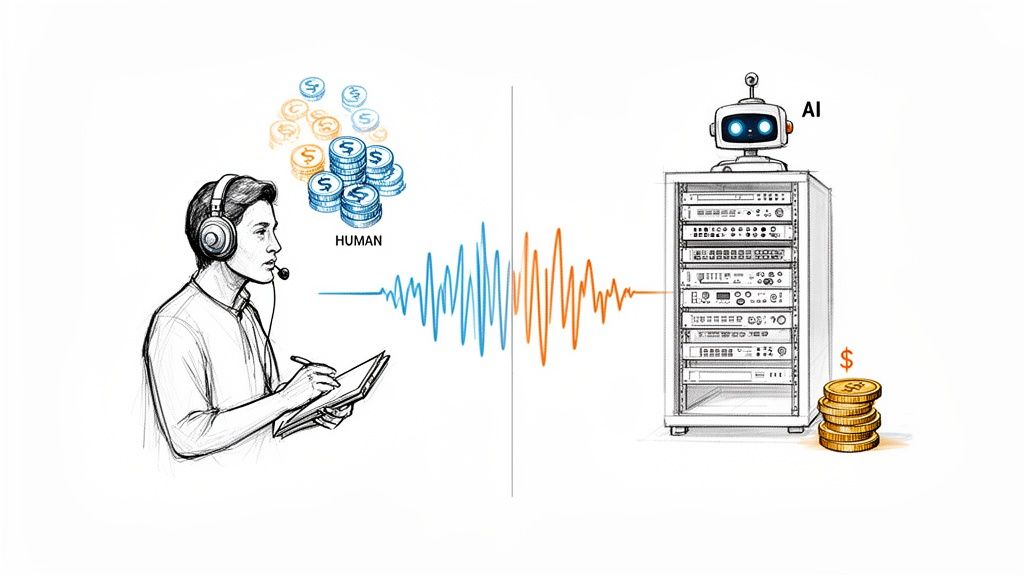
Getting a handle on this basic difference is the first step to managing your transcription budget. The final price tag isn't just about how many minutes of audio you have; it’s a direct reflection of the method you choose and how complex the job really is.
This guide is here to help you navigate all the things that influence your final price. We'll show you when it makes sense to pay for human expertise and when you can get incredible value from AI's efficiency.
We're going to break down:
The demand for transcription is booming. The global market was valued at around USD 3,042 million in 2024 and is expected to hit USD 7,866 million by 2032, according to recent transcription market growth data.
While traditional services often charge $1-2 per audio minute, the game is changing. The rise of powerful AI APIs like Lemonfox.ai, which can transcribe for less than $0.17 per hour, is completely rewriting the economic rulebook for businesses and developers.
It's not just about what it costs—it's about the value you get. The cheapest option probably isn't the right fit for a legal deposition, but a premium human service is definitely overkill for analyzing customer feedback calls.
By understanding the cost drivers and the technology available, you can make a smart choice that lines up perfectly with your project's goals and budget. You'll never have to worry about overpaying to turn speech into text again.
When you're looking at transcription, the very first and most important decision you'll make is choosing between a human professional and an AI service. This choice single-handedly dictates your budget. Think of it as the difference between commissioning a hand-carved piece of furniture and buying a high-quality, factory-made one. Both are useful, but they're built on completely different models of cost and effort.
Hiring a human transcriber is all about paying for expertise and meticulous care. You're investing in a person's ability to navigate the tricky parts of human speech—deciphering thick accents, understanding industry-specific jargon, or untangling a conversation where everyone is talking at once. Machines stumble here, but a skilled person can nail it. Naturally, this level of detailed work takes time and commands a premium price.
AI transcription, on the other hand, is built for pure efficiency. It throws massive computing power at the problem, converting spoken words into text in a fraction of the time it would take a human. This is where you get incredible speed and scalability. You're not paying for hours of someone's focused labor; you're paying for a few moments of a powerful algorithm's work.
The way these services are priced really tells the story. A human transcriber will typically charge you by the minute of audio they work on. An AI service usually charges you for the exact amount of processing time you use, often down to the second.
Here’s a practical look at what that means for your wallet:
Getting a handle on these cost and quality differences is everything. It's a perfect example of the new equation balancing human touch and AI precision we're seeing everywhere. The right choice really just depends on your project. If you need flawless accuracy for a legal proceeding, human expertise might be worth it. But if you're processing hundreds of hours of audio for data analysis, AI is the only practical way to go.
It's no secret that AI is taking over, largely because we're creating more audio and video content than ever and need to make sense of it all. The AI transcription market was valued at USD 4.5 billion in 2024 and is expected to rocket to USD 19.2 billion by 2034. Why the massive growth? Because AI offers speed and savings that human services just can't compete with on a large scale, as outlined in recent AI transcription market analysis.
While manual transcription can easily run $20-50 per hour of audio, AI alternatives have crushed that cost down to almost nothing. This is a game-changer, letting organizations transcribe huge volumes of audio that would have been financially out of reach just a few years ago.
For the vast majority of business tasks today—like getting notes from a team meeting, analyzing customer support calls, or creating captions for video content—AI delivers a fantastic blend of speed, affordability, and surprisingly good accuracy. It’s become the go-to choice for anyone needing to get the job done well without breaking the bank.
So, you know the basic difference between human and AI pricing. But what about the less obvious details that can quietly inflate your final invoice? Think of it like this: the base price is just the starting point. Several other factors can add significant costs if you're not prepared.
The biggest one, without a doubt, is poor audio quality. If your recording is a mess of background noise, echoes, or muffled voices, you're going to pay for it. A human transcriber has to stop, rewind, and listen over and over again to decipher what's being said. That extra time means extra money, often in the form of a surcharge that can be as high as 20-50%. Even the best AI models will stumble on messy audio, which means you'll spend more time on cleanup.
This chart drives home just how massive the cost difference is between the two main options.
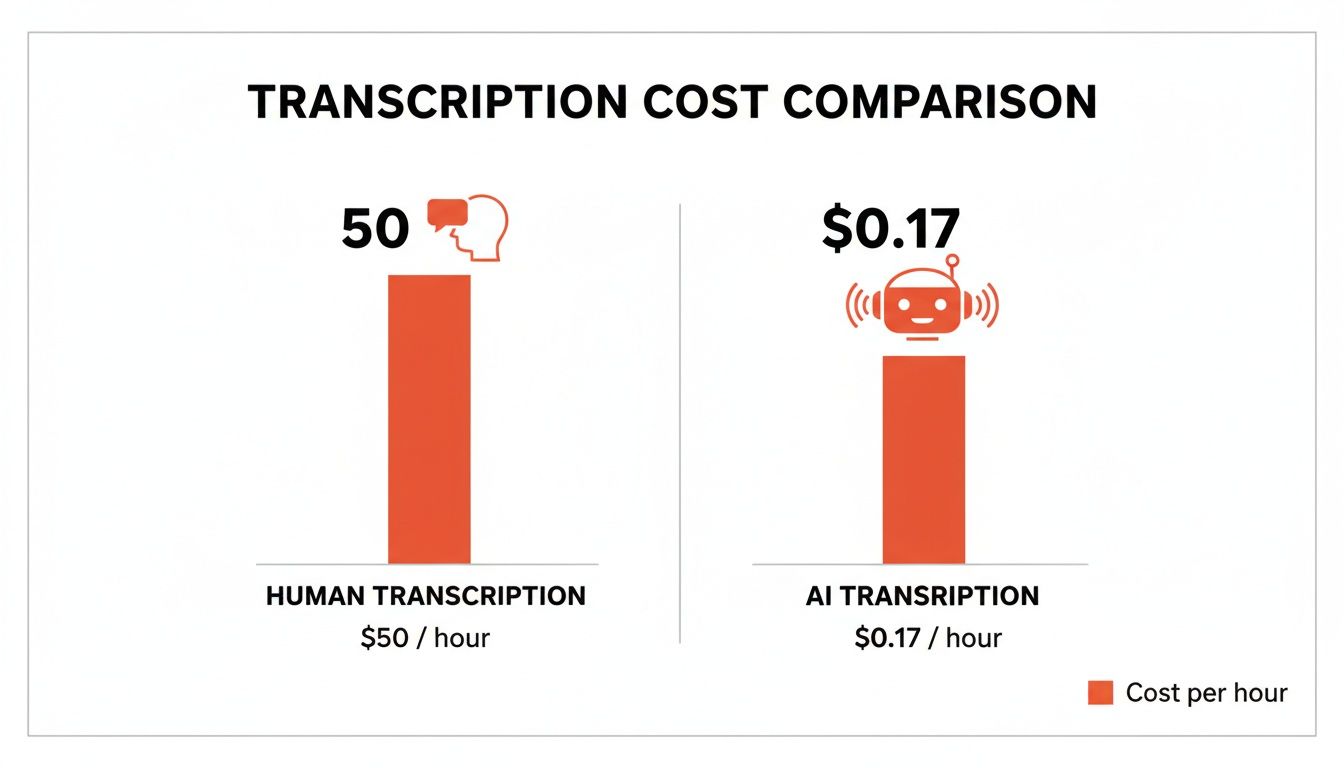
That gap is exactly why so many businesses now lean on AI, especially when dealing with a lot of audio. The savings are just too big to ignore.
Your turnaround time is another huge factor. Need that transcript back by the end of the day? With a human service, you’re looking at a rush fee, which can easily double the per-minute rate. You're essentially paying to jump to the front of the line. This is one area where AI has a massive advantage—the concept of a "rush job" doesn't really exist. The machine is always ready and processes audio in minutes, not hours.
The number of speakers in your recording also complicates things. Separating and labeling who said what (a process called diarization) is tricky.
The rule of thumb is simple: complexity costs money. Every layer of difficulty—bad audio, a tight deadline, or a crowded conversation—adds friction and gets passed on to you in the final quote.
Finally, what’s in the audio matters. If your recording is packed with specialized legal terms, dense medical language, or heavy accents, you'll need a human with that specific expertise. And specialist skills always command a higher price.
You also have to decide what kind of transcript you need. A standard transcript gives you a clean, readable version of the conversation. But a verbatim transcript captures everything—every "um," "ah," false start, and awkward pause. Creating one is incredibly time-consuming and, you guessed it, more expensive. For most people, a clean transcript is perfectly fine and a much smarter use of your budget.
Figuring out what you'll actually spend on transcription shouldn't feel like a guessing game. Thankfully, you can get a solid estimate with a straightforward formula and avoid any last-minute budget surprises.
It all boils down to this simple calculation: (Total Audio Length) x (Rate Per Unit) = Total Cost.
The trick is knowing what "unit" you're being charged for. Human services almost always bill by the minute. On the other hand, an automated API often bills by the hour or even by the second. This small difference is where you'll see a massive gap in the final cost.
Let's walk through a couple of real-world examples.
Imagine you need a transcript for a one-hour company webinar. The audio is clean, and there's only one speaker. That's a simple, predictable job.
Now, picture a much bigger task: transcribing an entire month of customer support calls, adding up to 40 hours of audio. This is where the cost of transcribing at scale becomes a serious financial decision, and your choice of service will make a huge impact on the bottom line.
Understanding the total cost isn't just about the rate—it's about how that rate multiplies across the entire scope of your project. A few cents per minute might seem small, but over hundreds of hours, the difference can be thousands of dollars.
To see just how dramatic the difference can be, let's compare the costs for that 40-hour project. We'll pit a standard human transcription service against a modern Speech-to-Text API like Lemonfox.ai.
The business transcription market is a big one, valued at US$ 3.01 billion in 2024. Traditional human services usually fall somewhere in the $1.50 to $3.00 per minute range and often come with a 24-72 hour turnaround time. In stark contrast, AI has brought those costs down by 70-80% and delivers results almost instantly. You can find APIs charging under $0.17 per hour, which completely changes the game. For a deeper dive, you can explore detailed stats on the business transcription market.
Here’s a quick look at what our 40-hour project would cost with each option.
This table illustrates the potential savings when transcribing 10 hours of audio, showing how different pricing models scale.
| Service Provider | Rate Structure | Estimated Cost for 10 Hours | Key Benefit |
|---|---|---|---|
| Human Service | $1.50 per minute | $900 | Human nuance and context |
| Lemonfox.ai API | Under $0.17 per hour | Less than $1.70 | Extreme affordability and speed |
The numbers speak for themselves. The API solution costs a tiny fraction of the human service for the exact same amount of audio. This is why running a quick calculation upfront is so important—it gives you a clear picture of the savings you can achieve and helps ensure you never overpay for transcription again.
Knowing the typical transcription rates is half the battle. The other half is figuring out how to actively lower them. The good news is you have a surprising amount of control over the final bill. By making a few smart moves before you even send your files off, you can often slash your expenses without compromising on quality.
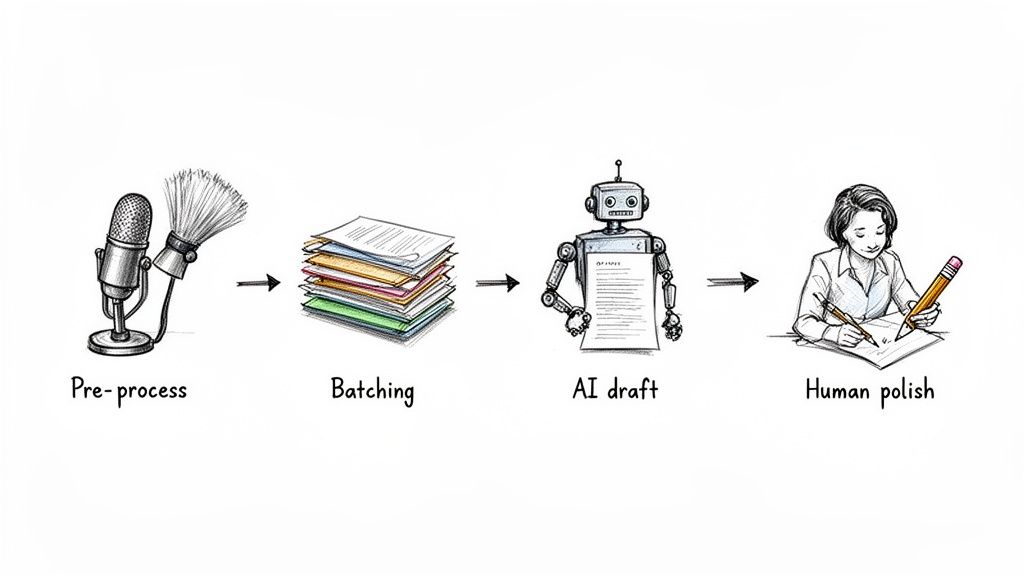
Think of it like prepping ingredients before handing them to a chef. Clean, organized ingredients make the cooking process faster, smoother, and ultimately cheaper. The same logic applies directly to transcription—better input always leads to a better, more affordable output.
The single biggest thing you can do to cut costs is to clean up your audio before anyone starts transcribing it. Clean audio is simply easier for both people and algorithms to understand, which translates directly into lower fees and fewer mistakes.
Here are a few quick wins:
Remember, every minute a human transcriber spends deciphering muffled audio is a minute you're paying for. And for an AI, clean audio means much higher accuracy, saving you the time and money of fixing errors later.
You don't have to be a purist. There’s no need to choose between 100% human or 100% AI. In fact, a hybrid approach often gives you the perfect blend of quality and cost-savings by playing to the strengths of both.
Here’s what that looks like in practice:
This two-step process can cut your total transcription expenses by up to 90% compared to using a human-only service from the very beginning. You get the raw speed and low cost of AI, backed by the final, nuanced touch of a human expert.
If you're dealing with a lot of audio, start thinking at scale. Simply batching your files together can unlock some serious savings. For human providers, submitting a large batch of files is more efficient, and they’ll often pass those savings on to you with a volume discount.
When it comes to automated services, batching just makes your own workflow more streamlined. For developers, taking this a step further and using a Speech-to-Text API gives you ultimate control over the cost of transcribing. Instead of paying the marked-up per-minute rates of a transcription service, you can build your own automated pipeline. This lets you process audio on your own terms and pay only for the raw processing, driving your per-hour cost down to just cents.
If you're building a business or product designed for growth, a Speech-to-Text API isn't just another tool—it’s a foundational piece of your strategy. Manual transcription services can feel like a quick fix, but their high, fixed per-minute rates don't scale. An API, on the other hand, gives you a flexible and powerful engine for the long haul.
Let's use an analogy. A manual service is like hiring a freelance typist for a specific project. An API is like installing an automated transcription factory right inside your own workflow. It’s a completely different mindset that moves transcription from a one-off task to an integrated, efficient part of your operation.
With an API, you can churn through massive amounts of audio without ever hitting a human bottleneck. This is a game-changer for anyone needing to analyze thousands of customer service calls or create captions for an entire video library. You’re not just paying for a single transcript; you’re investing in a system that does the work for you, 24/7.
Most APIs operate on a pay-as-you-go model, which is a much smarter way to manage costs compared to the rigid pricing of manual services. When you're looking at the numbers, it helps to think about the true cost of cloud computing, because an API is essentially a cloud service you're tapping into. This framing really highlights the long-term financial upside.
An API shifts your transcription from a recurring manual expense to a streamlined operational asset. You gain control, efficiency, and the ability to build innovative voice-enabled features directly into your products.
Perhaps one of the most crucial points is that a developer-first API puts you in the driver's seat when it comes to data privacy and security. Instead of uploading potentially sensitive audio files to a third-party platform, you keep everything within your own controlled environment. For any modern application where trust and compliance are non-negotiable, this makes the initial integration a very wise investment.
Even with all the details, you might still have a few lingering questions about transcription costs. Let's tackle some of the most common ones head-on so you can make your final decision with confidence.
This is the big one, and the answer really splits into two camps. For a skilled human transcriber, you can expect to pay anywhere from $1.00 to $2.50 per minute. It's a reliable, premium service.
On the other hand, a modern AI transcription API like Lemonfox.ai completely changes the math. We're talking less than $0.003 per minute—that’s under $0.17 per hour. For anyone dealing with a significant volume of audio, the cost difference is massive.
For the vast majority of business needs? Yes, absolutely. Top-tier AI models consistently hit over 95% accuracy on clear audio, which is more than enough for meeting notes, content creation, and analyzing customer calls.
A smart hybrid approach is becoming popular in fields like law and medicine where every single word matters. They'll run the audio through an AI first to get a cheap, fast draft, then have a human editor do a quick final polish. It saves a ton of time and money compared to a fully manual process.
It's actually much simpler than it sounds. The best way to begin is to find a provider that offers clear, easy-to-follow documentation and a free trial so you can test the waters without any commitment. Going directly with an API provider gives you the raw transcription power without paying extra for a fancy user interface you might not need.
For instance, a developer-focused service lets you grab an API key and start building transcription into your own software right away. You can often be up and running, testing the quality on your own files, in just a few minutes.
Ready to see how much you could save by switching to an API-first approach? Lemonfox.ai delivers powerful Speech-to-Text for less than $0.17 per hour. Sign up today and get your first 30 hours free.