
First month for free!
Get started
Published 1/1/2026
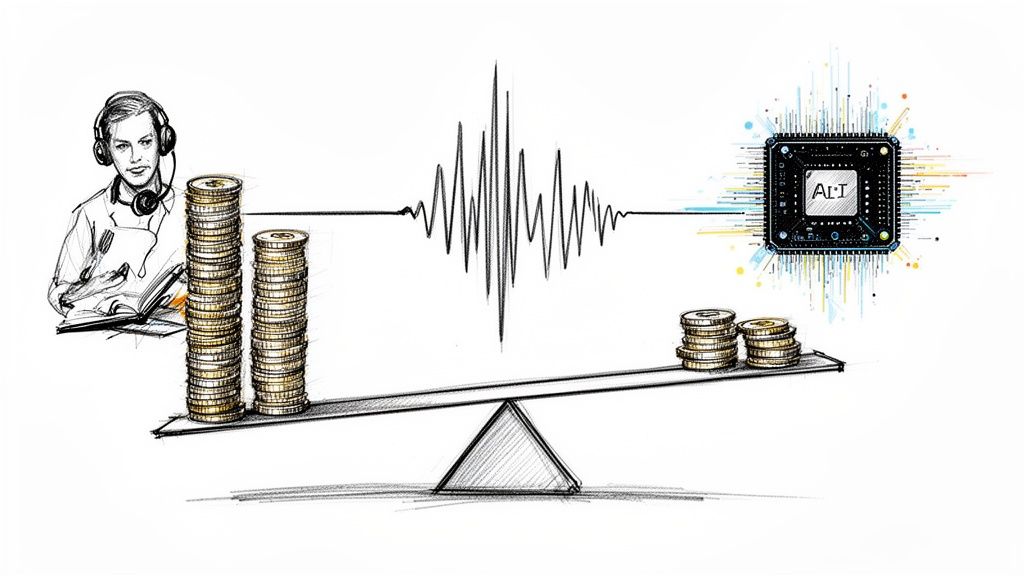
The price tag for transcription services can be a real shocker, swinging from over $150 per audio hour for a human expert to less than a dollar for a sophisticated AI. This isn't just a small difference—it's a massive gap that really defines your options. The choice boils down to a simple question: do you need the expensive, nuanced touch of a person, or the fast, affordable, and scalable power of an algorithm?
Think of the transcription world as having two main roads, each with a completely different toll. One road is paved with traditional, manual transcription done by skilled human professionals. The other is a high-speed expressway powered by automated speech-to-text AI. Getting a handle on the cost difference between these two paths is the first, most critical step in making a smart choice for your project or business.
The global demand for transcription is exploding, with the market projected to grow from $21.01 billion in 2022 to a staggering $35.8 billion by 2032. Everyone wants their audio data turned into text. But when human-led services charge anywhere from $1 to $3 per minute (that's $60 to $180 per hour!), it becomes a major budget roadblock for anyone dealing with a lot of audio. You can read more about this market shift and what's driving it.
To make this crystal clear, let's break down the typical costs you can expect. The table below shows just how different the pricing is between a traditional service and a modern API.
| Service Type | Cost Per Audio Minute | Estimated Cost Per Hour |
|---|---|---|
| Human Transcription | $1.00 - $3.00 | $60 - $180 |
| AI Transcription API | ~$0.015 | ~$0.90 |
As you can see, the numbers aren't even in the same ballpark. AI offers a dramatic cost reduction that fundamentally changes how you can use transcription.
Sometimes, a picture tells the whole story. The chart below gives you a stark, side-by-side look at the hourly cost of hiring a human versus using an automated API.
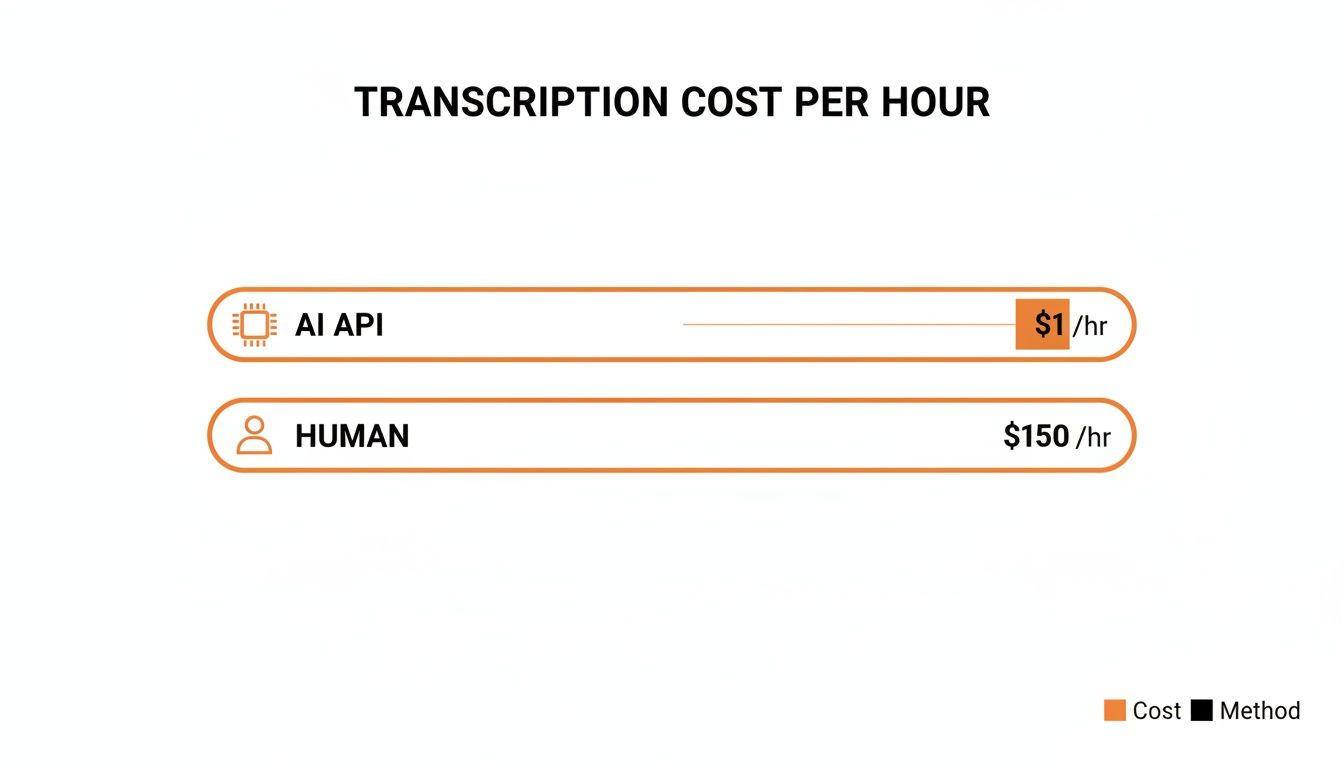
The data speaks for itself. We're talking about a potential cost saving of over 99% by switching from manual services to an AI-powered API.
This isn't just about trimming a budget. It represents a monumental shift in what's possible. For decades, the high price of human transcription meant it was reserved for only the most critical, low-volume tasks, like court depositions or vital medical notes.
The real magic of AI transcription is that it breaks the link between cost and volume. This lets businesses transcribe everything—from every single customer service call to all their internal meetings—at a scale that was simply unthinkable before.
This newfound affordability opens up a world of new opportunities. Companies can finally analyze 100% of their audio data to find hidden customer insights. Developers can create voice-powered apps without breaking the bank. Podcasters can make their entire back catalog searchable and accessible. It’s not just about saving money; it’s about fueling innovation that used to be too expensive for almost everyone.
Trying to figure out transcription costs can feel like comparing apples and oranges. Providers package their services in different ways, which can make a simple side-by-side comparison feel impossible at first. But once you get the hang of the main pricing structures, it all starts to click.
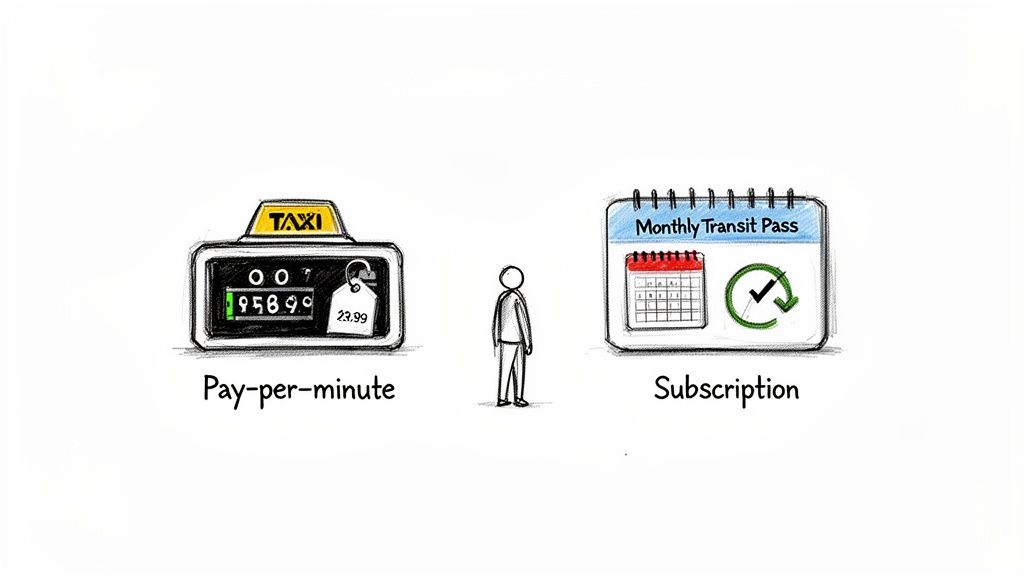
Think of it like getting around town. Sometimes, you just need a taxi for a single trip across the city. Other times, if you're commuting every day, a monthly transit pass makes way more financial sense. Transcription pricing follows the same logic, with different models built for different needs and budgets.
The most classic pricing structure you'll run into is pay-per-minute or pay-per-hour. This is the taxi meter of the transcription world—the clock starts when your audio does, and you pay for the exact length of the file.
It's beautifully simple. If you have a one-off project, like a 30-minute interview, you pay for exactly 30 minutes. Done. This model is perfect for infrequent use, but the costs can add up quickly and become unpredictable if you have a high volume of work.
For anyone with consistent transcription needs, a subscription model is usually the smarter play. This is your monthly transit pass. You pay a set fee each month and get a specific allotment of transcription minutes or hours in return. This makes budgeting a breeze because you know exactly what your bill will be.
Many services offer tiered plans, where you get a better per-minute rate as you commit to a higher-volume plan. For instance:
This approach rewards consistency and scale. As your needs increase, you jump to a higher tier and your cost-per-hour goes down. The trick is to accurately forecast your monthly usage so you're not paying for hours you never use.
It's always a good idea to research various subscription-based pricing models to see how different companies structure their offerings. This will help you find a plan that truly fits your workflow.
Beyond those two heavy hitters, a few other models pop up for more specialized situations.
You might see pay-per-word or pay-per-line pricing, especially in the legal or medical fields where formatting is key. For specialized work in the US, rates can fall between $0.07 and $0.16 per line. This can be a great deal if your audio has long, silent pauses, but not so much for rapid-fire dialogue.
For developers working with APIs, pay-as-you-go is another common setup. It's similar to pay-per-minute but is often billed in much smaller increments (like per second) and doesn't require a monthly commitment. It offers total flexibility, letting you scale your usage up or down instantly. This is a perfect fit for apps with unpredictable or spiky traffic patterns.
Picking the right model means looking past the headline price. You have to really think about your project volume, frequency, and budget to land on a plan that delivers real value without any costly surprises.
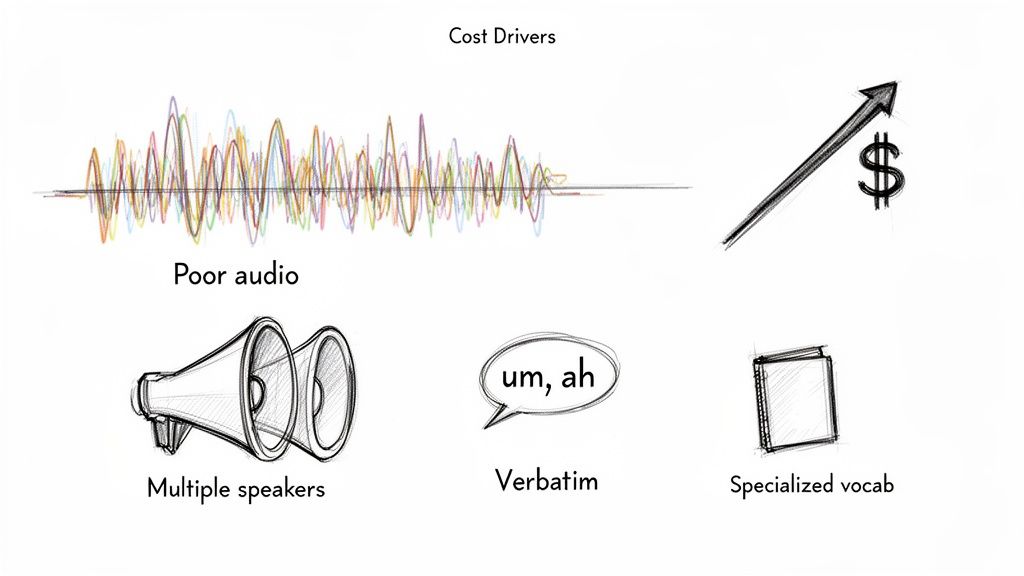
The advertised per-minute rate is just the starting line. Think of it as the base price. Several other variables can sneak up on you and significantly increase the final cost of transcription services, turning what looked like a great deal into a much bigger expense. Knowing what these factors are is the key to keeping your budget in check.
It’s a lot like hiring a contractor to paint a room. The initial quote might sound fantastic, but it rarely includes the cost of patching holes, moving heavy furniture, or applying a second coat. In the same way, transcription costs go up when the audio file needs extra work, whether that work is being done by a human or a sophisticated AI.
If there's one thing that will torpedo your transcription budget, it's poor audio quality. This is, without a doubt, the single biggest cost driver. When a recording is muffled, plagued by background noise, or recorded at a low volume, the whole process becomes a slog.
Imagine trying to follow a conversation happening in a bustling cafe versus one in a quiet recording studio. A human transcriber has to constantly rewind and strain to catch words, while AI models get confused trying to separate speech from the clatter of dishes. All that extra effort translates directly into higher costs, often tacking on surcharges of $0.20 per minute or even more.
You can get ahead of this by:
The more people you have talking, the more complicated the job gets. A straightforward one-on-one interview is a piece of cake to transcribe compared to a chaotic, five-person roundtable where everyone is talking over each other.
Simply identifying who is speaking at any given moment—a feature known as speaker diarization—adds another layer of complexity that services often charge more for. The same goes for files with more than two or three speakers. On top of that, heavy or unfamiliar accents can throw a wrench in the works for both human transcribers and AI, leading to lower accuracy and more time spent on edits.
A clear podcast interview with two speakers will always be cheaper to transcribe than a noisy conference call with ten participants from different regions. The complexity isn't just in the words themselves, but in untangling who said what.
The level of detail you need in the final transcript also makes a big difference in the price. You've generally got two options, and they come with different price tags.
Opting for a strict verbatim transcript when a clean read would have done the job is a surefire way to overpay. Before you choose, always think about what you’ll actually be using the transcript for.
To give you a clearer picture, here’s a quick breakdown of how these common cost drivers can affect your base rate.
| Cost Driver | Typical Price Increase | Example Scenario |
|---|---|---|
| Poor Audio Quality | +20% to 50% | A street interview with loud background traffic and wind noise. |
| Multiple Speakers | +15% to 40% | A focus group discussion with six participants speaking at once. |
| Strict Verbatim | +25% to 60% | A legal deposition where every hesitation and filler word must be documented. |
| Specialized Terminology | +10% to 35% | Transcribing a medical lecture filled with complex anatomical terms. |
As you can see, these aren't small percentages. By being proactive—making sure your audio is clear, knowing what you need regarding speakers, and choosing the right transcript type—you can take back control over the final cost of transcription services and keep your project from going over budget.
All the talk about pricing models and cost drivers is great, but things get real when you start putting numbers to your own projects. Let's move past the theory and walk through a couple of real-world scenarios.
This is where a vague idea of the cost of transcription services turns into an actual budget forecast. We'll look at two common situations: a business using a traditional human service for its meetings and a developer using a modern AI API for a high-volume application.
Picture a company that wants to transcribe its weekly executive meetings. The goal is simple: better record-keeping and accountability. They have one two-hour meeting every week, which adds up to eight hours of audio a month.
Since the conversations are sensitive and often have people talking over each other, they decide to go with a premium human transcription service.
Let's break down what their monthly bill would look like:
When you add it all up, the final cost is a lot more than just the base rate.
Monthly Cost Calculation:
($720 Base Cost) + ($144 Speaker Surcharge) + ($180 Rush Fee) = $1,044 per month
This example shows just how fast the price can climb with human services once you start adding pretty standard requirements. For many businesses, spending over $1,000 a month for just eight hours of audio is a serious operational expense.
Now, let's switch gears completely. Imagine a developer building an app that lets users record and analyze their audio notes. They expect the app will need to process about 200 hours of audio every month. At that scale, a human service isn't just expensive—it's completely impractical.
So, the developer integrates a speech-to-text API instead. We'll use a competitive rate you might find from an affordable provider: $0.0028 per minute (that's less than $0.17 per hour).
Here’s how simple the math becomes:
The calculation is refreshingly straightforward.
Monthly Cost Calculation:
(12,000 minutes) x ($0.0028 per minute) = $33.60 per month
The difference is staggering. The developer can process 25 times more audio than the corporation for less than 4% of the cost. This is a perfect illustration of the incredible scale and affordability that AI transcription brings to the table, making high-volume projects financially possible.
You can use these examples as a template to figure out your own transcription budget. Just start by answering a few key questions:
Once you have those answers, you can plug your numbers into a simple formula and get a pretty good estimate. Getting smart about your transcription budget is a lot like applying telecom expense management best practices—small efficiencies can lead to big savings over time. By carefully matching your needs to the right pricing model, you can accurately predict and control your costs.
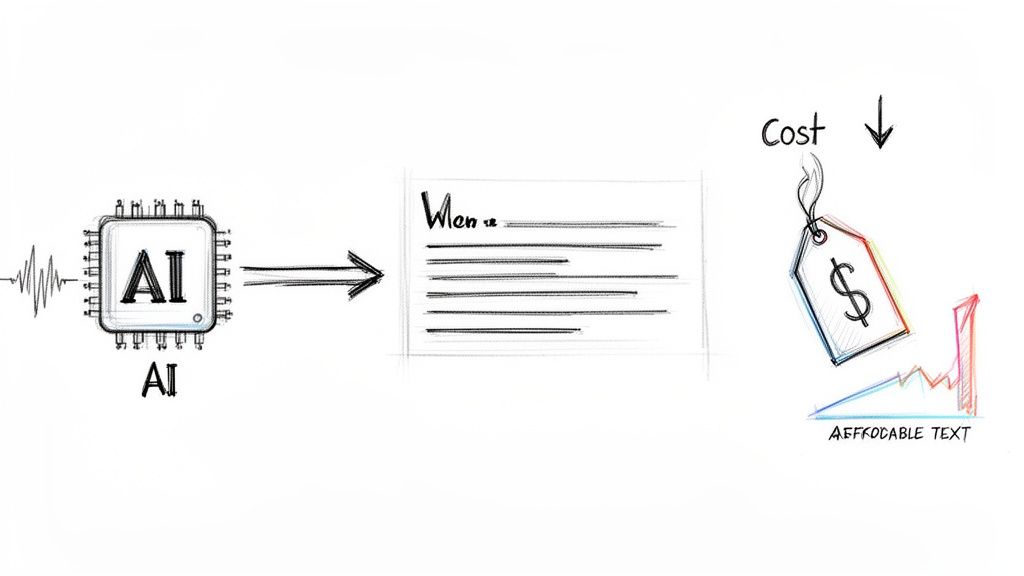
The transcription industry is undergoing a massive change, and AI is the reason why. This isn't just a small tweak to an old process; it's a complete reimagining of how we turn speech into text. The result? A fundamental shift in the cost of transcription services that makes the technology available to almost anyone.
At its heart, traditional transcription has always been a manual job. A person listens to a recording and types everything out. It’s a slow, painstaking process that demands serious concentration, which is why it has always been expensive. AI-powered speech-to-text flips the script by automating that entire workflow, taking the biggest cost out of the equation: human time.
That single technological leap is what makes pricing over 99% cheaper than old-school services possible. It’s a real game-changer, making high-volume transcription a realistic option for everyone from solo creators to massive companies.
So, how does AI pull off such a dramatic cost reduction? It helps to think of it like the difference between weaving a rug by hand versus using a modern, automated loom. A skilled artisan can make a stunning rug, but it takes days or even weeks. An automated loom can churn out a high-quality product in a tiny fraction of the time, which naturally brings the price down.
AI transcription works on the same basic principle. A sophisticated algorithm can "listen" to and process thousands of hours of audio at once—a task that would take a whole army of human transcribers. That massive efficiency is passed straight to you, the customer, in the form of lower prices.
You can see this shift playing out in the market data. The overall business transcription market is set to grow from $3.01 billion in 2024 to $9.51 billion by 2034. But the high cost of human transcription, especially for quick turnarounds—often $1.50 to $4.00 per minute—is still a huge hurdle. At the same time, the AI transcription market is projected to explode from $4.5 billion to $19.2 billion over the same period, which clearly shows where the industry is heading. You can dig deeper into this market shift in recent industry analysis.
The most exciting part of this isn't just about saving money on things you already do. It’s about unlocking completely new possibilities that were once unthinkable because of the cost. When transcription is this fast and affordable, it stops being a niche service and starts being a core business tool.
Just think about what you can do now:
AI doesn't just make transcription cheaper; it turns it from a simple documentation chore into a powerful data analysis tool. It unlocks all the valuable information trapped inside your audio and video files.
This downward trend in the cost of transcription services isn't slowing down. As the AI models get smarter and more efficient, the price will keep dropping, making this powerful technology even more widely available.
This change is clearing the way for developers to build innovative voice-powered apps, for researchers to analyze huge audio archives, and for businesses to operate more intelligently. The barrier to entry has all but disappeared, putting top-tier speech-to-text technology within reach for any project, no matter the budget. What was once a premium service is quickly becoming a standard, affordable utility.
When you're digging into transcription options, a few key questions always seem to pop up. Let's clear them up so you can feel confident about what you're paying for and what you're getting in return.
These days, top-tier AI can hit accuracy rates of 95% or even higher when it's working with clear audio. That puts it right on par with human transcribers for a huge range of tasks.
Sure, a seasoned human might have a slight edge on a recording with heavy accents, lots of background noise, or really technical jargon. But for most business needs—from meeting notes to content creation—the AI's speed and dramatically lower cost make it the clear winner. For what most people need, AI is more than accurate enough.
This is a big one, and the answer is: it really depends on the provider. Security isn't a given, so you have to do your homework, especially if you're transcribing anything sensitive.
My advice? Look for a service that's upfront and transparent about its privacy policy. Do they delete your files right after processing? Are they based in a region with strong data protection laws, like the EU's GDPR? These are the details that matter.
It really boils down to four things: how much audio you have (volume), how fast you need it (speed), what you can spend (budget), and whether you need it to connect with other software (integration).
The smartest move is to take a service for a test drive. Any decent provider will offer a free trial. Use it to check the quality for yourself and see if it truly fits what you need before you spend a dime.
Ready to see just how affordable and accurate transcription can be? With Lemonfox.ai, you can process audio for less than $0.17 per hour. Start your free trial today and get 30 hours of transcription on us.