
First month for free!
Get started
Published 2/6/2026
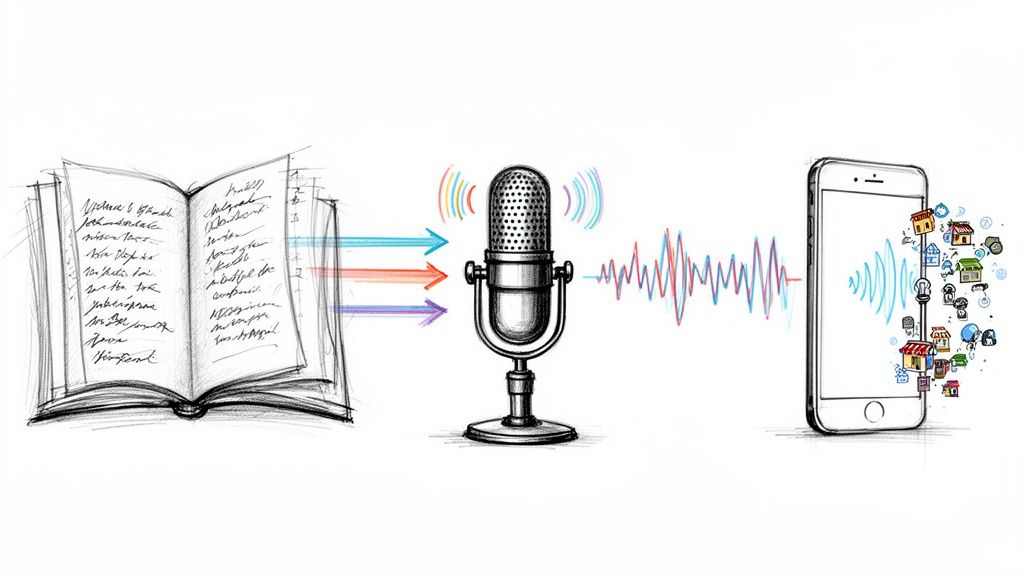
So, you want to turn your book into an audiobook? Smart move. The process breaks down into a few key stages: getting your manuscript ready for audio, deciding who (or what) will narrate it, producing and polishing the audio files, and finally, getting it out to the world. This guide walks you through every step, whether you're a first-timer or a developer looking to automate the entire workflow.
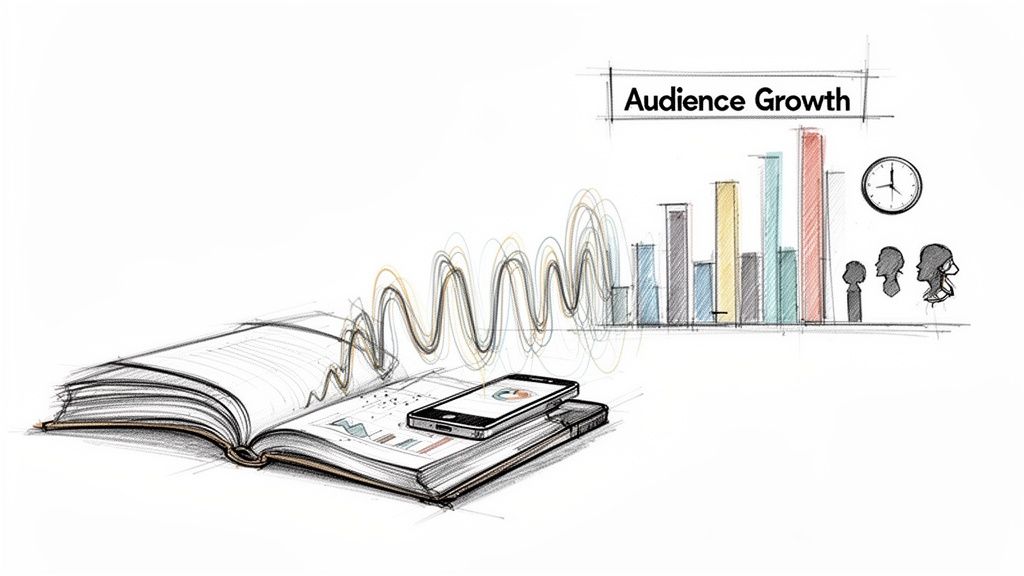
If you're an author or publisher, your written work is an untapped asset. The audiobook market isn't just growing; it's exploding. It’s no longer a question of if you should create an audiobook, but how soon you can get it done.
The numbers don't lie. The global audiobook market was valued at $10.88 billion in 2025 and is on track to hit a staggering $56.09 billion by 2032. What’s driving this? Modern listeners. Busy adults, who make up a massive 76.4% of the audience, are listening while they commute, work out, or do chores. Audio just fits their lives. You can dig deeper into these market trends to see the full picture.
An audiobook throws open a door to a whole new audience—people who might never pick up your print or ebook. Some people just prefer listening, while others don't have time to sit down and read. By offering an audio version, you meet them where they already are: on their phones, in their cars, and through their earbuds.
This guide is your roadmap. We’ll break down the entire journey into clear, manageable parts:
Throughout this guide, we'll show you how new tools have completely changed the game. Tech like the Lemonfox.ai API now lets you produce incredibly human-like narration for a fraction of what it used to cost, making audiobooks a viable—and profitable—option for creators of any size.
The opportunity here is massive. With digital formats making up 99% of all audiobook sales, the path from your manuscript to a listener's ear has never been more direct. Let's get started on turning your written words into a must-hear experience.
So, you’ve written a book. Now it’s time to give it a voice.
Before a narrator can even step into the booth (or before an AI can process a single word), your manuscript needs a serious once-over. An audiobook is a completely different beast than a print book, and simply handing over your final print-ready file is a recipe for a clunky, unprofessional recording.
Think of it this way: your manuscript is now a script. It’s the sheet music for the performer, and every single detail matters. The goal here is to get rid of any guesswork for the narrator, whether that’s a seasoned voice actor or a sophisticated AI.
First things first, you need a clean, audio-friendly script. This goes way beyond just running a spell check. You have to start thinking with your ears, not your eyes. Things that look perfectly fine on a page can sound confusing or downright awkward when spoken.
Here’s a practical checklist to get you started:
My favorite pro-tip: Read the tricky passages out loud yourself. If you stumble over a sentence, get tongue-tied, or feel like a character’s line just doesn't land right, I guarantee a professional narrator will, too. It’s the simplest, most effective QA you can do.
With your manuscript polished and ready, you've hit a major fork in the road. Who—or what—is going to narrate your book? This single decision will have the biggest impact on your budget, your production schedule, and the overall vibe of your final audiobook.
A professional human narrator brings a lifetime of performance art to the table. They understand pacing, emotional nuance, and can craft unique voices for each of your characters. It’s a true craft. But that level of expertise comes with a price tag. For a standard 90,000-word novel, which works out to about 10 finished hours of audio, you can expect to pay anywhere from $2,000 to $5,000 for a talented narrator.
Then there’s the other path: Text-to-Speech (TTS) technology, which has gotten scarily good. Modern AI voices are no longer the robotic monotone you might remember. They're impressively realistic and consistent. Using an API from a service like Lemonfox.ai lets you generate broadcast-quality audio for an almost unbelievable fraction of the cost. This makes it a fantastic option for authors on a shoestring budget, publishers with a deep backlist to convert, or developers who need to add audio features to an app.
Let's put some real numbers on it for an indie author with that same 10-hour book:
| Factor | Professional Human Narrator | Lemonfox.ai TTS API |
|---|---|---|
| Upfront Cost | $2,000 - $5,000+ | Less than $100 |
| Production Time | 4-8 weeks | A few hours |
| Consistency | Can vary slightly over sessions | Perfectly consistent |
| Revisions | Costly and time-consuming | Instant and inexpensive |
| Emotional Range | High (human interpretation) | Excellent (customizable delivery) |
For a self-published author, that comparison is a game-changer. Hiring a human narrator might mean putting the project on hold for months to save up. Using a top-tier TTS solution means they can get their audiobook on the market almost right away, saving that cash for marketing and advertising. The best choice really just boils down to your specific goals, your timeline, and what your bank account can handle.
With your manuscript polished and ready, it's time to give it a voice. This is the stage where your text transforms from marks on a page into a captivating listening experience. Your big decision here is whether to go with the rich nuance of a human narrator or the incredible efficiency of modern AI.
This simple workflow lays out the key decisions you'll make when preparing your manuscript for audio production.
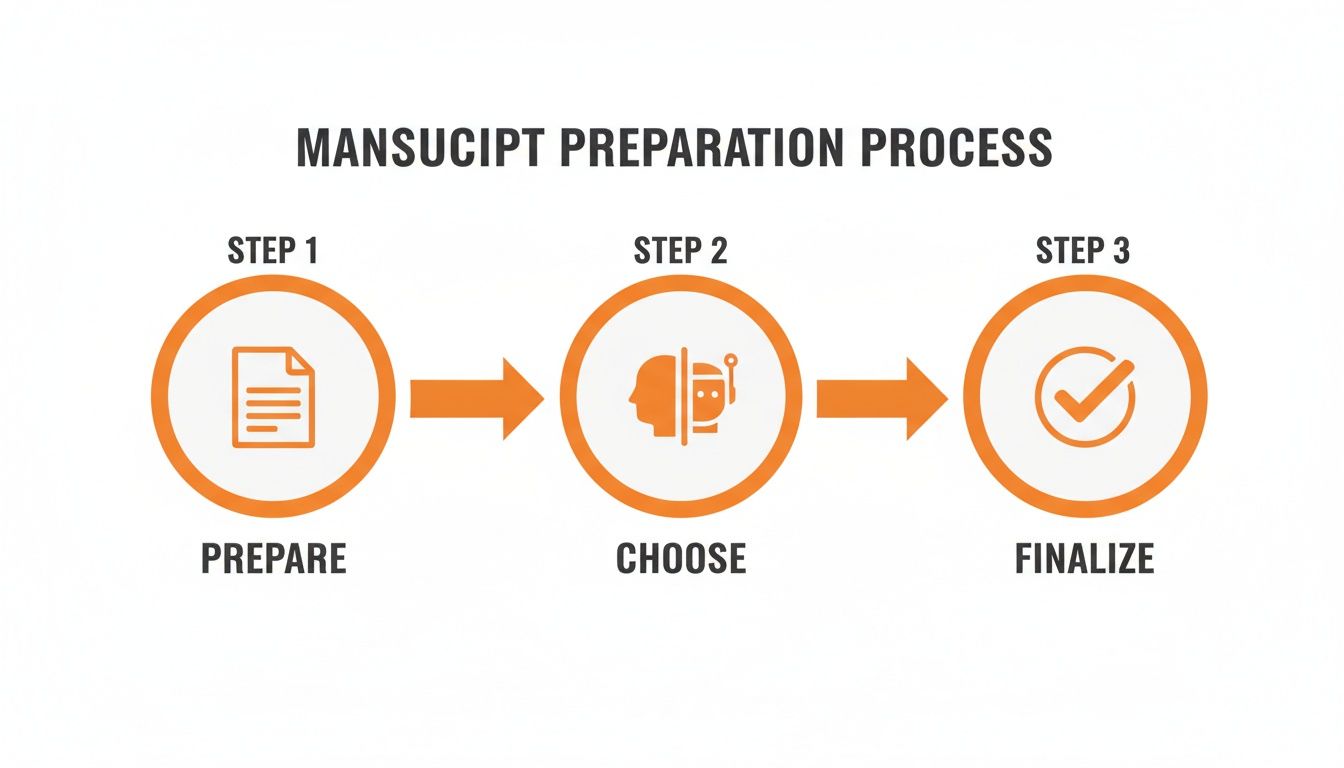
Essentially, you'll prepare the script, pick a narration method, and then finalize the audio for your audience.
If you're set on using a human narrator (or doing it yourself), you don't need a high-end recording studio. The secret to professional-sounding audio isn't spending thousands on gear—it's creating a space with zero background noise.
Your number one job is to capture clean, crisp audio. That means making your recording space as acoustically "dead" as possible. Forget expensive soundproofing panels; think soft surfaces. A walk-in closet packed with clothes is a classic industry hack for a reason. All that fabric does a fantastic job of absorbing sound reflections and echo.
Here’s a look at the essential gear to get started:
Perfecting your vocal delivery is a skill in itself. Believe it or not, looking into the benefits of reading aloud to children can give you some surprisingly useful tips on pacing and engagement that apply directly to audiobook narration.
For authors and publishers who value speed, scalability, and affordability, Text-to-Speech (TTS) technology has completely changed the game. Using an API like Lemonfox.ai lets you generate incredibly lifelike audio automatically, turning what used to be a weeks-long project into a task you can finish in an afternoon.
The process is surprisingly simple, even if you’ve never touched an API before. You're basically just sending your text to the Lemonfox.ai service, and in return, you get a high-quality audio file.
You can pick from a huge library of voices, filtering by language, gender, and style to find the perfect one for your book. Once you send a chunk of text—like an entire chapter—the API processes it and sends back a ready-to-use MP3 or WAV file.
This is where the cost savings really kick in. You can convert an entire manuscript into polished audio for a fraction of what a human narrator would charge.
To put the numbers in perspective, here's a detailed cost comparison for producing a typical 10-hour audiobook (around 90,000 words).
| Cost Factor | Professional Human Narrator | Lemonfox.ai TTS API |
|---|---|---|
| Narration Fee | $2,500 - $4,000 ($250 - $400 PFH*) | $0 (API usage fee instead) |
| Editing & Mastering | $750 - $1,500 ($75 - $150 PFH*) | Included in API output (or minimal cleanup) |
| Studio Rental (if needed) | $500 - $1,000+ | $0 |
| API Usage Fee | $0 | ~$108 (90,000 words ≈ 600,000 characters @ $0.18/1,000) |
| Total Estimated Cost | $3,250 - $6,500+ | ~$108 |
*PFH = Per Finished Hour
As you can see, the financial difference is dramatic. While a human narrator brings a unique artistry, the cost can be a major hurdle. The API approach makes professional-grade audio accessible on almost any budget.
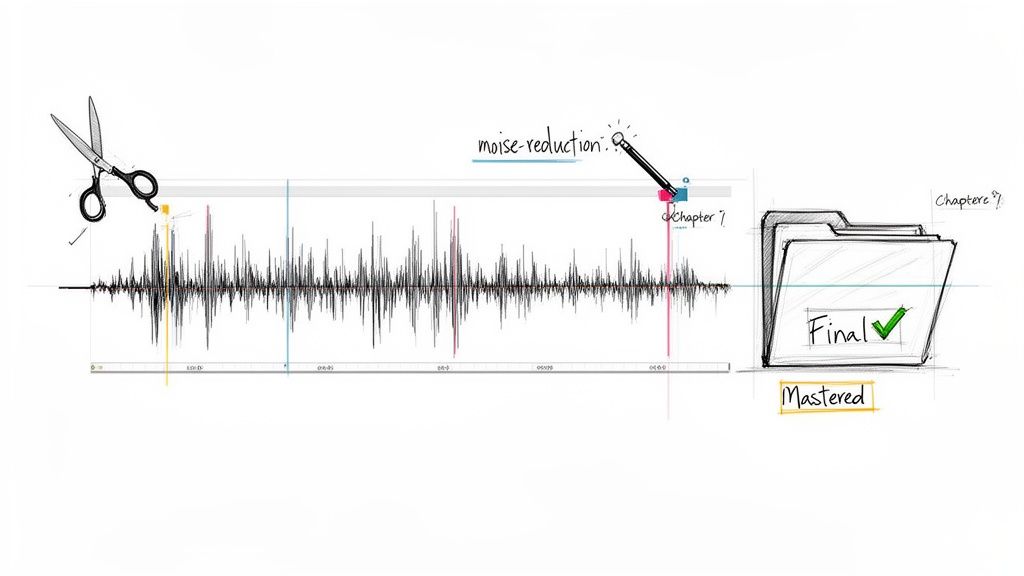
Whether you used a human narrator or a top-tier AI voice, hitting "stop" on the recording is a huge milestone. But the work isn't done yet. Those raw audio files, full of potential, need to be shaped into a polished, professional product. This is where post-production comes into play.
Think of this stage as the difference between a rough draft and a published novel. It transforms a good recording into an immersive listening experience and is essential for creating an audiobook that can stand alongside the bestsellers on major platforms.
At its core, editing is the art of subtraction. It’s all about removing the little distractions that can pull a listener out of the story. This isn't just about fixing obvious flubs; it’s about polishing every second of audio until it’s seamless.
Here’s what you’ll be focused on:
I like to think of it as weeding a garden. You aren’t changing the narrator's performance (the flowers), but you're carefully removing anything that doesn't belong, allowing the story to truly shine. This is a non-negotiable part of learning how to create audiobooks that sound professional.
Once your audio is edited and clean, it's time for mastering. This is the technical step where you ensure your audio files meet the stringent requirements of distribution platforms like Audible (through its Audiobook Creation Exchange (ACX) platform). These services have very specific rules for volume and file formatting to create a consistent experience for every listener.
Mastering is a three-part process:
A critical note from the field: Each chapter file has to be processed and exported individually to meet these technical specs. If you fail the ACX quality check, your release can be delayed for weeks. Getting this right the first time is absolutely crucial.
Manually proofing an audiobook is a Herculean task. Just think about it: for a 10-hour audiobook, you’re looking at 20-30 hours of intense, focused listening while cross-referencing the manuscript line by line. It’s exhausting and prone to human error.
This is where a Speech-to-Text (STT) API completely changes the game.
Instead of just listening, you can automate the most tedious part of the QA process. By running your final, mastered audio files through a service like the Lemonfox.ai Speech-to-Text API, you can generate a complete transcript of your audiobook in a matter of minutes.
This transcript becomes your secret weapon. Using a simple text-comparison tool (there are plenty of free ones online), you can instantly compare the AI-generated transcript against your original manuscript. The tool will flag every single discrepancy—misread words, skipped sentences, or added phrases. This lets you zero in on errors instantly, turning a multi-day chore into a quick afternoon task and ensuring your final audiobook is a perfect match for your book.
You’ve done the hard work. Your audiobook is edited, mastered, and sounds fantastic. Now, it’s time for the final, and most exciting, step: getting it into the ears of millions of potential listeners. This is where you’ll package your audio for the market and choose the right partner to get it there.
Think of distributors as the highways connecting your audiobook to countless digital storefronts. Each one has its own network, royalty structure, and reach. The path you choose will have a huge impact on who discovers your work and how much you earn.
For most indie authors, the decision comes down to three major players: ACX, Findaway Voices, and Author's Republic. There's no single "best" choice; it really boils down to your specific goals.
One of the biggest forks in the road, particularly with ACX, is the exclusivity question. If you grant ACX exclusive distribution rights for seven years, they’ll reward you with a 40% royalty rate. If you choose to go non-exclusive so you can also use platforms like Findaway, your ACX royalty rate drops to 25%.
This isn't just a simple numbers game; it's a core part of your author strategy. Going exclusive gives you a bigger slice of the biggest pie. Going wide builds your presence across many platforms and diversifies your income. Take some time to think about your long-term vision before you commit.
Once your distribution partner is selected, it's time to assemble your marketing assets. Don't underestimate this part! In a crowded digital store, your audiobook’s packaging is just as crucial as the audio itself. Listeners make snap judgments based on what they see.
A professional audiobook cover is non-negotiable. It needs to grab attention, convey your genre, and look good even as a tiny thumbnail on a phone. The standard is a perfect square, at least 2400 x 2400 pixels.
Next up is your book description. This is your sales pitch. It needs to be punchy, compelling, and loaded with the keywords people will use to find a book like yours. Hook them in the first sentence, lay out the core premise, and end with a question that makes them need to click "buy."
Pricing is the final piece, though often the platforms have the final say based on your audiobook's length. As a rule of thumb, a book between 5-10 hours will likely land in the $15 - $25 retail price range.
Simply publishing your audiobook and hoping for the best is a recipe for disappointment. You need to give it a nudge to get the platform algorithms to notice. The best way to do this is with promo codes.
ACX, for example, gives authors 25 free download codes for both the US and UK stores. Get these codes out immediately. Share them with your email subscribers, social media followers, or a dedicated review team.
The mission is simple: get those first few ratings and reviews up as fast as possible. This early activity serves as powerful social proof and signals to the platform's algorithm that your audiobook is worth showing to a wider audience.
Once you start digging into audiobook production, you'll find a lot of questions pop up. It’s a process with a surprising number of moving parts, from the initial script prep all the way to hitting "publish." Let's walk through some of the most common hurdles authors, publishers, and developers face.
This is usually the first question on everyone's mind, and the answer really boils down to one thing: who (or what) is doing the talking. The timeline can swing wildly based on your narration choice.
If you go the traditional route and hire a professional human narrator, you need to be patient. You're looking at a four to eight-week timeline from start to finish. This covers everything—finding and auditioning talent, the actual recording sessions, several rounds of proofing and editing, and final mastering. It's a collaborative dance with a lot of back-and-forth.
On the flip side, using a Text-to-Speech (TTS) API like Lemonfox.ai completely changes the game. You can generate the final, high-quality audio for an entire book in just a few hours. Since the post-production is minimal, you can realistically go from a finished manuscript to a complete set of audio files in a single afternoon.
Your budget is the next big hurdle, and just like the timeline, the costs are almost entirely driven by your narrator.
The short answer is yes, you can. Some authors, especially in non-fiction where they are the expert, pull this off quite well. But before you jump in front of a microphone, you have to be honest with yourself about what it takes.
It's not just about reading your words out loud. You need to consider:
Plenty of indie authors have made it work, but narrating your own book is a serious undertaking. Unless you already have a background in performance or audio engineering, you'll almost always get a more polished, professional result in far less time by hiring a pro or using a high-quality AI voice.
Jumping into your first audiobook is exciting, but a few common mistakes can quickly turn that excitement into frustration. Knowing what to watch out for can save you a world of pain.
The single biggest error I see is failing to prep the manuscript for audio. You can't just hand the narrator your ebook file. A script littered with phrases like "see the chart below," confusing dialogue tags, or long, rambling sentences will sound awful when spoken. It creates a clunky, confusing experience for the listener.
The other cardinal sin is skimping on audio quality. Listeners have zero patience for bad sound. Any background noise, hiss, mouth clicks, or inconsistent volume will get you slapped with negative reviews that can tank your sales. This is non-negotiable. Whether you record it yourself or hire it out, the final audio absolutely must be clean, crisp, and professionally mastered. Honestly, this is one area where a top-tier TTS service often produces a more technically perfect file than a low-budget home recording.
Ready to create professional-grade audio for your book without the high costs and long timelines? Lemonfox.ai offers the most affordable Text-to-Speech and Speech-to-Text APIs on the market, giving you the tools to produce a high-quality audiobook in hours, not weeks. Start your free trial and bring your story to life today.