
First month for free!
Get started
Published 12/29/2025
Text-to-speech (TTS) in India is more than just a cool feature; it's the technology that’s giving digital applications a local voice. For developers, it's the key to reaching hundreds of millions of new internet users who are far more comfortable speaking and listening in their native languages than they are typing in English.
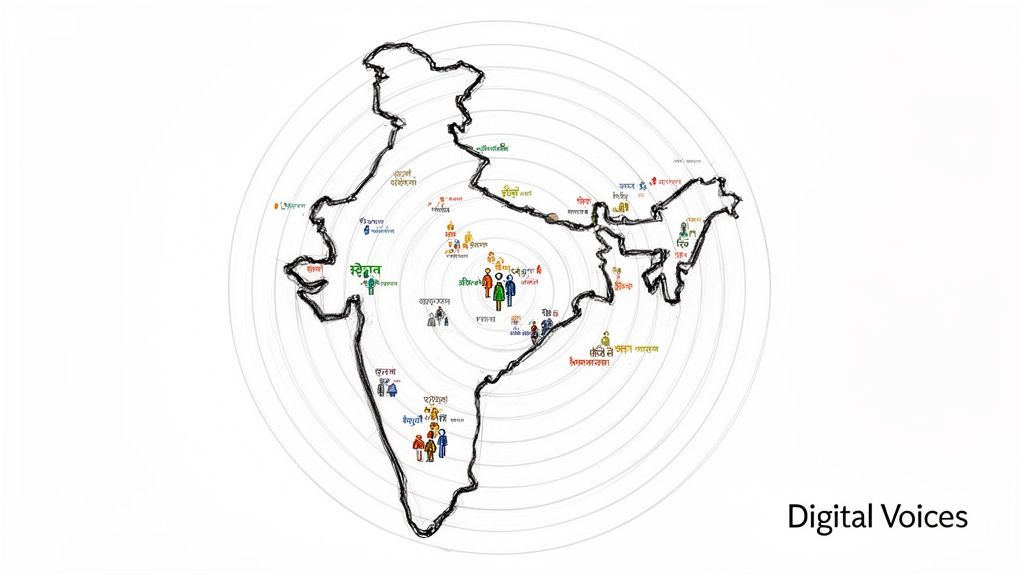
The next chapter of India's digital revolution will be spoken, not typed. As millions of people get online for the very first time, they aren't turning to keyboards. They're using their voice. This simple fact presents a huge opportunity—and a real challenge—for anyone building apps for this audience.
Let's be honest: text-only interfaces just don't cut it anymore. If you want to build products that feel truly welcoming and intuitive, you need systems that can speak the languages people use in their everyday lives. This is exactly where India text to speech technology comes into play.
The numbers tell a story of incredible momentum. The Indian text-to-speech market was already valued at USD 176.88 million in 2024. By 2035, it's expected to explode to USD 720 million.
That’s a compound annual growth rate (CAGR) of 13.61%, fueled by a thriving digital economy and a massive appetite for content in local languages. For a deeper dive, you can explore more data about the Indian TTS market to see where things are headed.
But this isn't just about market value. It's about opening doors and making connections. TTS is making entirely new kinds of applications possible:
At its core, text-to-speech is a bridge. It connects modern digital services with a diverse population, breaking down literacy and language barriers one spoken word at a time.
This guide is for developers who want to be part of that story. We’ll walk through the tech that powers authentic Indian voices, show you how to pick the right TTS API for your project, and give you the practical steps to bring it all to life. Let’s get started.
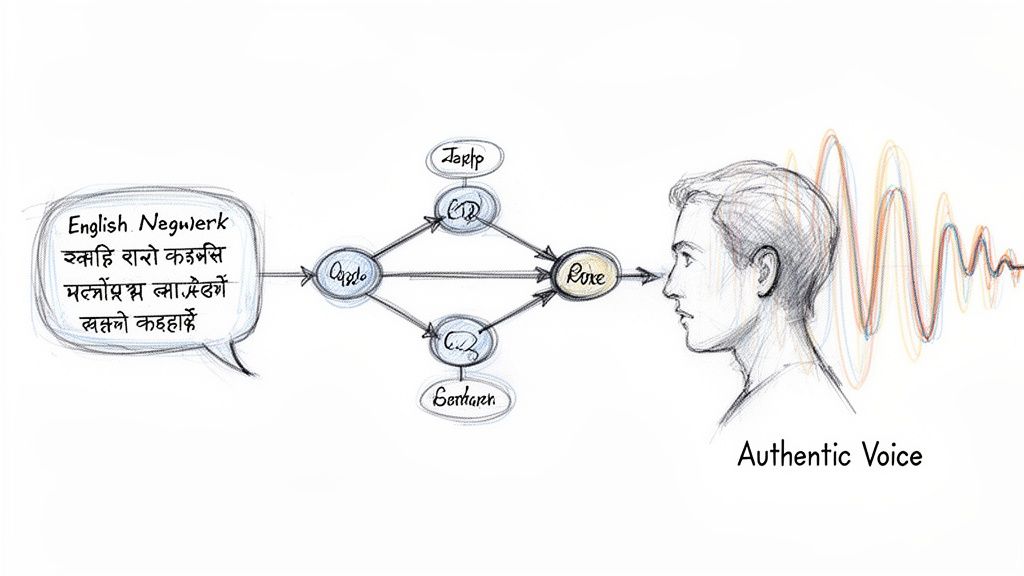
Remember those old, robotic GPS voices that sounded like they were reading words off a list? That’s a classic example of an older method called concatenative synthesis. It literally stitched together pre-recorded words, which is why it always sounded so choppy and unnatural. It was a good first step, but it lacked any real human flow.
Today’s India text to speech technology is in a completely different league. The engine behind these incredibly lifelike voices is a deep learning approach known as neural TTS. Instead of just gluing words together, these modern AI models generate speech from scratch, learning the subtle patterns of human language.
Think of it like an actor studying for a role that requires a specific Indian accent. They wouldn't just memorize the words. They'd listen for hours, absorbing the unique rhythm, the rise and fall of the tone, and the little details that make a voice sound truly authentic. A neural TTS model goes through a similar, data-driven training process.
To build a truly authentic Indian voice, a neural TTS model needs a massive amount of high-quality data. We’re talking thousands of hours of crystal-clear audio from native speakers, all meticulously transcribed. This is the foundation the AI learns from.
During this training, the AI dissects the core elements of human speech:
By analyzing this huge library of audio, the AI learns the unwritten rules of a language, whether it’s Hindi, Tamil, or Marathi. It understands how sounds blend together and how pitch changes in a natural conversation. This is what separates a voice that simply reads words from one that truly communicates.
A neural TTS model doesn't just read words. It understands the context and generates a brand-new audio waveform that captures the right meaning and emotion, making the voice feel genuinely human.
Once the model is fully trained, it's ready for action. When you give it a new sentence, the AI predicts the most natural-sounding audio for that specific text. It takes punctuation, sentence structure, and context into account to produce a smooth, flowing output.
This process gives it incredible versatility. The best models can even shift their speaking style, adopting different emotions or accents based on simple commands. This is crucial for creating applications that feel interactive and aware of the situation. For instance, creators can now make product demo videos with AI that use dynamic voiceovers generated directly from a script, sounding engaging and professional.
The jump from the old concatenative method to modern neural TTS is what makes today’s India text to speech so impressive. It’s the difference between a machine that can simply pronounce words and one that can actually speak. This is why our digital assistants, e-learning tools, and customer service bots can finally interact with us in a way that feels personal and, most importantly, human.
If you want to build an app that truly connects with people in India, simply translating your text won't cut it. You have to speak their language, literally. The country's linguistic diversity is staggering, and a generic, robotic voice just feels out of place. To create a genuine connection, your India text to speech needs to capture the authentic sounds of both major languages and their distinct regional accents.
India has 22 official languages and an incredible 19,500 mother tongues. It’s a complex landscape, but also a massive opportunity. While supporting every dialect is impossible, a smart strategy focusing on the most influential languages can open the door to millions of users. Deciding which languages to prioritize is one of the most important calls you'll make.
For most projects, it makes sense to roll out support for the most widely spoken languages first. This approach gets your product in front of the largest audience right away, and you can use the feedback to guide your next steps.
Here’s a look at the languages that offer the biggest impact right from the start.
| Language | Approximate Speakers (Millions) | Key States/Regions | Primary Use Case |
|---|---|---|---|
| Hindi | 500+ | North & Central India | Pan-India communication, media, education |
| Bengali | 97+ | West Bengal, Tripura, Assam | Regional news, storytelling, customer support |
| Marathi | 83+ | Maharashtra | BFSI, government services, local commerce |
| Telugu | 82+ | Andhra Pradesh, Telangana | EdTech, entertainment, tech support |
| Tamil | 75+ | Tamil Nadu, Puducherry | E-learning, global diaspora engagement, IVR |
This core group gives you a strong foothold across India's major economic and cultural centers. Once you've established a presence, you can strategically expand to include other prominent languages like Gujarati, Kannada, or Malayalam based on where your users are and where you want to grow.
The goal isn't just to make your app usable; it's to make it feel like it was built specifically for the person listening. This level of localization is what turns a functional tool into a beloved product.
Even within a single language, the way people speak can change dramatically from one city to the next. A Hindi speaker from Delhi sounds different from someone in Lucknow or Mumbai. These subtle nuances are what separate a good TTS voice from a truly great one. A modern India text to speech API shouldn't just offer one voice per language; it should provide a whole portfolio of them.
This is where hyper-localization comes in. Imagine an EdTech app offering lessons in a standard Hindi accent for nationwide reach, but also providing a voice with a Bihari accent for students in that region. The content instantly feels more familiar, relatable, and trustworthy. This isn't just a nice feature anymore—it's a serious competitive edge.
The demand for high-quality vernacular TTS in India is reshaping the entire industry. Hindi TTS alone is seeing explosive growth with a 13.70% CAGR, driven by an internet user base of over 700 million who prefer to engage online in their native language. This trend is a huge part of why the global TTS market is expected to reach USD 7.28 billion by 2030, with the Asia-Pacific region growing at a blistering 15.30%. You can discover more insights about the global text-to-speech market to see the full picture.
What this all boils down to is a fundamental shift in user expectations. People want digital services that speak to them in their own voice, with all its local flavor. Partnering with a TTS provider that understands and invests in regionally-specific voices is key to building products that feel personal, authentic, and genuinely Indian.
Picking the right Text-to-Speech (TTS) provider isn't just a technical task—it's a business decision that directly shapes your user experience and, ultimately, your bottom line. Go too cheap, and you risk an unprofessional, robotic voice that turns users away. But a high-quality service that’s too slow can be just as frustrating, especially in real-time interactions.
The trick is to find that perfect balance of performance, cost, and security that fits what you're building. To help you cut through the noise, I've laid out the five key areas I always evaluate when choosing a TTS partner for any project, especially for the diverse India text to speech market.
First things first: how does it actually sound? You’re looking for a voice that's practically indistinguishable from a human. Does it have that subtle, natural rhythm, or does it have that dead-giveaway robotic monotone?
When you’re testing different APIs, listen closely for these things:
Latency is simply the delay between when you send the text and when you get the audio back. For a lot of applications, this needs to be lightning-fast. Think about it: a customer service bot that pauses for a few seconds before every reply feels clumsy and broken.
For any real-time use case—like an IVR system, a voice assistant, or live sports commentary—you should be aiming for a latency well under 300 milliseconds. Anything more than that creates a noticeable, awkward lag that users will definitely feel.
A key feature to look for here is audio streaming. This lets the audio start playing almost instantly while the rest of the file is still being generated in the background. It’s a game-changer for longer passages of text, as it eliminates that initial frustrating wait time.
This flowchart can help you think through which languages to prioritize based on your audience.
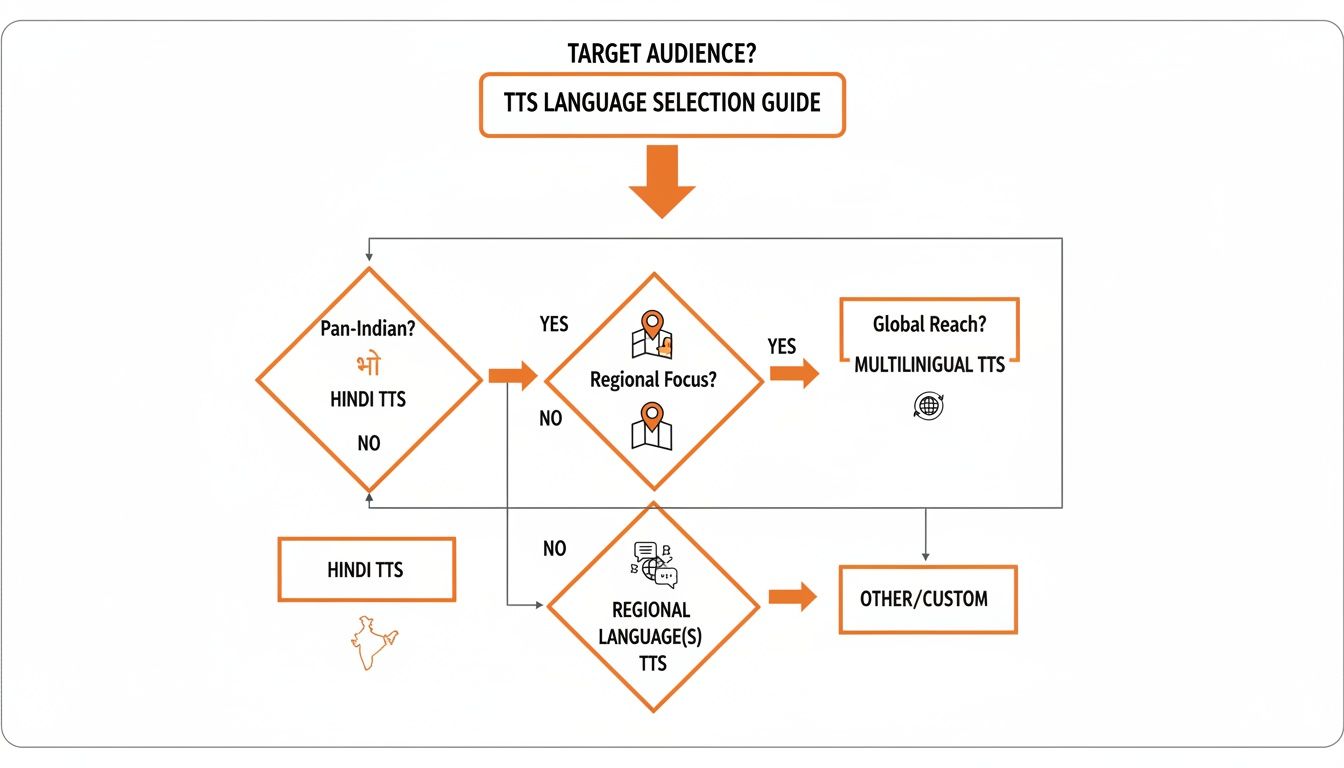
As you can see, a pan-India strategy almost always starts with Hindi, but as you zoom in on specific regions or look globally, your language needs will get a lot more specific.
TTS pricing can be all over the map. Some providers have simple pay-as-you-go models, while others have complicated subscription tiers with all sorts of hidden fees. Be on the lookout for extra charges for "premium" voices, specific languages, or even commercial usage rights.
You want a provider whose pricing is easy to understand and won't give you any nasty surprises. A straightforward model, usually based on the number of characters or seconds of audio you generate, makes it so much easier to budget. For example, a service like Lemonfox.ai offers a clear, competitive rate that lets you accurately forecast your costs, whether you're serving a thousand users or millions.
An amazing API is completely useless if your developers can't figure out how to use it. A great provider invests in a smooth developer experience. That means clean, thorough documentation with copy-paste-ready code snippets in languages your team actually uses, like Python or Node.js.
Good documentation should make it dead simple to:
Last but definitely not least, don't forget about data privacy. Every time you send text to a TTS provider, you're handing over data. Make sure you know what they’re doing with it. Does their privacy policy make sense?
Look for providers who are transparent about their data handling. For example, EU-based companies are held to the high standards of GDPR, which is a great sign. You need to be certain that your data isn't being stored forever or used to train their AI models without your permission.
To bring it all together, here's a quick look at how a modern, developer-focused API like Lemonfox.ai stacks up against some typical competitors on these key features.
| Feature | Lemonfox.ai | Typical Competitor A | Typical Competitor B |
|---|---|---|---|
| Latency | Ultra-low (<100ms) with streaming | Moderate (300-800ms) | Variable, can be high |
| Voice Quality | Lifelike neural voices | Good, but can sound robotic | Mix of standard and neural |
| Indian Languages | Extensive, with regional accents | Limited to major languages | Basic Hindi and English |
| Pricing Model | Transparent pay-as-you-go | Tiered subscriptions, hidden fees | Complex, per-request pricing |
| Developer Docs | Comprehensive, with code samples | Basic, often outdated | Minimal documentation |
| Data Privacy | GDPR-compliant, no data stored | Vague policy, potential data use | Stores data for model training |
Choosing the right API comes down to weighing these factors against your specific needs. A platform that excels in all five areas gives you the foundation to build a truly excellent voice experience for your users in India and beyond.
The true power of text-to-speech for India isn't buried in technical jargon or developer documentation. You can see it in action, solving real problems for real people every single day. From the busiest city centers to the most remote villages, TTS is quietly powering a new wave of applications that make technology more inclusive and businesses more effective.
It’s one thing to talk about technology, but it’s another to see how it’s actually being used. Let's dig into a few examples of how developers are using TTS to build solutions that speak directly to the needs of millions of Indians.
The EdTech sector is probably one of the most exciting areas where TTS is making a massive difference. For a long time, language was a major roadblock, locking many students out of high-quality digital learning simply because the content wasn't in their native tongue. TTS is flipping that script.
Think about an e-learning app that can instantly read lesson text aloud in clear, natural-sounding Hindi, Tamil, or Bengali. This single feature unlocks educational content for students who might struggle with reading or just learn better by listening. It’s more than a convenience—it's a massive step toward making education fair and accessible for everyone.
This is a big part of why India’s e-learning market is expected to jump from USD 2.5 billion in 2023 to a staggering USD 10 billion by 2025. This growth is directly linked to the voice assistant sector, which is projected to grow at a 35.7% CAGR and hit USD 957.61 million by 2030. TTS is the connective tissue here, making courses more engaging and helping students actually finish what they start.
For millions of visually impaired people in India, TTS isn't just a cool feature—it's a lifeline. It’s the technology that gives them the freedom to browse websites, read messages from friends, and use government service portals without needing someone else's help.
Here are just a few ways it works in the real world:
Text-to-speech technology transforms digital interfaces from visual barriers into audible gateways, fostering a new level of independence and inclusion.
These aren't niche applications; they're essential for building a truly "Digital India." For example, the ability to use AI for extracting transcripts from videos is a perfect complement to TTS, creating a full circle of accessible content.
In the business world, communication is everything. The old, robotic, and often frustrating automated phone menus are finally being replaced by intelligent Interactive Voice Response (IVR) systems. The secret sauce? High-quality text-to-speech for India.
Modern IVRs can now speak to callers in their own dialects, making the entire experience feel more personal and helpful. A bank can give you your account balance in fluent Marathi, or an e-commerce site can confirm your order in perfect Kannada. This kind of localized communication builds trust and gets rid of the usual friction points.
The result is that businesses can serve a much wider audience, keep customers happy, and bring down their operational costs at the same time. From the classroom to the call center, TTS is becoming the voice of modern Indian technology.
Alright, enough theory. The best way to understand how this all works is to get your hands dirty and actually build something. This section is your practical walkthrough for plugging an India text to speech API into your project. We’ll see just how fast you can go from an idea to a working audio file.
Modern TTS APIs are built for developers, which means they’re designed to be simple and quick to implement. You can forget about wrestling with complicated setups. Our goal here is to get you up and running in a matter of minutes.
Let's break it down into a simple, three-step process with clear code examples in both Python and Node.js.
First things first, you need a way to tell the service who you are. This is done with an API key, which is essentially a unique password for your application to access the TTS service. Getting one is usually a breeze.
This key is what authenticates your code and allows it to communicate with the API.
With your API key ready, it’s time to write a little code. This is where the magic happens. You’ll send a request to the API containing your text, the language, and the specific voice you want to use, and in return, you'll get the audio data.
Let's try to generate an audio file for the Hindi phrase "नमस्ते दुनिया" (Namaste Duniya). We’ll pick a common female Hindi voice, which often has an identifier like hi-IN-Standard-A.
Python Example:
import requests
API_KEY = "YOUR_API_KEY"
headers = {
"Authorization": f"Bearer {API_KEY}"
}
payload = {
"text": "नमस्ते दुनिया",
"voice_id": "hi-IN-Standard-A"
}
response = requests.post(
"https://api.lemonfox.ai/v1/audio/speech",
headers=headers,
json=payload
)
if response.status_code == 200:
with open("output_hindi.mp3", "wb") as f:
f.write(response.content)
print("Audio file saved successfully!")
else:
print(f"Error: {response.status_code}")
print(response.text)
Node.js Example:
const fetch = require('node-fetch');
const fs = require('fs');
const API_KEY = 'YOUR_API_KEY';
const textToSpeak = 'नमस्ते दुनिया';
const voiceId = 'hi-IN-Standard-A';
async function generateSpeech() {
const response = await fetch('https://api.lemonfox.ai/v1/audio/speech', {
method: 'POST',
headers: {
'Authorization': Bearer ${API_KEY},
'Content-Type': 'application/json',
},
body: JSON.stringify({
text: textToSpeak,
voice_id: voiceId,
}),
});
if (response.ok) {
const buffer = await response.buffer();
fs.writeFileSync('output_hindi.mp3', buffer);
console.log('Audio file saved successfully!');
} else {
console.error(Error: ${response.status});
const errorText = await response.text();
console.error(errorText);
}
}
generateSpeech();
See how similar they are? In both examples, the logic is the same: authenticate using the API key, send the text and voice ID in a POST request, and then prepare to handle the audio that comes back.
The final piece of the puzzle is deciding what to do with the audio file you get back from the API. The code snippets above show how a successful request returns raw audio data (like an MP3 or WAV file). Your application needs to know its next move.
Depending on what you're building, you could:
And that's really all there is to it. In just these three steps, you've integrated a powerful India text to speech service into your application. You're now ready to start communicating with your users in their own language.
Picking a text-to-speech provider isn't just a technical decision. It's about finding a partner who gets what it takes to succeed in the incredibly diverse Indian market. A good TTS API does more than just turn text into audio; it's the key that unlocks authentic, scalable, and secure apps that genuinely connect with your users.
This is where Lemonfox.ai really shines. It's been built from the ground up to solve the specific problems developers face when building for India, offering a powerful mix of features designed for real-world success.
Cracking the Indian market comes down to a few critical factors. You need technology that not only performs brilliantly but is also affordable enough to scale to millions of users. And just as important is a smooth developer experience—because that's what determines how fast you can turn your great ideas into reality.
Here’s what truly makes a difference:
Your TTS API isn't just another tool in your stack—it's a strategic investment. It directly impacts your user experience, your development speed, and your ability to grow in one of the world's most exciting digital economies.
Ultimately, the best tools get out of your way and let you build. They make it easier to serve a massive, diverse audience and create more inclusive products. By focusing on quality, affordability, and a great developer experience from the start, you're setting your project up to win.
Ready to build voice-enabled applications that truly resonate with the Indian market? Lemonfox.ai provides the high-quality, affordable, and easy-to-use Text-to-Speech API you need to get started. Test our API for free and discover the difference.