
First month for free!
Get started
Published 11/2/2025

Imagine having an expert co-pilot for every member of your customer support team. That's the essence of real-time agent assistance. It's an AI-powered tool that works in the background during live calls or chats, analyzing conversations in milliseconds to give agents the exact information and guidance they need, right when they need it.
Real-time agent assistance is designed to empower your human agents, not replace them. Instead of making agents scramble to find answers in a knowledge base or put frustrated customers on hold, this technology acts as a silent partner. It listens to the conversation and proactively pushes helpful resources directly to the agent's screen. Think of it as a seasoned expert whispering the right answers and next steps in their ear.
This completely changes the dynamic. It removes the guesswork and drastically reduces the cognitive load on your team. By instantly delivering troubleshooting guides, product details, or the perfect response, the system helps agents solve problems faster and more accurately. The goal is to shift support from a reactive search for information into a proactive, guided conversation.
At its heart, the technology uses sophisticated AI to understand the nuances of a live conversation. This infographic breaks down the three key elements the AI analyzes to provide truly effective support.
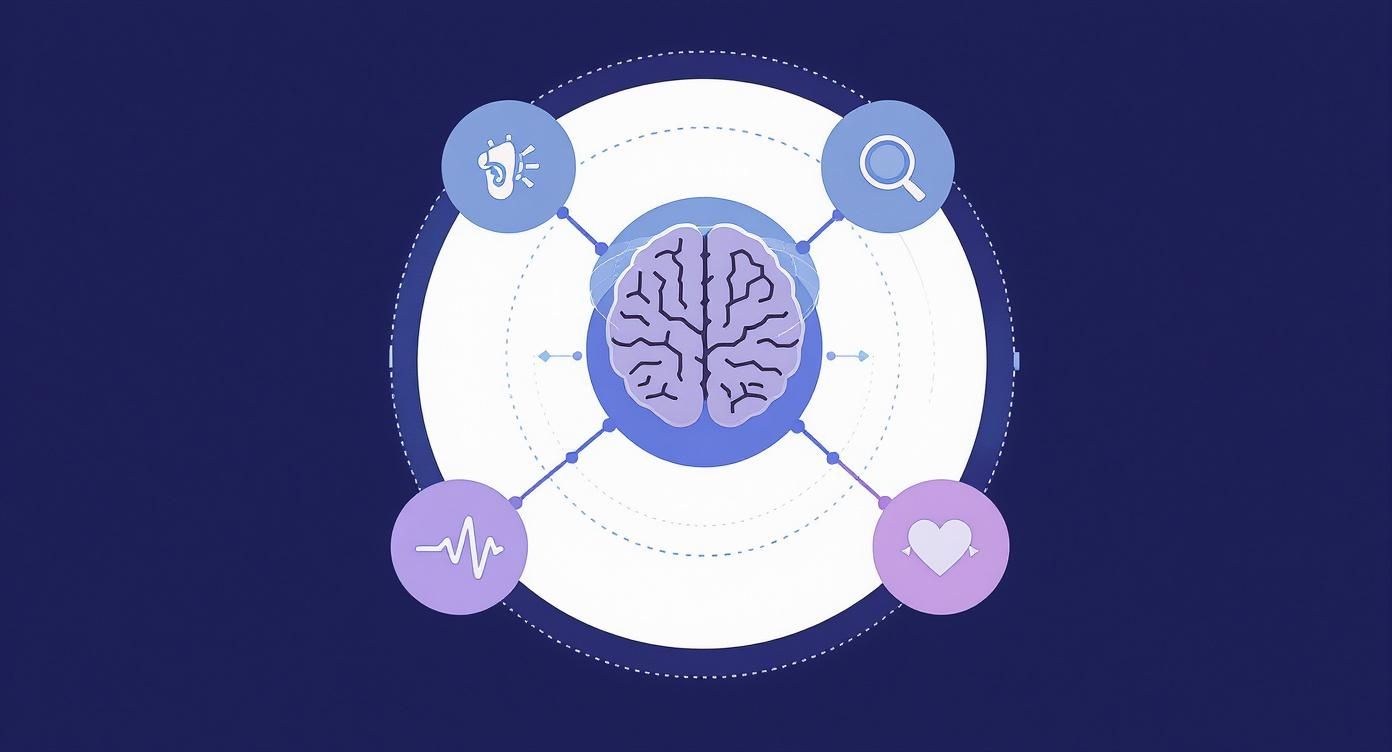
As you can see, the AI isn't just listening for keywords. It’s simultaneously deciphering the customer's needs, their specific intent, and their emotional state to provide assistance that’s genuinely helpful.
The incredible growth in this space speaks volumes. The global real-time AI agent assist market is projected to explode from USD 4.4 billion to an estimated USD 124.6 billion by 2034. This staggering 39.7% compound annual growth rate is a direct result of the rising demand for more personalized and efficient customer service. You can discover more insights about the market's trajectory and what’s driving this expansion.
This isn't just about being faster; it's about being smarter. By understanding the context and sentiment of a conversation, the AI ensures agents get support that's not just quick but also empathetic and perfectly timed.
To better understand how this works in practice, let's look at the core functions these platforms provide. The table below summarizes the key capabilities that are central to any real-time agent assistance tool.
| Capability | How It Helps the Agent | Impact on Customer |
|---|---|---|
| Knowledge Retrieval | Instantly finds the exact article, FAQ, or product spec needed, eliminating manual searches. | Gets accurate answers faster, reducing hold times and frustration. |
| Response Suggestion | Offers pre-approved, context-aware phrases to ensure brand voice consistency and clarity. | Experiences a more consistent and professional interaction every time. |
| Process Guidance | Provides step-by-step instructions for complex tasks, ensuring compliance and accuracy. | Issues are resolved correctly the first time, preventing repeat calls. |
These functions work together to create a seamless support experience.
Ultimately, real-time agent assistance gives every single agent—from a brand-new hire to a seasoned veteran—the ability to perform like a top-tier expert on every single interaction.

While the technology behind real-time agent assistance is impressive on its own, what really matters are the concrete results it brings to the table. Let's move past the features and functions. At the end of the day, any decision to adopt this tech comes down to the return on investment (ROI). This isn't just another cost center; it’s a strategic move that pays dividends across three core areas of your business.
The first, and most obvious, win is a big boost in operational efficiency. Imagine your contact center as an engine. Real-time assistance is the high-octane fuel that makes it run faster and smoother. By feeding agents instant answers, it cuts down on Average Handle Time (AHT) and dramatically reduces those long, frustrating holds for customers.
This added speed and accuracy naturally push up your First-Contact Resolution (FCR) rates. When your team has the right information exactly when they need it, they can solve problems on the first go, which means fewer expensive follow-up calls and a much cleaner workflow.
Beyond the hard numbers, AI assistance is a game-changer for your agents. It acts as an always-on co-pilot, taking a huge amount of cognitive load off their shoulders when they’re navigating tricky problems or difficult conversations. This frees up their mental bandwidth to focus on what truly matters: building rapport and connecting with the customer on a human level.
This kind of support has a ripple effect throughout the entire agent journey:
Investing in real-time agent assistance is an investment in your people. It equips them with the tools to succeed, turning a high-stress job into a more manageable and rewarding career.
Ultimately, better efficiency and happier agents lead directly to the most critical outcome of all: a genuinely better customer experience. It’s a simple formula: happy, well-supported agents create happy, loyal customers. When every interaction is quick, correct, and empathetic, your Customer Satisfaction (CSAT) scores can't help but climb.
The data backs this up in a big way. Support agents using AI tools can handle 13.8% more customer inquiries per hour, a massive lift in productivity. But even more impressive, companies report a 31.5% increase in customer satisfaction scores and a 24.8% rise in customer retention after bringing AI into their support stack. You can explore the full statistics on AI agent performance to see the documented impact for yourself.
This is about more than just closing a single ticket. It's about building real trust and fostering loyalty, transforming your contact center from a necessary expense into a powerful engine for business growth.
To really get a feel for real-time agent assistance, let's move past the theory and see what it looks like on the ground. This isn't some abstract concept; it’s a practical tool that plugs right into an agent's daily workflow, completely changing the game for both them and the customers they talk to.
Imagine you’re an agent for a busy online store. A customer calls, on the fence about a purchase. They mention they need something "durable for hiking." Instantly, a card pops up on your screen comparing two popular outdoor jackets, complete with durability ratings and snippets from customer reviews. A second later, another suggestion appears: "Customers who bought this jacket also loved our waterproof hiking socks." Just like that, you have everything you need to guide the customer and confidently make the sale.
This screenshot from Lemonfox.ai gives you a peek under the hood, showing how conversational data gets processed to power these kinds of real-time suggestions.
You can see how the spoken words are broken down into structured, useful information. This is how the AI instantly picks up on keywords, intent, and even the customer's sentiment.
The same idea works just as well in more complex, high-stakes fields. Think about an agent at a financial services firm. A client calls about a sensitive transaction, and as they're talking, the AI feeds the agent a real-time compliance checklist. It ensures every required disclosure is made and even flags if the conversation starts drifting into risky territory. What used to be a high-stress call becomes a secure, guided process.
Or take a classic tech support headache:
What could have been an escalation and a frustrated customer is turned into a moment of fast, expert service. The AI doesn’t just fetch articles; it delivers the perfect solution for the problem that's happening right now.
This ability to surface the right information at the right time is what makes real-time assistance so powerful. It dramatically lightens the agent's mental load, freeing them up to stop hunting for answers and start focusing on actually solving the problem and connecting with the customer.
Picking a platform for real-time agent assistance is a big deal. It’s not just about buying a new piece of software; you're essentially bringing on a digital partner for your entire support team. To get it right, you need to dig deeper than the flashy marketing claims and really understand the core features that will make a difference on the floor.
At its heart, any good system needs to nail knowledge base integration. I’m not just talking about linking to your help articles. A truly effective platform surfaces the exact piece of information an agent needs, right when they need it, mid-conversation. This kind of instant, smart retrieval stops agents from having to put customers on hold to search for answers, a change that can slash average handle time by up to 13%.
But simply pulling up facts isn't enough. Top-tier systems also provide sophisticated sentiment analysis. Imagine an AI that can read the room, gauging a customer’s emotional state in real time. This allows it to suggest more empathetic responses or flag a conversation for a supervisor before it escalates, giving agents the proactive guidance needed to turn a frustrating call into a positive experience.
When you start comparing platforms, your first focus should be on the tools that directly help your agents during live calls. These are the features that cut down on mental juggling and let your team focus on the customer.
Here’s what should be on your must-have list:
A truly great real-time agent assistance platform should feel like an extension of the agent's own skills. It anticipates needs, removes friction, and allows them to focus entirely on the customer, not on their tools.
A powerful solution doesn't just benefit agents; it provides immense value for managers and the business as a whole. The right platform will give you the tools to oversee performance, coach effectively, and turn call data into a roadmap for improvement.
Make sure the system includes real-time coaching dashboards. These give supervisors a bird's-eye view of active calls, showing things like customer sentiment and compliance checks as they happen. This allows them to offer silent tips to an agent or step in if a conversation is going sideways.
You'll also need comprehensive performance analytics. This is non-negotiable. Tracking metrics like First-Contact Resolution and CSAT scores over time gives you the hard data to prove the platform’s value and justify the investment in better support technology.
Bringing real-time agent assistance into your workflow is a game-changer, but let’s be honest—any major tech upgrade has its potential snags. The secret to a smooth rollout isn't hoping for the best; it's anticipating the challenges before they become problems. A clear, phased plan is your best friend here.
First up is the technical side of things. An assistance platform needs to play nicely with the tools your team already uses every day. If it doesn't plug directly into your CRM, helpdesk, and internal knowledge bases, you're just creating another window for agents to manage. That’s more friction, not less.
Data security is another non-negotiable. This system will be listening in on customer conversations, so it has to be locked down tight. You need a solution that meets serious compliance standards and is transparent about its security measures. Trust is everything, both with your customers and with regulators.
Once the tech is sorted, you have to focus on the people. This is often the trickiest part. Some agents will see an AI tool and immediately worry about being replaced or micromanaged. It’s a natural reaction, but the data shows this tech is here to stay. A PwC survey found that 79% of businesses are already using AI agents and seeing real results. The market itself, valued at USD 5.4 billion, is expected to hit USD 7.6 billion next year.
The key to getting your team on board is clear and consistent communication. This isn't about replacing them; it's about giving them a co-pilot.
Frame real-time agent assistance as a tool for empowerment, not enforcement. Show them how it’s designed to reduce mental strain, get rid of boring after-call work, and give them the backup they need to handle tough conversations with confidence.
Here are a few tactics that work every time:
Looking down the road, real-time agent assistance is shifting from a nice-to-have tool into a core component of any modern customer experience strategy. The technology is getting smarter, moving beyond just reacting to what's being said and starting to actually anticipate where the conversation is headed. The next wave of these tools will be all about predictive assistance—pinpointing customer needs before they're even fully voiced.
Picture this: an AI analyzes a customer's recent orders and browsing history the second a chat pops up. Before your agent can even type their greeting, the system flags a recently delayed order and hands them the latest tracking details. That’s the leap from reactive problem-solving to proactive relationship-building.
Another huge frontier is making multilingual support completely seamless. As businesses grow their global footprint, language remains one of the trickiest operational hurdles. The next generation of assistance platforms will deliver instant, high-fidelity translation not just for text, but for live voice calls too.
This opens the door for companies to create centralized support hubs staffed by their best experts, ready to help a worldwide customer base without needing to hire agents fluent in dozens of languages.
This is exactly why having a powerful, low-latency API is non-negotiable. For an AI tool to translate a conversation and feed an agent a relevant tip in a split second, it needs a lightning-fast and accurate engine running behind the scenes. Solutions like the Lemonfox.ai multi-language API were built for this very purpose, engineered to process and transcribe over 100 languages with the speed that real-time applications demand.
The goal is to make communication effortless. By removing language as a barrier, companies can focus on delivering consistently excellent service to every customer, regardless of where they are in the world.
This evolution isn't just about bolting on a few new features. It’s about fundamentally building a smarter, more personal, and globally-minded support operation. Getting on board with this technology today is how you lay the groundwork for the intelligent, responsive customer service of tomorrow—and how you’ll meet and beat customer expectations on a global scale.
Still have a few questions about real-time agent assistance? Let's clear up some of the most common ones we hear from businesses looking into this technology.
This is where a good system really shines. Basic tools might just pull up a static knowledge base article, which isn't much help for a truly tricky problem.
Advanced platforms, however, give agents dynamic, step-by-step guidance. The AI can suggest the right troubleshooting questions to ask, map out a solution path on the fly, and even flag the conversation for a supervisor if it senses the customer is getting frustrated. It’s a safety net for those one-off issues that aren't in the standard playbook.
Yes, and it’s a really important distinction to make. Think of it this way: real-time agent assistance is an open-book test. It's all about providing help right now, in the middle of a live conversation, to solve the immediate problem.
AI coaching, on the other hand, is about long-term development. It analyzes an agent's performance trends over many interactions to build a personalized training plan. One is for winning the current play, the other is for improving your skills for the whole season.
The impact is often immediate. When agents don't have to manually hunt for information, things speed up fast. We've seen teams reduce their average handle time by 13% and slash hold times by as much as 23% right out of the gate.
This instant boost in efficiency means agents can solve problems faster and move on to the next customer, all without compromising the quality of their service.
Over time, this adds up. You start seeing better First-Contact Resolution (FCR) rates and a real lift in your overall customer satisfaction scores. The whole point is to give every agent the tools to be a top performer.
Ready to power your own real-time solutions with unmatched speed and accuracy? Explore the Lemonfox.ai Speech-to-Text API and see how our low-latency, multi-language engine can transform your customer support. Start your free trial at Lemonfox.ai.