
First month for free!
Get started
Published 11/5/2025
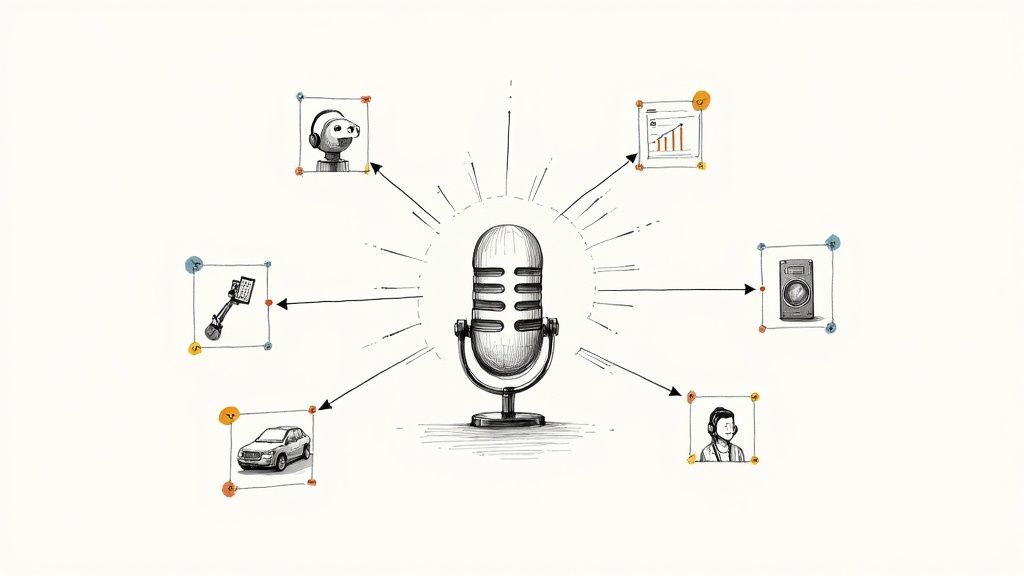
Speech recognition technology has moved far beyond simple commands and now powers critical functions across numerous industries. This technology, which converts spoken language into machine-readable text, is the engine behind applications that enhance efficiency, improve accessibility, and create entirely new user experiences. For businesses and developers, understanding its practical applications is the first step toward innovating with voice. Integrating a powerful Speech-to-Text API, like Lemonfox.ai, can unlock significant competitive advantages by automating processes and extracting valuable insights from audio data.
This article dives deep into ten specific speech recognition examples, moving beyond surface-level descriptions to provide a strategic breakdown of each use case. We will analyze how companies are implementing this technology, detailing the specific tactics that make their solutions effective. More importantly, you'll find actionable takeaways and replicable strategies you can apply to your own projects. Whether you're aiming to automate customer service, streamline clinical documentation, or build the next generation of assistive tech, this guide provides the practical insights needed to turn voice into a powerful operational asset. We will explore everything from call center automation and medical dictation to real-time translation and educational tools, showcasing the true versatility of modern speech recognition.
Perhaps the most ubiquitous of all speech recognition examples, voice assistants like Amazon Alexa and Google Assistant have transformed how users interact with technology in their homes. These systems leverage sophisticated, always-on speech recognition to interpret natural language commands, enabling hands-free control over everything from lighting and thermostats to music playback and scheduling.
This application’s success lies in its ability to remove friction from daily tasks. Instead of navigating multiple apps, a user can issue a single voice command to initiate a complex sequence of actions, like a "good morning" routine that turns on lights, starts the coffee maker, and reads the day's calendar.
Strategic Insight: The true innovation isn't just recognizing words but understanding intent within a home environment. This requires robust models that can handle background noise, multiple speakers, and ambiguous commands, turning a simple speech-to-text output into a meaningful action.
For developers and businesses, the smart home space offers clear lessons. Integrating a voice API like Lemonfox.ai can add a layer of accessibility and convenience to any application. Consider how hands-free control could streamline user workflows, whether it's for logging data in a business app or controlling features in a consumer product. The key is to identify high-friction user interactions that can be simplified with a simple voice command.
In healthcare, speech recognition has become a critical tool for efficiency and accuracy. Clinicians use specialized systems like Nuance Dragon Medical One to dictate patient notes, prescriptions, and diagnoses directly into electronic health records (EHRs). This application is one of the most impactful speech recognition examples, as it directly addresses physician burnout by automating time-consuming administrative tasks.
By converting spoken words into structured text in real-time, these tools free up medical professionals to focus on patient care rather than cumbersome typing. This reduces documentation time, minimizes clerical errors, and accelerates the entire clinical workflow from consultation to billing.

Strategic Insight: The key innovation is not just transcription but contextual understanding within a clinical setting. Advanced systems can identify structured data within a narrative (like vitals or medication dosages) and populate the correct fields in an EHR, turning unstructured speech into actionable, organized data.
For businesses developing solutions in regulated or specialized industries, the healthcare model offers valuable lessons. Integrating a precise voice API like Lemonfox.ai can streamline complex data entry tasks where accuracy is paramount. Consider building custom language models trained on industry-specific jargon to boost transcription accuracy and deliver a superior user experience. The goal is to transform tedious manual documentation into a fast, voice-driven process.
One of the most impactful commercial speech recognition examples is the transformation of customer service through call center automation. Modern Interactive Voice Response (IVR) systems and AI-powered voice bots use speech recognition to understand a customer's intent in real-time, route inquiries, and even resolve issues without human intervention. This significantly reduces operational costs and customer wait times.
This application’s value lies in its efficiency and scalability. Instead of navigating confusing button-based phone menus, customers can state their problem in natural language, like "I need to check my account balance." The system can then instantly access the relevant information or direct the call to the correct specialist, improving first-call resolution rates and overall customer satisfaction.
Strategic Insight: The key innovation is moving beyond simple keyword spotting to understanding complex user intent. A successful system must distinguish between "cancel my flight" and "check my flight status," a nuance that requires sophisticated natural language understanding to avoid costly errors and customer frustration.
For businesses managing high call volumes, implementing voice automation offers a clear return on investment. By integrating a voice API like Lemonfox.ai into an existing telephony system, you can build a voice bot to handle routine, high-frequency inquiries. Start by identifying the top 3-5 reasons customers call, and create automated workflows for those specific use cases to deliver immediate efficiency gains and free up human agents for more complex problems.
One of the most powerful speech recognition examples is its role in democratizing technology for users with disabilities. For individuals with motor impairments or visual challenges, voice commands replace the need for traditional input methods like keyboards and mice, offering a direct line of interaction with digital devices and software.
This application is transformative, breaking down barriers to communication, education, and employment. Tools like Apple's Voice Control and Google's Live Transcribe use advanced speech-to-text and command recognition to enable users to navigate interfaces, dictate documents, and participate in conversations more freely.
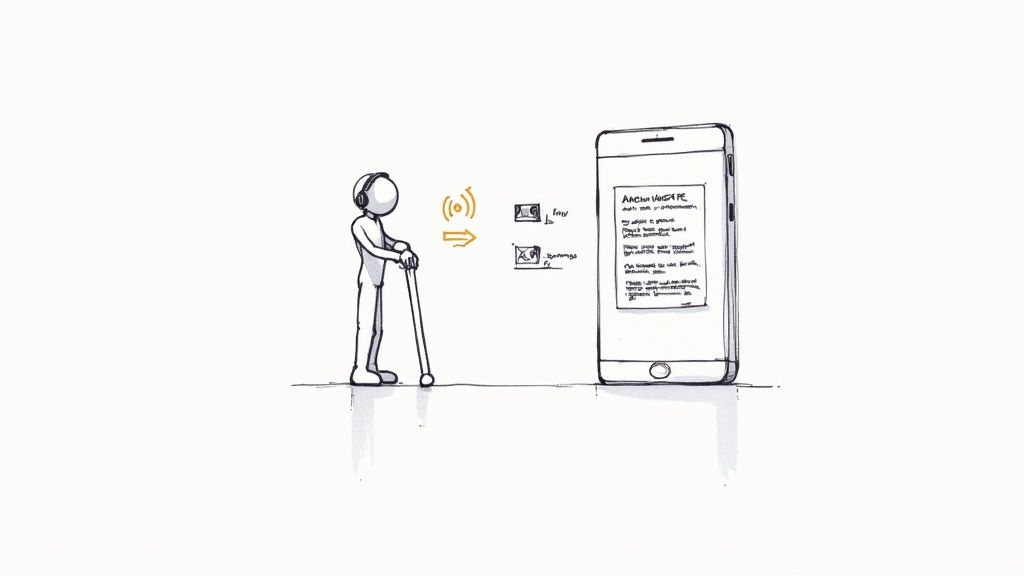
Strategic Insight: The key to successful assistive technology is not just transcription accuracy but a deep understanding of user intent within a specific context of need. The system must reliably differentiate between dictation and commands, empowering users with seamless control rather than creating new frustrations.
For businesses and developers, integrating accessibility features is no longer a niche consideration; it's a core component of inclusive design. By incorporating a voice API like Lemonfox.ai, you can build voice-activated navigation, dictation, and control features directly into your application. This not only expands your potential user base but also aligns with modern accessibility standards, creating a more equitable and user-friendly experience for everyone. Consider how voice commands could make your product usable for someone who cannot use their hands.
Automated transcription has become an indispensable tool in corporate and media environments, converting hours of spoken content from meetings, lectures, and interviews into searchable, editable text. Services like Otter.ai and built-in features in Zoom and Microsoft Teams use speech recognition examples to provide near-instant documentation, fundamentally changing how information is captured and revisited.
This application’s power lies in unlocking the value trapped in audio and video files. Instead of manually transcribing recordings, teams can automatically generate records, identify key action items, and make spoken content as searchable as an email archive. This increases productivity and ensures critical details are never lost.
Strategic Insight: The key innovation is not just the transcription itself but its integration into collaborative workflows. By making spoken conversations searchable and shareable, these tools transform transient discussions into permanent, accessible knowledge assets for an entire organization.
For businesses, integrating an automated transcription API like Lemonfox.ai can streamline documentation for compliance, training, or meeting minutes. To ensure high accuracy, prioritize clear audio by using quality microphones and minimizing background noise. For developers, building features on top of transcripts, such as automated summaries or keyword alerts, can create significant value for users by turning raw text into actionable intelligence.
In-vehicle systems represent one of the most safety-critical speech recognition examples, allowing drivers to manage navigation, climate, and entertainment hands-free. Systems like Ford SYNC and Tesla's voice controls integrate deeply into the vehicle's functions, translating natural language into direct commands to reduce driver distraction and enhance the user experience.
This application is pivotal for safety, as it allows drivers to keep their hands on the wheel and eyes on the road. Instead of fumbling with touchscreens or physical buttons, a simple command like "navigate to the nearest gas station" or "set temperature to 70 degrees" executes the desired action seamlessly, creating a safer and more convenient driving environment.
Strategic Insight: The challenge in automotive voice control isn't just speech-to-text; it's intent recognition in a high-noise, high-stakes environment. Success requires edge processing for low latency and robust algorithms that can filter out background conversations and road sounds to accurately interpret the driver's command.
For developers, the automotive sector highlights the need for specialized, environment-aware voice solutions. When building voice features for any application used on the go, consider the unique audio challenges. Integrating a robust API like Lemonfox.ai can provide the noise cancellation and accent recognition models necessary for high-accuracy performance. The key is to design for the specific context of use, ensuring reliability when it matters most.
One of the most powerful speech recognition examples is its integration with machine translation to break down language barriers. Tools like Google Translate’s conversation mode and Skype Translator use speech recognition to capture spoken words, which are then fed into a translation engine and synthesized back into another language in near real-time, facilitating fluid cross-cultural communication.
This application has profound implications for global business, travel, and international relations. Instead of relying on human interpreters for every interaction, individuals can engage in spontaneous conversations, turning their smartphones into universal translators and making the world more accessible.
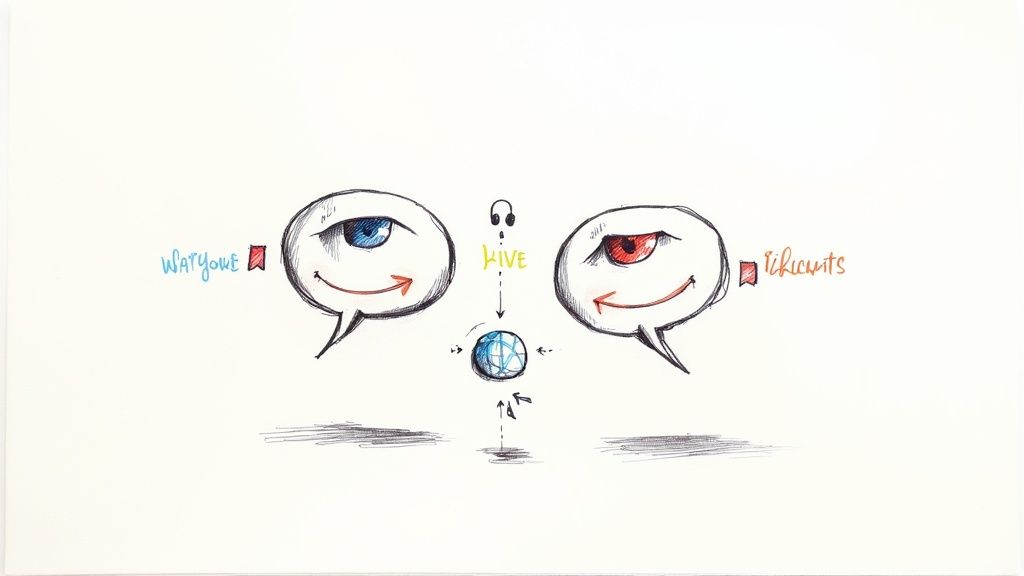
Strategic Insight: The primary challenge is not just translating words, but preserving nuance and intent across languages. Success depends on sophisticated NLU models that can understand cultural context and idiomatic expressions, preventing the literal but nonsensical translations common in older systems.
For businesses operating globally, integrating a voice API with translation capabilities can dramatically improve customer support and international sales. Using a service like Lemonfox.ai to build a voice-enabled translation feature into a customer service chatbot or meeting software can reduce friction and foster better client relationships. The key is to identify communication bottlenecks caused by language barriers and deploy this technology to create a more inclusive and efficient user experience.
In the high-stakes legal field, accuracy and speed are paramount. Speech recognition technology provides a critical advantage by automating the transcription of depositions, court proceedings, and testimonies. Systems like CART (Communication Access Realtime Translation) and services from companies like Veritext Legal Solutions use advanced algorithms to create precise, searchable written records from spoken word, a key example of a specialized application for this technology.
This application fundamentally transforms legal workflows. It accelerates the creation of official transcripts, reduces the manual burden on court reporters, and provides legal teams with immediate, searchable access to testimony. This efficiency allows for faster case preparation and review, directly impacting legal outcomes.
Strategic Insight: The challenge in legal transcription isn't just word-for-word accuracy; it's capturing the complete record with correct speaker attribution and formatting. Success requires robust diarization (who spoke when) and the ability to parse dense, industry-specific language without error.
For businesses in regulated industries, the legal sector offers a powerful model. Integrating a secure, accurate speech recognition API like Lemonfox.ai can streamline compliance and documentation processes. Focus on training custom models with your industry’s specific terminology to achieve the level of precision required for official records. This ensures that every transcription is not just fast but also defensible and reliable.
Typing queries into a search bar is quickly being replaced by one of the most natural speech recognition examples: voice-based search. Integrated into everything from smartphones (Google Voice Search, Siri) to smart speakers, this technology allows users to ask questions in natural language and receive immediate, relevant answers. It transforms information retrieval into a conversational, hands-free experience.
This shift is crucial in mobile and IoT contexts where traditional input is cumbersome. Instead of fumbling with a small keyboard, a user can simply speak a query to find directions, check facts, or even shop online with platforms like Alexa. The system parses the speech, understands the user's intent, and retrieves the information from vast online databases.
Strategic Insight: The competitive edge in voice search lies in context and speed. It’s not just about converting speech to text; it's about understanding the user's situation (e.g., location, previous searches) to deliver the most relevant information instantly, often without requiring the user to look at a screen.
For businesses and developers, integrating voice search is a powerful way to reduce user friction. An API like Lemonfox.ai can enable users to search product catalogs, knowledge bases, or internal data using their voice. The key is to design the system to handle natural language, allowing users to ask "Where are the red shoes in a size nine?" instead of typing "red shoes size 9," making information access faster and more intuitive.
Speech recognition is revolutionizing education by creating more interactive and personalized learning experiences, particularly in language acquisition. Platforms like Duolingo, Babbel, and ELSA Speak use this technology to analyze a student's pronunciation and provide immediate, actionable feedback. This transforms a traditionally passive learning process into an active, conversational practice session.
By integrating speech-to-text, these applications can score spoken words and phrases for accuracy, helping learners correct their accents and intonation without needing a live tutor. This creates a scalable and low-pressure environment for students to practice speaking, building confidence and accelerating fluency in a way that static textbooks cannot.
Strategic Insight: The key is not just transcribing the words but analyzing the nuances of pronunciation, such as phoneme accuracy, stress, and rhythm. This granular feedback loop allows for a highly personalized learning path that addresses an individual's specific weaknesses.
Developers in the EdTech space can leverage a voice API like Lemonfox.ai to build powerful interactive learning tools. The opportunity extends beyond language learning to areas like public speaking coaching or reading assistance for children. Consider how real-time vocal feedback could enhance your educational product, providing users with a "virtual tutor" to guide their progress and keep them engaged.
| Application | 🔄 Implementation complexity | ⚡ Resource requirements | ⭐ Expected outcomes | 📊 Ideal use cases | 💡 Key advantages / tips |
|---|---|---|---|---|---|
| Voice Assistants and Smart Home Control | Medium 🔄 (continuous ASR + NLU + device APIs) | Moderate ⚡ (smart speakers, cloud services, ecosystem integrations) | ⭐⭐⭐⭐ (high convenience; accuracy varies with accents/noise) | Home automation, daily routines, accessibility | 💡 Hands-free control; place devices away from noise and review privacy settings |
| Medical Dictation and Clinical Documentation | High 🔄 (medical vocab, HIPAA compliance, EHR integration) | High ⚡ (specialized models, secure infrastructure, training data) | ⭐⭐⭐⭐⭐ (large time savings; improved documentation quality) | Hospitals, clinics, clinician note-taking | 💡 Train models on user voice and run regular accuracy audits; maintain updates |
| Customer Service and Call Center Automation | High 🔄 (IVR, sentiment, CRM integration, multilingual support) | Moderate–High ⚡ (cloud ASR, monitoring, human fallback) | ⭐⭐⭐⭐ (24/7 coverage and cost reduction; some frustration from users) | High-volume support, automated routing, analytics | 💡 Provide easy human escalation and test with diverse speaker samples |
| Accessibility and Assistive Technology | Medium 🔄 (voice-to-text, adaptive learning, custom commands) | Low–Moderate ⚡ (client devices, accessible UI configurations) | ⭐⭐⭐⭐ (enables independence; limited for some speech disorders) | Assistive interactions for visually/motor-impaired users | 💡 Customize command libraries and combine with other accessibility features |
| Transcription Services and Meeting Documentation | Low–Medium 🔄 (real-time ASR + speaker ID + timestamps) | Moderate ⚡ (good microphones, cloud/edge models, post-editing tools) | ⭐⭐⭐ (fast, cost-effective; needs post-editing for publication quality) | Meetings, lectures, podcasts, searchable archives | 💡 Use high-quality audio, ensure speaker introductions, and edit transcripts |
| Automotive Voice Control Systems | High 🔄 (noise cancellation, vehicle integration, driver ID) | Moderate–High ⚡ (in-vehicle hardware, tuned models) | ⭐⭐⭐⭐ (improves safety and convenience; road noise affects accuracy) | Driving: navigation, media, hands-free calls | 💡 Keep microphones clear, learn common commands, use on highways |
| Multilingual and Real-time Translation | Very High 🔄 (ASR + MT + context handling; low-latency) | High ⚡ (multilingual models, fast networking, compute) | ⭐⭐⭐ (enables communication but loses cultural nuance; latency possible) | Travel, international meetings, ad-hoc interpretation | 💡 Speak clearly, provide context for complex topics, verify critical translations |
| Legal and Courtroom Documentation | Very High 🔄 (legal vocab, accuracy, regulatory compliance) | High ⚡ (specialized hardware, secure systems, human verification) | ⭐⭐⭐ (useful for drafts/searchable records; often not legally official) | Draft transcripts, search/indexing of proceedings, accessibility | 💡 Use professional microphones, spell out names/terms, verify before filing |
| Voice-Based Search and Information Retrieval | Medium 🔄 (query understanding, context-aware results) | Moderate ⚡ (search backend, voice front-end, privacy controls) | ⭐⭐⭐⭐ (fast, natural queries; ambiguity and privacy trade-offs) | Mobile/IoT hands-free searches, quick info retrieval | 💡 Use natural phrasing, be specific, review privacy settings for voice data |
| Educational Technology and Language Learning | Medium 🔄 (pronunciation scoring, feedback, tracking) | Moderate ⚡ (speech models, content, progress analytics) | ⭐⭐⭐⭐ (excellent practice and feedback; limited conversational nuance) | Pronunciation practice, self-paced language learning | 💡 Practice regularly, combine with human feedback, record progress for review |
From the smart speakers in our living rooms to the sophisticated systems transcribing critical medical notes, the speech recognition examples we've explored reveal a technology that is no longer a futuristic concept but a present-day reality. The common thread connecting all these diverse applications is the strategic conversion of spoken language into structured, actionable data. This transformation is the cornerstone of modern efficiency, accessibility, and innovation.
We've seen how healthcare institutions use it to reduce physician burnout and improve patient records. In customer service, it powers IVR systems that resolve queries faster and analyzes call sentiment to enhance agent training. For legal professionals, it ensures pinpoint accuracy in courtroom transcripts, while in education, it breaks down language barriers and creates more inclusive learning environments.
The most successful implementations of speech recognition share several core principles. They don't just replace manual processes; they reimagine entire workflows.
Mastering the application of this technology is no longer optional for forward-thinking developers and businesses. The ability to harness voice data provides a significant competitive advantage, opening doors to enhanced productivity, deeper customer insights, and the creation of truly innovative products and services. The speech recognition examples detailed in this article are not just case studies; they are blueprints for what's possible.
Your immediate task is to identify the friction points within your own operations or product ideas that involve spoken language. Where are manual transcription, data entry, or communication barriers slowing you down?
Actionable Insight: Begin by mapping a single, high-impact workflow where audio data is a central component. This could be transcribing customer feedback calls, documenting internal meetings, or adding voice command capabilities to your application. Start small, prove the ROI with a powerful API, and then scale your implementation across the organization.
The journey from spoken word to tangible value is more accessible than ever before. By choosing the right tools and focusing on a clear strategic outcome, you can unlock the immense potential hidden within voice data, driving your projects and business forward into a more efficient and connected future.
Ready to build your own powerful speech recognition applications? Lemonfox.ai provides a high-quality, affordable, and developer-friendly Speech-to-Text API designed for accuracy and scale. Start transforming your audio data into actionable insights today by exploring our documentation at Lemonfox.ai.